INSTRUCTION MANUAL ECOSOFT
®
MEDIA SYSTEMS
6
2. INSTALLATION
Installation area must meet all applicable building code. Water and power supply,
and ambient conditions must meet Specication requirements of this manual.
Observe all local plumbing and electrical code when connecting system to utilities
• Install check valve when connecting the device to water mains as per IEC 61770. Install second
check valve after the system to prevent back ow.
• Particulate impurities (such as sand, scale or rust) may damage the control valve. To prevent
malfunction, install a point-of-entry sediment lter as shown on drawing in the end of this chapter.
• Fit the system with relevant sampling taps and pressure gauges shown on drawing. This will help
maintain and troubleshoot the system.
• Install vacuum relief valve as shown if using booster pump downstream of Ecosoft system. The FRP
tanks may implode when subjected to negative pressure.
• If your system does not include bypass, implement bypass pipeline to aid maintenance and
diagnostics.
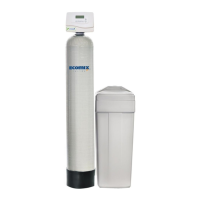
2.1. FK, FU, FPA, FPC, FP Simplex
1. Install FRP tank on rm level surface capable of supporting its weight. Put riser pipe in the tank
bottom distributor rst. Ensure that top end of riser pipe is level with the top opening of FRP tank
(within +5 mm).
2. Plug or cap top end of the riser pipe to avoid letting media particles inside. Use funnel to pour the
media in the tank. When loading the tank, maintain vertical orientation of riser pipe. If the pipe tilts,
restore it to straight vertical direction. When nished, rinse thread of tank opening with water and
remove any media particles stuck in thread groove.
If assembling FPA, FPC, or FP system, ll the tank to 30% its height with water before proceeding.
3. Lock top distributor in circular slot at the bottom of control valve shank. Mate the distributor with top
end of riser pipe, then screw control valve on tank.
4. Install ¾″ pipe in control valve drain tting and run it to oor drain or pipe socket. Fix the drain pipe
end above oor drain to provide at least 1″ wide air gap.
5. If assembling FU or FK system, place the brine tank next to FRP tank. Install ⅜″ exible tube in brine
elbow and run it to brine tank. Remove tank lid and brine well cap, pull the tube inside the well and
connect it to brine valve, then re‑assemble in reverse order. Fill the brine tank with salt at least half
full.
6. Install connection tting kit: mate the tting to control valve ports and screw the coupling nuts on port
threads. Do not put any mechanical load on ttings or use them to support pipes.
Connect the system to water supply and downstream pipework without opening water supply shut-
o valves. Observe correct ow direction when connecting pipes. Inuent and treated water ports
are indicated with arrows on control valve.
Start manual regeneration of the system. Scroll regeneration to backwash if it is not performed on
1st cycle of regeneration sequence. As soon as the control valve starts backwashing, slightly open
entry shut-o valve to let water in the system. Air will escape via drain line with an audible hiss.
When water emerges from the drain line, open the entry valve completely. Carefully inspect the
system for leaks.
Let the system nish regeneration, then perform one more manual regeneration


 To Next Page
 Loading...