EasyManua.ls Logo

ECS B85H3-M7 - User Manual

ECS B85H3-M7
74 pages
Print Icon
To Next Page IconTo Next Page
Loading...
B85H3-M7 USER MANUAL
Preface
Copyright
This publication, including all photographs, illustrations and software, is protected
under international copyright laws, with all rights reserved. Neither this manual, nor
any of the material contained herein, may be reproduced without written consent of
the author.
Version 1.0
Disclaimer
The information in this document is subject to change without notice. The manufac-
turer makes no representations or warranties with respect to the contents hereof
and specifically disclaims any implied warranties of merchantability or fitness for
any particular purpose. The manufacturer reserves the right to revise this publica-
tion and to make changes from time to time in the content hereof without obligation
of the manufacturer to notify any person of such revision or changes.
Trademark Recognition
Microsoft, MS-DOS and Windows are registered trademarks of Microsoft Corp.
MMX, Pentium, Pentium-II, Pentium-III, Celeron are registered trademarks of Intel
Corporation.
Other product names used in this manual are the properties of their respective owners
and are acknowledged.
Federal Communications Commission (FCC)
This equipment has been tested and found to comply with the limits for a Class B
digital device, pursuant to Part 15 of the FCC Rules. These limits are designed to
provide reasonable protection against harmful interference in a residential instal-
lation. This equipment generates, uses, and can radiate radio frequency energy and,
if not installed and used in accordance with the instructions, may cause harmful
interference to radio communications. However, there is no guarantee that interfer-
ence will not occur in a particular installation. If this equipment does cause harmful
interference to radio or television reception, which can be determined by turning
the equipment off and on, the user is encouraged to try to correct the interference by
one or more of the following measures:
Reorient or relocate the receiving antenna
Increase the separation between the equipment and the receiver
Connect the equipment onto an outlet on a circuit different from that to
which the receiver is connected
Consult the dealer or an experienced radio/TV technician for help
Shielded interconnect cables and a shielded AC power cable must be employed with
this equipment to ensure compliance with the pertinent RF emission limits govern-
ing this device. Changes or modifications not expressly approved by the system’s
manufacturer could void the user’s authority to operate the equipment.

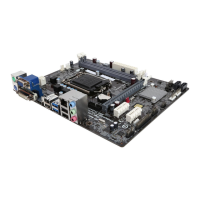
Table of Contents

Questions and Answers

ECS B85H3-M7 Specifications

General IconGeneral
Non-ECCYes
Memory channelsDual-channel
Memory slots typeDIMM
Supported memory typesDDR3-SDRAM
Maximum internal memory16 GB
Supported memory clock speeds1066, 1333, 1666 MHz
System bus rate5 GT/s
Processor socketLGA 1150 (Socket H3)
Processor manufacturerIntel
Compatible processor seriesIntel Celeron, Intel Pentium
Maximum number of SMP processors1
USB 2.0 connectors2
Number of Parallel ATA connectors-
USB 3.2 Gen 1 (3.1 Gen 1) connectors4
Supported storage drive interfacesSATA II, SATA III
eSATA ports quantity0
USB 2.0 ports quantityUSB 2.0 ports have a data transmission speed of 480 Mbps, and are backwards compatible with USB 1.1 ports. You can connect all kinds of peripheral devices to them.
LAN controllerRealtek RTL8111G
Ethernet interface typeGigabit Ethernet
Audio chipRealtek ALC662
CertificationCE/FCC \\r ErP/EuP \\r WHQL \\r WHCK
Component forPC
Power source typeATX
Motherboard chipsetIntel® B85
Audio output channels5.1 channels
Motherboard form factormini ATX
Windows operating systems supportedWindows 7 Home Basic, Windows 7 Home Basic x64, Windows 7 Home Premium, Windows 7 Home Premium x64, Windows 7 Professional, Windows 7 Professional x64, Windows 7 Starter, Windows 7 Starter x64, Windows 7 Ultimate, Windows 7 Ultimate x64, Windows 8, Windows 8 Enterprise, Windows 8 Enterprise x64, Windows 8 Pro, Windows 8 Pro x64, Windows 8 x64
BIOS typeAMI
ACPI version5.0
BIOS memory size64 Mbit
Weight and Dimensions IconWeight and Dimensions
Depth180 mm
Width225 mm

Summary

Chapter 2 Installing the Motherboard

Safety Precautions

Lists essential safety precautions to follow before installing the motherboard.

Installing the motherboard in a Chassis

Provides instructions on mounting the motherboard into a computer chassis.

Chapter 2 Installing Hardware

Installing the Processor

Details the procedure for installing the CPU into the LGA1150 socket.

Chapter 2 Installing the CPU Cooler

Apply Thermal Grease

Instructs on applying thermal grease to the heatsink for optimal heat transfer.

Fasten Cooling Fan Base

Describes securing the cooler's base and connecting the CPU fan.

Connect CPU Cooler Power

Details connecting the CPU cooler's power connector to the motherboard.

Chapter 2 Installing Memory Modules

Open DIMM Slot Latches

Explains how to open the DIMM slot latches for memory installation.

Insert DIMM Module

Guides on inserting the memory module correctly into the DIMM slot.

Secure Memory Latches

Describes the latches securing the installed memory module.

Chapter 2 Installing Add-on Cards

PCIEX16 Slot

Describes the PCI Express x16 slot for graphics cards.

PCIE1~2 Slots

Describes the PCI Express x1 slots for expansion cards.

Chapter 2 Connecting Optional Devices

Serial ATA Connectors

Details the SATA connectors for storage devices.

Front Panel USB 2.0 Headers

Describes the front panel USB 2.0 connection headers.

Front Panel Audio Header

Explains the front panel audio connection header.

Front Panel USB 3.0 Header

Details the front panel USB 3.0 connection header.

Chapter 2 Installing a SATA Hard Drive

Installing Serial ATA Hard Drives

Provides steps to connect SATA hard drives using SATA cables.

Chapter 2 Connecting Case Components

CPU and System Fan Connectors

Explains connecting CPU and system cooling fan headers.

Power Connectors

Connecting 24-pin Power Cable

Guides on connecting the 24-pin ATX power cable.

Connecting 4-pin Power Cable

Guides on connecting the 4-pin ATX12V power cable.

Front Panel Header Connections

Reset Switch Function

Details the function and connection of the reset switch.

Chapter 3 Using BIOS

Chapter 3 PC Health Status

CPU Smart Fan Control

Allows enabling/disabling CPU smart fan control.

Smart Fan Mode Selection

Selects fan operation mode (Normal, Quiet, Silent, Manual).

Chapter 3 Power Management Setup

Chapter 3 CPU Configuration

Hyper-Threading Control

Enables or disables CPU hyper-threading.

Chapter 3 SATA Configuration

SATA Mode Selection

Selects the SATA mode (e.g., AHCI).

Chapter 3 USB Configuration

All USB Devices Enable;Disable

Enables or disables all USB devices on the system.

Chapter 3 Super IO Configuration

Serial Port Configuration

Configures the onboard serial port (COM).

Chapter 3 Parallel Port Configuration

Parallel Port Enable;Disable

Enables or disables the onboard parallel port (LPT).

Chapter 3 PCH Configuration

Restore AC Power Loss Setting

Sets the system's AC power state after a power failure.

Chapter 3 ME Configuration

ME Firmware Control

Enables or disables Intel ME Firmware.

Chapter 3 M.I.B. III Menu

CPU OverClocking Configuration

Allows configuration of CPU overclocking settings.

Chapter 3 CPU OverClocking Settings

CPU Ratio Control

Controls the non-turbo CPU ratio.

Package Current Lock

Enables or disables Package Current Lock.

IA Core Current Limit

Controls the CPU Current Limit.

Intel SpeedStep Technology

Enables or disables Intel SpeedStep Technology.

Turbo Boost Technology

Controls Intel Turbo Boost Technology.

Package TDP Lock

Enables or disables Package TDP Lock.

Power Limit Settings

Sets power limits for Turbo Boost duration.

Overclocking Lock Control

Controls Overclocking Lock.

Chapter 3 North Bridge Configuration

Graphics Core Ratio Limit Control

Controls the internal graphics core ratio.

Adaptive Voltage Settings

Adaptive Voltage Target

Adjusts adaptive voltage target for CPU/RING/Cache/GT.

Voltage Offset

Adjusts voltage offset for various components.

Spread Spectrum and Overclocking Recovery

Spread Spectrum

Enables spread spectrum to reduce EMI.

Fail-Safe Procedures for Over-clocking

Provides steps to recover from overclocking failure using the PgUp key.

Chapter 3 Boot Menu Settings

Set Boot Priority

Sets the boot priority for all boot devices.

Chapter 3 Exit Menu Options

Save Changes and Exit

Saves changes and exits BIOS setup.

Discard Changes and Exit

Exits BIOS setup without saving changes.

Save Changes and Reset

Saves changes and resets the system.

Discard Changes and Reset

Resets system without saving changes.

Chapter 3 Updating the BIOS

Chapter 4 Using Motherboard Software

Auto-installing under Windows XP;7;8

Guides on automatic driver and software installation from DVD-ROM.

Manual Software Installation

ECS Utility Software (Intelligent EZ Utility)

Introduces ECS Intelligent EZ Utility for system management.

eSF Smart Fan Utility

eSF(Smart Fan) utility

Adjusts fan speed based on system load and temperature.

eDLU Driver Live Update

ECS eDLU utility

Facilitates fast and easy updating of drivers online.

eBLU BIOS Update Utility

ECS eBLU utility

Simplifies BIOS updates with online latest BIOS listing.

Chapter 5 Troubleshooting Guide

Start up problems during assembly

Addresses common startup issues encountered after PC assembly.

System does not power up and the fans are not running

Troubleshooting steps for when the system fails to power on.

Power is on, fans are running but there is no display

Troubleshooting steps for no display with fans running.

The PC suddenly shuts down while booting up

Troubleshooting steps for sudden shutdowns during boot.

Startup Problems After Prolonged Use

Basic Troubleshooting Flowchart

Related product manuals