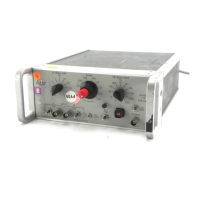
POWER CORD
WHEN CHANGING
THE LINE
with
normal heart
functioning.
However,
recent
VOLTAGE
SETTING.
Depend'ng
on
the
switch research has shown
that
dangerexists
at
far
lower
position,
either “115”
or
“230”
(both
are
printed
on
current
levels
than
was previously
suspected. As
the
switch)
will
be
visible
to
the
operator.
For a consequence
of this
increased
awareness,
and
operation
from
a line
voltage
of
nominally
115 V
after a careful analysis
of
the Model 113 design,
ac,
the
switch
should be set
so
that
“115”
shows.
EG&G
Princeton
Applied
Research
Corporation
For
operation
from
a
line
voltage
of
nominally
feelsthat it cannot recommend the Model 113for
230 V
ac,
“23O”
should show. use
in applications
involving human
subjects
or
patients. In
certain situations
involving
specific
conditions
of
grounding,
internal component
E. LINE
FUSE failure,
or
excessive
common-mode input,
the
The Model
113
line
fuse
is
located inside
the
in- high input
impedance of the
Model
113
could fail
strument.
To
check
or
replace
the
fuse,
it is
first
and
potentially
dangerous currents
could
flow
necessary
to
remove
the
top
cover and also
the
through the
subject.
shield
mounted
on
the
inside
of
the
rear panel.
The
fuse
should be a
slow-blow
type
rated
at
However,
the
reader
should not
get
the
impres-
either 1/16 A (115 V Operation) or 1/32 A (230 V sion
that
the
Model
113
is
in
any wayadangerous
operation).
The voltage
rating should
be
125 V
or
instrument
to
use in ordinary applications.
Those
higher in the Case 01 115 V Operation and 250 V or characteristics
that necessitate
the
advisory
hiélherththe eeee Qt 230V0DeFeti0i1-9h|YeBU$$
against
the
instrument’s use
in
bio-medical
ap-
MDL OF equh/eteht
thee
Sheuld be
USed-
plications with
humans
are
common
to
most
other
preamplifiers as
well. In
fact,
with
its
low
internal
wA|=tNiN(;i supply
voltages,
capability
for
internal battery
TO
AVOID
THE
POSSIBILITY o|= A SAFETY HAZ-
power with
epinpieie independence of
the ep
line.
ARD FRQM E|_ECTR|CA|_ SHQCK wi-ii(3i-i (3QUi_|3 and
extremely
high input impedance under
normal
REsui_T |N INJURY OR DEATH, |)|$(;()Ni\|EcT operating
conditions,
the
Model
113
is
probably
THE PQWER CORD BEFQRE REM()V|NG QR |i\|- one
of the
safest
preamplifiers
available
for
$"i'Ai_i_|N(3 A FU$E_ i3E(;Ati$E QF Ti-ii; PQTEN- general use.
For
all practical
purposes,
it
can be
T|A|_ HAZARD, Ti-ii; FUSE Si-|()U|_[) BE CHECKED considered
to
be
completely harmless.
The
maxi-
AND/OR
CHANGED
BY
A
QUALIFIED SERVICE
mum
internei
Supply
vpitepee
eppiied tp the em-
"|'E(3i-i|\ii(3iAN ()Ni_Y_ plifiers
are
only
i
12 V. Even
these
low
voltages
can
only
appear at
the
input
under
very specific
A prooeoure for geinino eooeee to the fuse operating
conditions,
and
then
generallyforonlya
follows.
few
milliseconds.
A person
inadvertently
touching
the
input
under
these
conditions
would,
in
(1) Remove the top oover_ it is eeoureo by e general,
not even
be aware
that there
was
any
single screw
on
the
bottom surface
ofthetop-
Vettege
there at
ett ehd hY he etfeteh Qt the im-
oover “tip” et the reer of the inetrument_ with agination
could
the
operator
of
the
instrument
be
the
screw removed,
the
cover simply slides ie9eTded
ee hethg
ih
ehY dehgeh
back
to
where it
can
be
freed from
the
instru-
ment_ The
preamplifier
can
be used in
biological appli-
cations
involving animal subjects.
However,
if
the
(2)
Remove
the
shield
attached
to the
inside
of
eppiieeiipn
ie pne in whieh ekin reeieienee is
the
rear panel. This shield is secured by
a
dreetivredueed prbvpeeeed.tne
pperetprie
advis-
einoie eorew at its oenter_ with the ehieio ed
to
observe the
following
recommendations if
removeo, the iuee hoioer, iooeteo oireotiy unnecessary risk
to
the
experimental animal
isto
above
the
Line Voltage
Selector switch, he evetdeti
becomes accessible.
1
(1) Turn
the
amplifier
power
on
BEFORE
making
(3) After oheokino eno, it eppropriete, ohenging any
connections
to
the
experimental animal.
the
fuse, remount
the
shield
and
top
cover
before
plugging
in
the
line
cord
and
operating
(2) set
the
thput
Ceuhtthg ewttehee 01 the Medet
the inetrument_ 113
to
GND
before
making
any
connections to
the
experimental animal.
Do
not
transfer
from
the
GND
settings
until
after
the
connections
are
completed.
F.
USE
OF THE MODEL
113 IN
1
BIO-MEDICAL
APPLICATIONS
(3) Do
not
turn
the
power
switch
on
or
off
while
In
the
past
few years,
safety in bio-medical
ap-
the
instrument is connected
to the
experi-
plications
has been
a matter
of
growing
concern
mental
animal.
to
both
the
users
and suppliers
of
electronics
equipment.
It
has
long
been
known
that
electrical
It
may
prove
helpful to consider the reason for
currents
passing
through
the
heart
can interfere these
precautions.
By understanding
them,
the
3
—_---up
POWER
CORD WHEN CHANGING THE LINE
VOLTAGE SETTING. Depending on the switch
position, either
"115"
or
"230"
(both
are
printed on
the switch) will be visible
to
the operator. For
operation from a line voltage
of
nominally
115
V
ac, the switch should
be
set so that "115" shows.
For operation from a line voltage
of
nominally
230
V ac,
"230"
should show.
E.
LINE FUSE
The Model 113 line fuse is located inside the in-
strument. To check or replace the fuse, it is first
necessary
to
remove the top cover and also the
shield mounted on the inside
of
the rear panel.
The fuse should be a slow-blow type rated at
either
1/16 A
(115
V operation) or 1/32 A
(230
V
operation). The voltage rating should
be
125
V or
higher in the case
of
115 V operation and
250
V
or
higher in the case
of
230
V operation. Only a
BUSS
MDL
or
equivalent fuse should be used.
WARNING!
TO
AVOID THE POSSIBILITY OF A SAFETY HAZ-
ARD FROM ELECTRICAL SHOCK WHICH COULD
RESULT
IN
INJURY
OR
DEATH, DISCONNECT
THE POWER CORD BEFORE REMOVING
OR
IN-
STALLING A
FUSE.
BECAUSE OF THE
POTEN-
TIAL HAZARD, THE
FUSE
SHOULD
BE
CHECKED
ANDIOR CHANGED
BY
A QUALIFIED SERVICE
TECHNICIAN ONLY.
A procedure for gaining access to the fuse
follows.
(1)
Remove the top cover. It is secured by a
Single screw on the bottom surface
of
the top-
cover
"lip"
at
the rear
of
the instrument. With
the screw removed, the cover simply slides
back to where
it
can
be
freed from the instru-
ment.
(2)
Remove the shield attached to the inside
of
the rear panel. This shield is secured by a
Single screw at its center. With the shield
removed, the fuse holder, located directly
above the Line Voltage Selector switch,
becomes accessible.
(3)
After checking and,
if
appropriate, changing
the fuse, remount the shield and top cover
before plugging in the line cord and operating
the instrument.
F.
USE OF THE MODEL 113 IN
BIO·MEDICAL APPLICATIONS
In
the past few years, safety
in
bio-medical
ap-
plications has been a matter
of
growing concern
to
both the users and suppliers
of
electronics
equipment. It has long been known that electrical
currents passing through the heart can interfere
with normal heart functioning. However, recent
research has shown that danger exists at far lower
current levels than was previously suspected. As
a consequence
of
this
increased awareness, and
after a careful analysis
of
the Model 113 deSign,
EG&G
Princeton Applied Research Corporation
feels that it
cannot recommend the Model 113 for
use
in
applications involving human subjects or
patients.
In
certain situations involving specific
conditions
of
grounding, internal component
failure, or excessive common-mode input, the
high input impedance
of
the Model
113
could fail
and potentially dangerous currents could flow
through the subject.
However, the reader should not get the impres-
sion that the Model 113 is in any way a dangerous
instrument
to
use in ordinary applications. Those
characteristics that necessitate the adviSOry
against the instrument's use in bio-medical
ap-
plications with humans are common
to
most other
preamplifiers as well.
In
fact, with
its
low internal
supply voltages, capability for internal battery
power with complete independence
of
the ac line,
and extremely high input impedance under normal
operating conditions, the Model 113 is probably
one
of
the safest preamplifiers available for
general use. For all practical purposes,
it
can be
considered
to
be
completely harmless. The maxi-
mum internal supply voltages applied
to
the am-
plifiers are only
±
12
V.
Even
these low voltages
can only appear at the input under very specific
operating conditions, and then generally for only a
few milliseconds. A person inadvertently touching
the input under these conditions would, in
general, not even be aware that there was any
voltage there at all and by no stretch
of
the im-
agination could the operator
of
the instrument be
regarded
as
being
in
any danger.
The preamplifier can be used in biological appli-
cations involving animal subjects. However,
if
the
application is one in which skin resistance is
greatly reduced
or
bypassed, the operator is advis-
ed
to
observe the following recommendations
if
unnecessary risk to the experimental animal is
to
be avoided.
(1)
Turn the amplifier power on BEFORE making
any connections
to
the experimental animal.
(2)
Set the Input Coupling switches
of
the Model
113
to
GND before making any connections
to
the experimental animal.
Do
not transfer from
the GND settings until after the connections
are
completed.
(3)
Do
not turn the power switch on
or
off
while
the instrument is connected
to
the experi-
mental animal.
It may prove helpful
to
consider the reason for
these precautions. By understanding them, the


 To Next Page
 Loading...