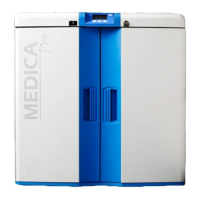
The PURELAB flex 1 & 2 is a laboratory water purification system designed to provide a guaranteed supply of purified water for various applications. It is available in different configurations, including a base model with an optional purification pack, and a more advanced model that includes a purification pack, UV lamp, and TOC (Total Organic Carbon) monitoring. The system is designed for ease of use and maintenance, with features that allow for customized operation and self-help troubleshooting.
Function Description
The primary function of the PURELAB flex is to purify water to meet specific laboratory requirements. It achieves this through a combination of purification technologies, which may include a purification pack, UV lamp, and TOC monitoring, depending on the model. The system is capable of dispensing purified water on demand, with real-time monitoring of water purity displayed on a handset.
The purification process typically involves several stages. Incoming feed water, which can be from a potable supply, reverse osmosis (RO), filtered service deionization (SDI), or distilled, first passes through an inlet filter to remove particles. This protects the system from contaminants that could affect performance. After the initial filtration, the water undergoes further purification through the purification pack, which is a consumable item designed to remove specific impurities. For models equipped with a UV lamp, the water is exposed to ultraviolet light to reduce microbial contamination and improve water quality. The TOC monitoring feature, available in advanced models, continuously measures the organic carbon content in the water, ensuring it meets the required purity levels.
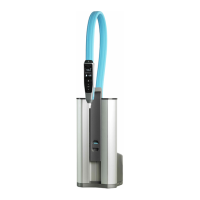
The system is designed to be user-friendly, with a flexible dispense tube and a handset that allows for precise control over water dispensing. The handset features a display screen that shows water purity, TOC levels (if applicable), and other important system information. It also includes buttons for dispensing, adjusting volume, and navigating menus. An "AutoVolume" feature allows users to dispense a pre-set volume of water, enhancing convenience and reproducibility in laboratory tasks.
Usage Features
The PURELAB flex offers several features to enhance its usability in a laboratory setting:
- Flexible Dispense Tube: The system includes a flexible dispense tube, allowing users to easily direct purified water to various containers and points of use, providing versatility in different lab setups.
- Dispense Handset: The ergonomic handset integrates a display screen and control buttons, making it convenient to monitor water purity and control dispensing operations directly at the point of use.
- Water Purity Display: The handset's display screen provides real-time feedback on water purity, typically showing resistivity in MΩ-cm, and TOC levels in ppb for models equipped with TOC monitoring. This allows users to confirm water quality before use.
- Infobar: A scrolling information bar on the display provides continuous updates on the unit's status, alerting users to any operational changes or maintenance requirements.
- AutoVolume Feature: This function enables users to program and dispense specific volumes of water automatically, which is particularly useful for repetitive tasks and ensures consistency in experiments.
- Adjustable Arm: The system features an adjustable arm for the dispense handset, allowing users to position it optimally for their workspace and specific dispensing needs.
- Footswitch (Optional): An optional footswitch can be connected to the system, providing hands-free control over water dispensing, which can be beneficial in sterile environments or when handling delicate lab equipment.
- USB Connectivity: The inclusion of a USB port suggests potential for data logging, software updates, or downloading additional features, allowing for customization and enhanced functionality.
- Customized Operation: The PURELAB flex can be customized by downloading additional features and changing current settings, which can be accessed via the manufacturer's website. This allows users to tailor the system's operation to their specific application needs.
- Quick Start and Reference Guides: The system comes with a Quick Start Guide for installation and commissioning, and a Quick Reference Guide for day-to-day functions, minimizing the need to consult the full operator manual for routine tasks.
Maintenance Features
Regular maintenance is crucial for the optimal performance and longevity of the PURELAB flex. The manual outlines several user-performable maintenance tasks:
- Consumables Replacement: The system relies on several consumable items, including purification packs, UV lamps, 0.2µm microfilters, biofilters, and sanitization cartridges. The manual provides estimated service lives for these items and prompts users when replacement is due.
- Replacing Ultraviolet Lamp (LC210): The UV lamp needs to be replaced when failure occurs or efficiency decreases. The manual provides detailed, step-by-step instructions for safely replacing the UV lamp, including warnings about UV-C radiation and mercury hazards. It emphasizes the importance of isolating the electrical and water supply, wearing cut-resistant gloves, and handling the lamp carefully to avoid breakage and contamination.
- Cleaning the Inlet Filter Assembly: The inlet filter protects the system from particles in the feed water. The manual recommends periodic cleaning of this filter to prevent blockages and maintain performance. Instructions include isolating the electrical and water supply, locating and unscrewing the filter, removing and checking the mesh filter for damage, cleaning or replacing it, and then reassembling the unit.
- Replacing Point-of-Use Filters: For models fitted with point-of-use filters (e.g., 0.2µm microfilter or biofilter), specific instructions for their installation are provided with each filter.
- Self-Help Guidelines: The manual includes a comprehensive troubleshooting section with common problems and recommended actions. This allows users to diagnose and resolve minor issues independently, such as display malfunctions, purification pack change reminders, sanitization reminders, high-temperature water alarms, reduced dispense flow rates, and feed/dispense water purity alarms.
- Sanitization: The system may require sanitization, and a sanitization cartridge (LC209-M2) is available for single use. The manual mentions a sanitization reminder, indicating that the system prompts users when this maintenance is needed.
- Customer Support: For issues that cannot be resolved through self-help, the manual provides contact information for ELGA LabWater customer support, including email addresses and phone numbers, ensuring users can access professional assistance when needed.
- Environmental Considerations: The manual specifies environmental requirements for installation (clean, dry, level surface, 5-40°C, max 80% non-condensing humidity) to ensure proper operation and prevent damage. It also advises against using the unit in fume cupboards where chemicals could damage the system.
- Safety Notes: Detailed health and safety notes are provided, covering warnings related to electrical supply, UV light exposure, and residual biostat. These notes are critical for user safety during operation and maintenance. For instance, it warns against operating the UV lamp outside its chamber and recommends wearing cut-resistant gloves during handling. It also highlights that the UV lamp contains mercury and should be disposed of according to local regulations.

 Need help?
 General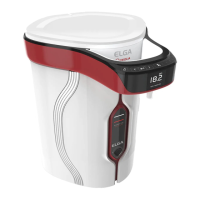



 To Next Page