Adjusting the Needle Thread Tension
Choosing the Correct Tension - Straight Stitch
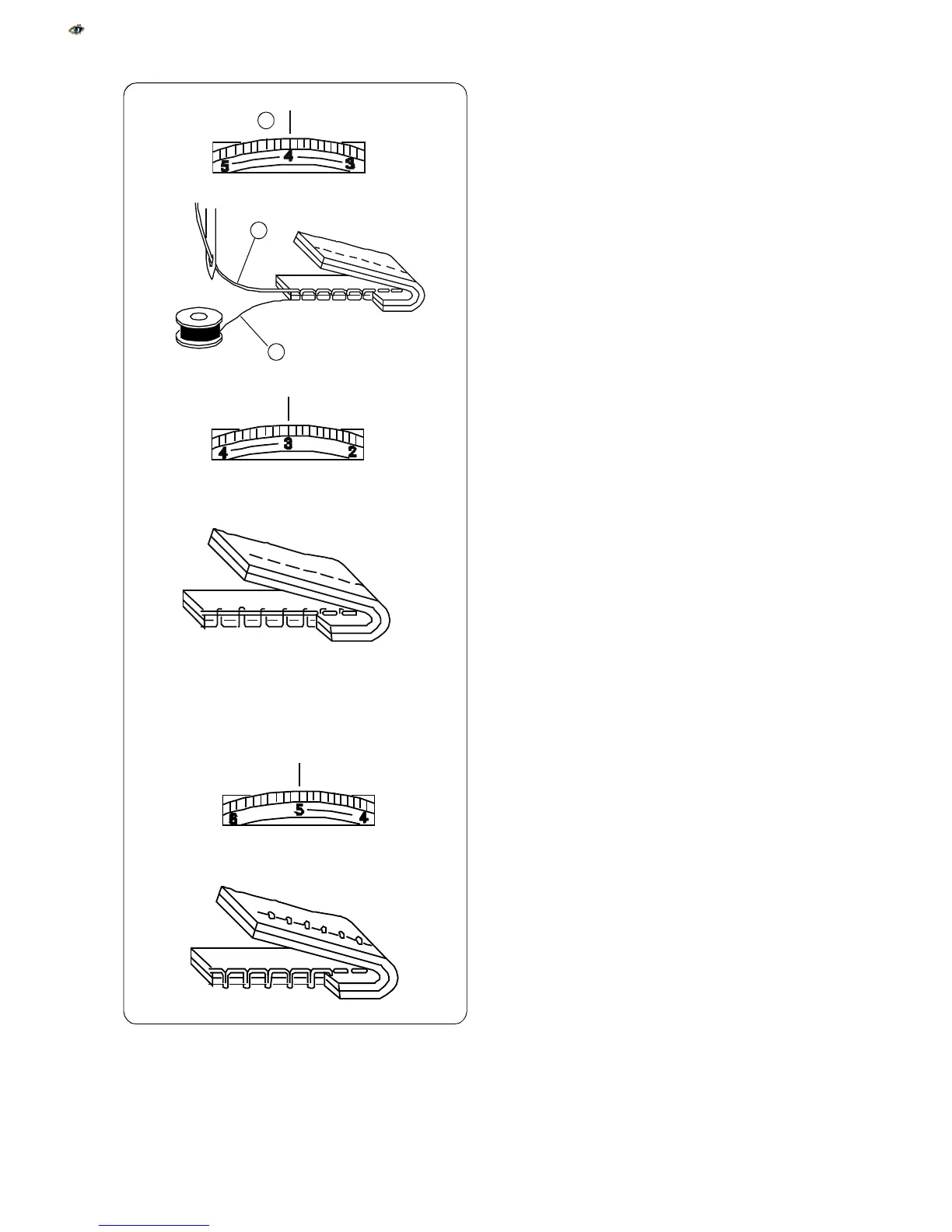
The ideal straight stitch will have threads locked be-
tween the two layers of fabric, as shown left (magni-
fied to show detail). Needle thread tension can range
from 3 – 5 and is normally set on 4
j
.
If you look at the needle thread
k
(top thread) and
bobbin thread
l
(bottom thread), you will notice that
there are no gaps. Each stitch is smooth and even.
Occasionally the needle thread tension needs to be
adjusted. Examples:
−
stiff or heavy fabric
−
sewing more than two layers of fabric
−
type of stitch
−
thread
When adjusting needle thread tension, the higher
numbers tighten, the lower numbers loosen.
• Tension is too tight
The bobbin thread shows through on the topside of
the fabric and it will feel bumpy.
Turn the dial to a lower number to loosen the needle
thread tension.
• Tension is too loose
The needle thread shows through on the underside
of the fabric and it will feel bumpy.
Turn the dial to a higher number to tighten the
needle thread tension.
• Adjusting Tension for Zigzag and Satin
Stitches
The upper thread tension should be slightly looser
when sewing a zigzag or a satin stitch. The upper
thread should appear slightly on the underside of the
fabric.
9
1
2
3


 To Next Page