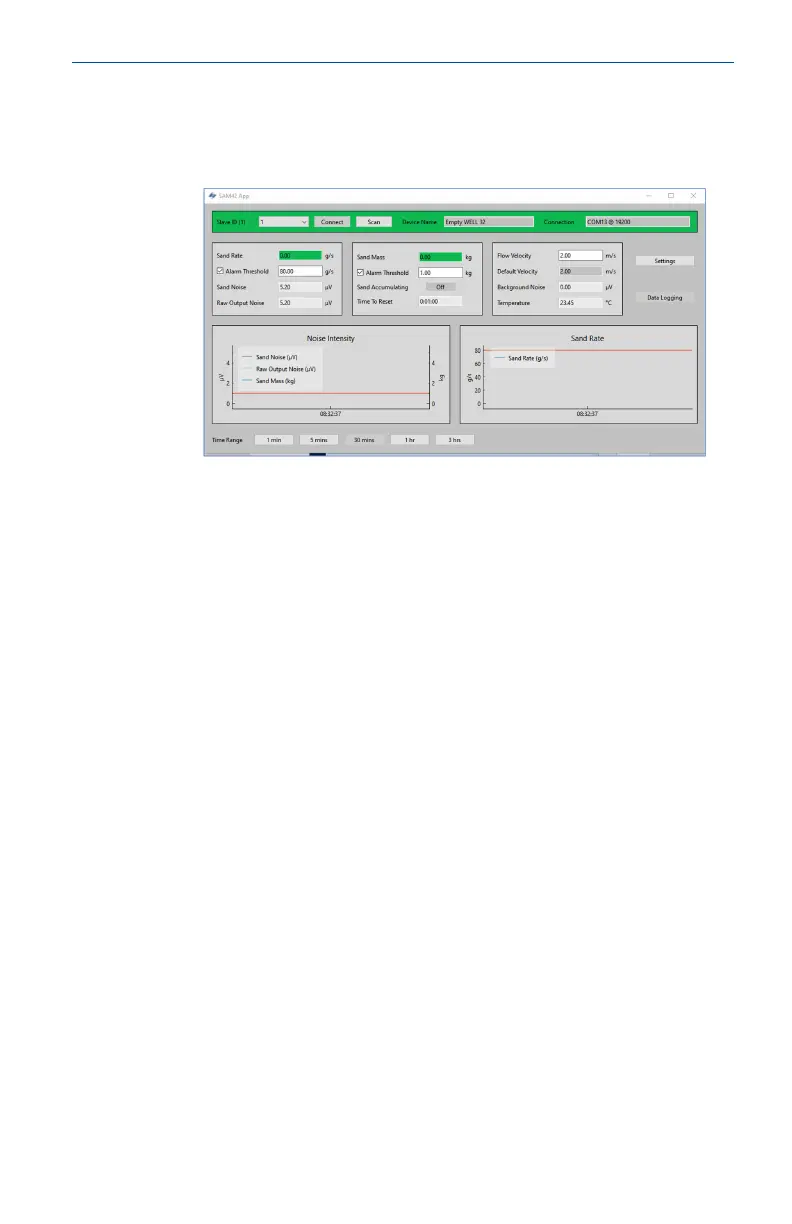
5. Once connection has been established, the application home
screen will display general information for the device. The
measurement information (sand noise/raw output noise) will
refresh every second.
4.2 Calibration strategy
The calibration method to be used should be agreed in advance of
any commissioning work.
The purpose of the calibration is to establish the relation between
flow noise and velocity (i.e., the background noise function) and the
sand induced noise and velocity (i.e., the sand noise function).
The calibration strategy is dependent on the end user requirement
for accuracy and sand management philosophy. There are normally
three different approaches to operate the Rosemount SAM42
Acoustic Particle Monitor.
Sand detection
This method requires no calibration and no velocity input. When
observing abnormal signal behavior compared to stable background
signal, this will indicate that the well is producing sand. Trending of
raw data and manual interpretation of this data is required, unless a
threshold alarm level is defined in the DCS/PCS.
Sand indication
This method requires background noise calibration and velocity
input. The sand calculation will be based on default factory
calibration curves. The system output will give a rough estimation
of sand rate. One point calibration as described in Background
noise calibration of the device can be performed to decrease the
measurement uncertainty.
May2024 Quick Start Guide
Quick Start Guide 35





 To Next Page