consideration when connecting multiple SAM42s are chained
together.
In Ex-d applications, it is possible to connect up to 32 devices on a
two wire RS485 process bus. There may be a requirement to change
the baud rate of the devices to ensure that the polling rate of one
reading per second is maintained.
Ex-a applications are limited to three devices. This is due to the
current limitations on the barriers which are used. If connecting
more than three devices through the same barrier, then the polling
rate will drop below one reading per second.
The communication protocol is standard Modbus RTU mode. The
SAM42 device stores all the configuration data and calibration
coefficients in a flash memory and needs no computer for normal
operation hooked up to the PCS/DCS.
The PCS/DCS supplies the SAM42 device with flow velocity
parameters and retrieves computed sand rate values as well as sand
alarms and technical error alarms from the SAM42. Digital interface
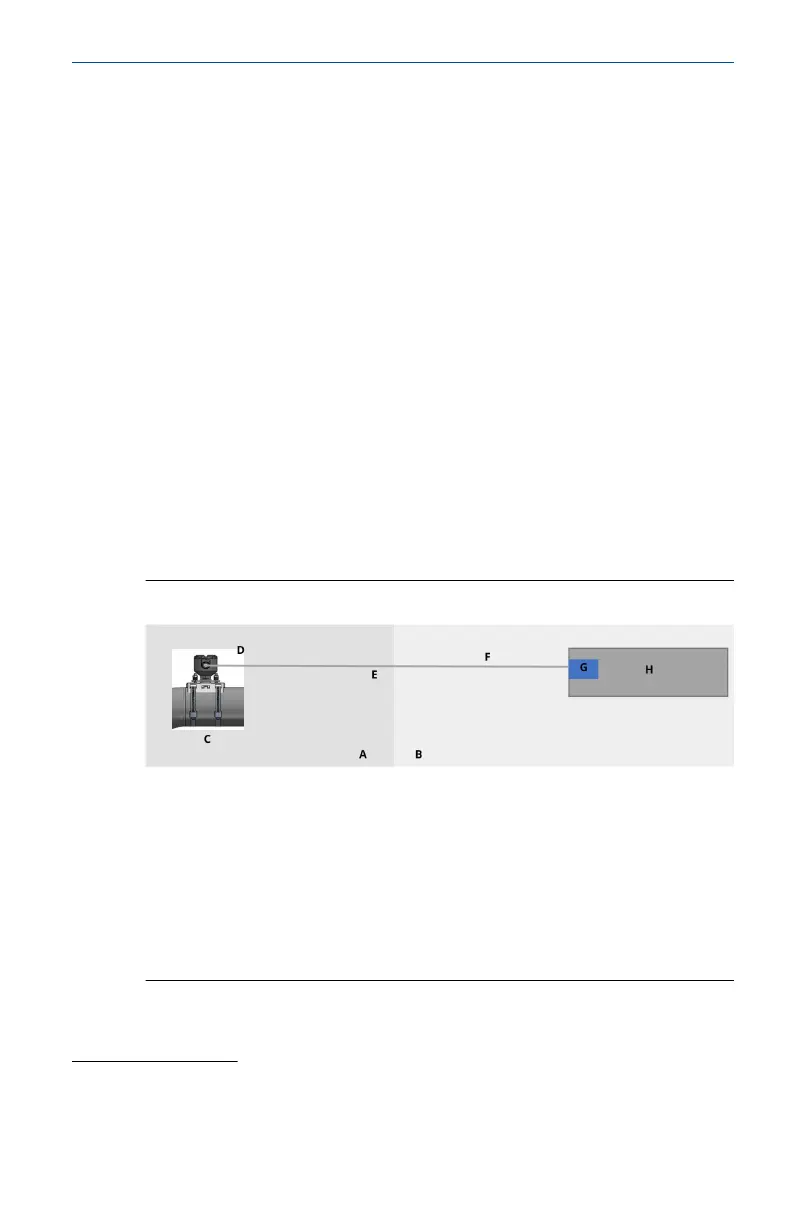
is represented in Figure 6-4 and Figure 6-5. In cases where the flow
velocity is not available from the PCS/DCS, a static flow velocity can
be set.
(1)
Figure 6-4: Ex-d interfacing between SAM42 and DCS
A. Hazardous area
B. Safe area
C. Acoustic Particle Monitor
D. Modbus RTU RS485
E. Ex d cable
F. Modbus RTU RS485 and Power
G. 24 Vdc
H. Distributed Control System (DCS)
(1)
If a static velocity is set, this will have impact on device accuracy. For optimal
accuracy results, it is recommended that a live flow rate is supplied from the
DCS/PCS to the device.
May2024 Quick Start Guide
Quick Start Guide 63





 To Next Page