22
• Ventilation must be sucient.
• If ventilation is not sucient, the indoor air humidity
will rise, which can cause condensation on cold
surfaces.
• The indoor air humidity levels must be checked at
regular intervals.
• During winter an indoor relative humidity level
of no more than 40-45% is recommended (room
temperature 20-22°C). The relative humidity level can
be checked from the ventilation unit measurements.
If the relative humidity level rises over 45%, ventilation
should be boosted. c v
• The cleanliness of lters must be checked regularly.
• Often in winter, the extract air lter collects more dirt
than the supply air lter. This means that the extract
air ow is reduced, which can lead to a rise in indoor
air relative humidity, and reduced heat recovery
eciency.
• More information about cleaning and changing the
lters can be found in the User manual Maintenance
section.
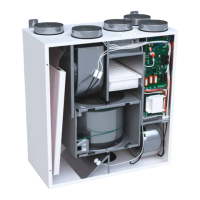
• Check monthly that the heat exchanger is functioning
correctly, i.e. rotating.
• More information on checking and cleaning the
heat exchanger can be found in the User manual
Maintenance section.
• If the ventilation unit is shut down for longer than
a couple of hours during winter, the fresh air intake
vent and exhaust air blowout vent must be covered
airtight. This prevents humidity from condensing on
the electric motors of the fans, for example.
• In the autumn, before the beginning of the heating
season and in the spring, before the beginning of the
cooling season (if the unit has a cooling function),
the condensation water drain must be checked by
pouring water in the condensation water drain and
making sure that the water drains away.
General instructions
Do not shut down the ventilation unit. Always
select the correct operating mode depending on
the ventilation need.
NOTE
Using the eAir control panel
Ventilation is used primarily with modes. The modes in use
can be seen in the control panel main screen. The user can
choose the best mode for each situation: At Home, Away,
Boost, Overpressure, Silent, or Max. cooling / Max. heating.
The Silent and Max. cooling / Max. heating modes must
be activated separately from the Settings > Modes menu
before they are shown in the Modes menu. The Modes
menu can be accessed by tapping the round button in
the middle of the control panel main screen.
Eco mode can be activated in all modes except in Max.
cooling / Max. heating mode. Eco mode stops post-
heating and active cooling, and maximizes the use of heat
recovery. Heat recovery is 100% until outdoor temperature
reaches the outdoor temperature limit of heating, or until
supply air temperature reaches the supply air temperature
maximum limit. If the supply air temperature drops below
the minimum temperature limit, post-heating activates
and keeps the supply air temperature at minimum level.
The circle around the operating mode button changes
its color depending on what the ventilation unit is doing.
The circle is green when heat recovery is active; orange
and red when heating is active, and blue when cooling is
active.
The other functions of the ventilation unit can be found
in the Main menu. The menu can be accessed by tapping
the arrow at the bottom of the control panel main screen.
The main menu consists of the following submenus:
Time programs, Measurements, Alarm, Settings, System
information, Setup wizard, and eAir web settings. For more
information on menus, see the User manual.
If an alarm is active, it is shown in yellow in the control
panel main screen. The most common alarm is a service
reminder to remind the user to change the lters. The
reason for any alarm should always be checked. Check the
Alarms menu for the possible reason for the alarm and the
instruction on how to acknowledge it.


 To Next Page