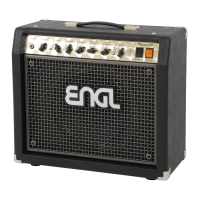
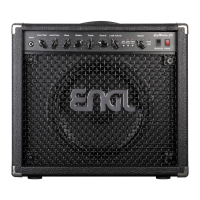
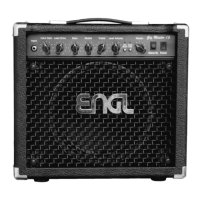
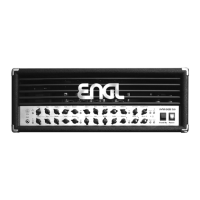
great choice for clean or edgy rock riffs, while the E412 (Vintage) smokes for heavy
rockshredding,wailingleadsandchunkymetalrhythmworkinLeadmode.
We endowed this baby with an electronic surveillance system to monitor
, , and . If a plug is not inserted into one of these ports, the
monitoring system automatically shuts the power amp down to ensure it is not
operated without a connected load. The red Status LED above the Write button (47)
willflashbrieflyinadistinctivepatterntoalertyouthatthishastakenplace.Ifyouplug
a cord into either or , the speaker switching option is disabled
and that output is selected automatically. If you use a MIDI preset whose
programming does not match the currently selected speaker output, the monitoring
system automatically switches to the currently selected output. For example, if you
programmed for Preset 1, but have connected a speaker to
,theampwillautomaticallyselect .
Press this button to activate an onboard and suppress excess noise in the
Crunch channel or thetwo Leadchannels. Control the Noise Gate using thetwo Level
Threshold(59)andMuteDepth(58)knobsonthebackoftheamp.TheLEDabovethe
button lights up to indicate the is activated. This feature can also be
switchedviaMIDIprogramchangeortheENGLCustomZ-9Footswitch.
: The may open up inadvertently
whenthe isactivated,ahigh-gainLeadchannelisselected,andthevolume
exceeds the Threshold knob setting. At very high volume and gain settings, this may
generate instant feedback, particularly if your guitar is facing the speakers. Rather
than musical and controlled, this is the shrill, unpleasant and potentially harmful
variety of feedbacksquealing thatsends your audience andfellow musicians packing.
Thoughtheampisnotmoresusceptibletofeedbackwhenthe isactivated,
the fact that it suppresses extraneous noise means you can't hear those telltale signs
that feedback isswelling and consequentlycan't take measuresto suppress it.For this
reason, make an extra effort to be careful when the is activated: Before
you approach theamp and speakercabinet with yourguitar inhand, turnthe guitar's
volume knob to the far left position (to 0 so that no signal is audible) to prevent the
pickupsandspeakersfrominteracting!
Noise is a definite no-no in many situations. For example, studio etiquette demands
that you keep a lid on extraneous noise during short breaks. It's in the nature of high-
gain rigs to generate undesirable peripheral noise in overdriven channels. This is
attributable to the physical properties of an amp's constituent components, in
particular its active components. That's right; those cherished tubes are the culprits.
The Noise Gate is a tool that lets you silence this noise during breaks by way of signal
mute circuit. Note that electric guitars pick up interference signals, and these are
amplifiedtremendously at highgainlevelsinLeadmode. The most commonsourceof
noise is 50 or 60 hertz mains hum, particularly when the guitar is positioned near
transformers and power units. Because in worst-case scenarios this humming can
attain extremely high levels, the Noise Gate can hardly distinguish between the
Headsup,importantnote:
IMPORTANT note; please read and heed
Atipfromthedesigner:
Power Amp
Output A1 A2 B1 B2
Power Amp Output A B
Speaker B/Output B
OutputA OutputA
Noise Gate
Noise Gate
Noise Gate
NoiseGate
NoiseGate
Noise Gate
46NOISEGATE
18


 To Next Page