Minute Volume cont.
There are two ways to change the Minute Volume per Kilogram number:
a. Since the Minute Volume number is directly proportional to Breaths Per
Minute, the most direct way to change the Minute Volume number is to change
the number of Breaths Per Minute.
b. Changing the Peak Inspiratory Pressure (P.I.P.) will change the Tidal Volume
and therefore change Minute Volume number as well. Obese patients with low
thoracic compliance and patients with restrictive lung conditions will often need
a higher Peak Inspiratory Pressure. The best method is to observe the “rise
and fall” of the chest and adjust the Peak Inspiratory Pressure for a
"reasonable" amount of filling.
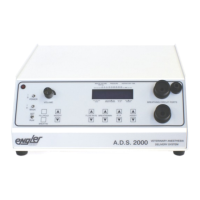
THE PEAK INSPIRATORY PRESSURE GRAPH
1. The Peak Inspiratory Pressure of the patient is indicated by a cursor moving
across the middle of the LCD display.
2. The cursor starts at 0 cm. of H
2
O and moves up to the selected Peak
Inspiratory Pressure.
3. A square BLACK cursor moving across a WHITE background indicates that the
breath was initiated by the ADS 2000. Whereas a square WHITE cursor moving
across a BLACK background indicates that the patient initiated the breath, (ASSIST
MODE).
THE INSPIRATORY TIME
1. The information in the upper right hand corner of the display shows the
Inspiratory Time in seconds, e.g., 1.20 and is updated with each breath. The exact
length of inspiration is not critical, but it should allow an INSPIRATORY:
EXPIRATORY RATIO of at least 1:2. This means at 10 Breaths Per Minute, the
inspiratory time should be no longer than two seconds. Generally, intervals of 0.75 to
2 seconds are suggested, the shorter time intervals being best for smaller patients.
2. The easiest way to adjust the Inspiratory Time is to adjust the Flow Rate, i.e. the
higher the Flow Rate the quicker the lungs will be brought up to the preset Peak
Inspiratory Pressure, thus a quicker Inspiratory Time. Generally set the Flow Rate so
that the patient's chest rises in a reasonable time.
IMPORTANT: Very short Inspiratory Times may indicate a very high Flow Rate into
a very small patient. Under these circumstances, the narrowness of the tube and the
resistance of the trachea and other air passageways will cause the pressure to build
up without inflating the lungs. It is usually very obvious when this occurs because the
pressure will rise extremely rapidly, but the chest will not fill. DO NOT LET THIS
CONDITION GO UNCORRECTED. Lower the FLOW RATE to 2 or 4 LPM and let the
chest fill more slowly.
16 Engler Engineering Corporation ADS2000


 To Next Page