The provided document is an instruction manual for ESAB TIG welding torches, specifically covering models SR-B 9, SR-B 17, SR-B 26, SR-B 26-HD, SR-B 18, SR-B 20, SR-B 21, SR-B 400, and XCT-B 400W.
Function Description
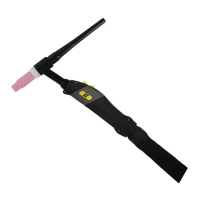
These ESAB TIG welding torches are designed for manual TIG (Tungsten Inert Gas) welding. They are available in both air/gas-cooled and liquid-cooled versions, catering to different welding current requirements and applications. Certain models also feature flexible heads, allowing for unlimited movement in confined spaces, which enhances usability in complex welding scenarios. The torches facilitate the creation of an arc for welding by holding a non-consumable tungsten electrode and supplying shielding gas to protect the weld pool from atmospheric contamination.
Important Technical Specifications
The technical specifications vary across the different models and cooling types:
Operating and Transportation Temperatures:
- Operating temperature range: -10 to +40 °C (+14 to +104 °F)
- Transportation temperature range: -20 to +55 °C (+4 to +131 °F)
Current Ratings (AC [A] / % and DC [A] / %):
- SR-B 9 (Air/Gas-cooled):
- SR-B 17 (Air/Gas-cooled):
- AC: 100/60 A
- DC: 140/60 A
- SR-B 26 (Air/Gas-cooled):
- AC: 140/60 A
- DC: 200/60 A
- SR-B 26-HD (Air/Gas-cooled):
- AC: 160/60 A
- DC: 230/60 A
- SR-B 18 (Liquid-cooled):
- AC: 225/100 A
- DC: 320/100 A
- SR-B 20 (Liquid-cooled):
- AC: 160/100 A
- DC: 220/100 A
- SR-B 21 (Liquid-cooled):
- AC: 240/100 A
- DC: 340/100 A
- SR-B 400 (Liquid-cooled):
- AC: 315/100 A
- DC: 450/100 A
- XCT-B 400W (Liquid-cooled):
- AC: 315/100 A
- DC: 450/100 A
Electrode Diameter Range (Ømm):
- SR-B 9: 0.5–1.6 mm (0.02–0.063 in.)
- SR-B 17: 0.5–2.4 mm (0.02–0.094 in.)
- SR-B 26, SR-B 26-HD: 0.5–4.0 mm (0.02–0.157 in.)
- SR-B 18, SR-B 20, SR-B 21: 0.5–3.2 mm (0.02–0.126 in.)
- SR-B 400, XCT-B 400W: 1.0–4.8 mm (0.039–0.189 in.) for SR-B 400 and 1.6–4.0 mm (0.063–0.157 in.) for XCT-B 400W.
Shielding Gas: Argon (Ar) or Argon/Helium (Ar/He) mixtures.
Torch Lengths: Available in 4 m (13 ft) and 8 m (26 ft) for most models, with some TSB 3550 models offering 12 m (39 ft) and 16 m (52 ft) options.
Ignition Voltage: Max. kV is 12 kV for all models.
Up max. V: 113 V for all models.
Water-cooled Torches Specifics:
- Max. °C: 70 °C (158 °F)
- Min. water pressure: 2.5 bar
- Max. water pressure: 4.0 bar
Recommended minimum values for cooling power and coolant flow rate (for liquid-cooled torches):
- Up to 300 A DC / 210 A AC:
- 4 m torch: 1.0 kW / 1.0 l/min
- 8 m torch: 1.6 kW / 1.2 l/min
- Up to 450 A DC / 315 A AC:
- 4 m torch: 1.2 kW / 1.2 l/min
- 8 m torch: 2.0 kW / 1.4 l/min
- Up to 500 A DC / 350 A AC:
- 4 m torch: 1.6 kW / 1.4 l/min
- 8 m torch: 2.5 kW / 1.7 l/min
Duty Cycle: The duty cycle is specified as a percentage of a ten-minute period during which welding or cutting can be performed at a certain load without overloading, valid for 40 °C (104 °F) or below.
Protection Class: IP3X (EN 60 529), indicating protection against solid objects of 2.5 mm Ø and greater.
Usage Features
Electrode Choice and Preparation:
- Tungsten Electrodes: The manual emphasizes the use of alloyed tungsten electrodes (1-2% lanthanum or cerium) for improved striking, restriking, and arc stability, leading to longer service life and higher current tolerance.
- Types of Electrodes:
- Pure tungsten (Green/WP): For light metal alloys (AC).
- Cerium alloyed tungsten (Grey/WC20): For light metals like aluminum and magnesium (AC/DC). Requires a rounded tip for welding.
- Lanthanum alloyed tungsten (Gold/WL15): For stainless steel, steel, copper, titanium (DC).
- Lanthanum alloyed tungsten (Black/WL10): For light metal alloys, stainless steel, steel, copper, titanium (AC/DC).
- Grinding: Tungsten electrodes must be grounded lengthways. The grinding angle should increase with higher welding currents (e.g., 30° for 20A, up to 120° for over 200A). For AC welding, the electrode end should be gently rounded, and grinding may be unnecessary if the tip forms a ball shape when carefully overloaded.
- Connections: All torch connections must be tightened carefully to prevent overheating, connection interference, mechanical damage, or leakage of liquid/gas. Water connections are color-coded (red to red, blue to blue).
Flexible Torches:
- Some models are available with flexible heads, allowing for enhanced maneuverability in confined spaces.
- Bending: The maximum bending angle for flexible torches is 45 degrees. Users are advised to support the torch head with their thumb when bending to prevent damage from sharp bends and prolong the torch's life.
Valve Torches:
- TIG torches with an integrated valve in the torch neck should not be operated on welding systems equipped with an ignition and stabilization device.
Cooling System (for liquid-cooled torches):
- The cooling power must be sufficient to keep the return fluid temperature below 60 °C (140 °F) to prevent torch damage. If the temperature exceeds this, cooling power should be increased, or welding current reduced.
- Only special cooling fluid with corrosion inhibitors (e.g., ESAB Cooling Fluid) should be used.
Maintenance Features
General Maintenance:
- Regular maintenance is crucial for safe and reliable operation.
- All warranty undertakings cease if the customer attempts to rectify faults during the warranty period.
- Repair and electrical work should only be performed by an authorized ESAB service technician using original spare and wear parts.
Daily Checks:
- Cables and Hoses: Inspect for damage or kinks.
- Gas Nozzle: Ensure it is free from defects and suitable for the task.
- Shielding Gas Flow: Verify even flow without restriction.
- Electrode: Check for damage and ensure it is ground to the correct angle.
- Water Flow: For liquid-cooled units, check the water flow at the return line.
Troubleshooting:
The manual provides a troubleshooting guide for common issues:
- Arc not striking: Check cable/contact, regrind electrode, flush gas, replace with smaller electrode if too large/stubby.
- No trigger function: Check/repair control cable.
- Poor gas shielding: Flush gas, clean base material, check gas bottle/hoses/pressure, shield welding area from drafts, clean/replace gas lens or hood.
Spare Parts:
- Spare and wear parts can be ordered through an ESAB dealer.
- When ordering, provide product type, serial number, designation, and spare part number to ensure correct delivery.
- Technical documentation is available on the ESAB website.
The manual includes detailed ordering numbers for various wear parts such as tungsten electrodes, back caps, heat shields, collets, collet bodies, and gas nozzles, categorized by torch model and electrode diameter. This comprehensive list supports easy identification and replacement of components, ensuring the longevity and optimal performance of the welding torches.


 To Next Page
 General