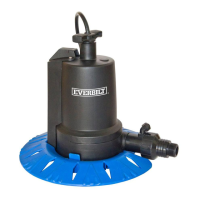
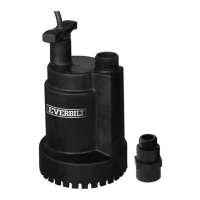
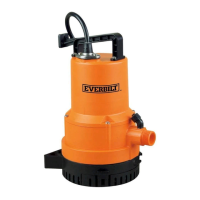
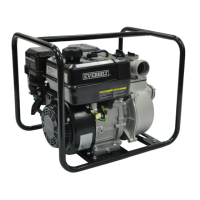
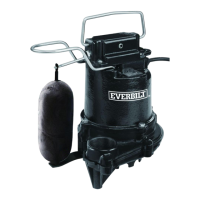
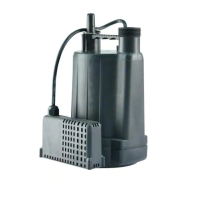
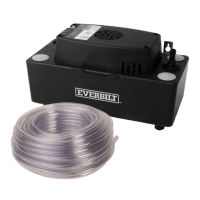
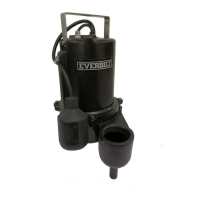
The Everbilt Submersible Utility Pump (SKU#1000026578, Model#UT03301) is a 1/3 HP centrifugal utility pump designed for water removal applications. It is engineered to automatically drain or remove water from various flooded areas such as pits, sinks, window wells, basements, swimming pool covers, boats, and low spots in yards. This pump is specifically designed for pumping clear water and is not intended for use with flammable or explosive liquids like oil, gasoline, kerosene, or ethanol, nor in the presence of their vapors, as this could lead to explosions or fires, resulting in property damage, serious personal injury, or death.
Technical Specifications:
- Power Supply: 115V, 60 Hz, requiring a 15 Amp circuit.
- Discharge: 1 in. Male NPT or 3/4 in. garden hose thread.
- Liquid Temperature Range: 32°F to 95°F (0°-35°C).
- Operating Water Depth: Minimum 1-1/4 in.
- Maximum Lift: 30 ft.
- GPH of Water @ Total Feet Of Lift:
- 0 ft.: 1920 GPH
- 5 ft.: 1800 GPH
- 10 ft.: 1620 GPH
- 15 ft.: 1440 GPH
- 20 ft.: 1200 GPH
- 25 ft.: 900 GPH
- 30 ft.: 0 GPH
Usage Features:
The pump is equipped with water detector sensors, allowing it to automatically start operating when the water level exceeds 1-1/4 inches. It will continue to pump water until the level drops to 1/4 inch, then restart when the water level again reaches 1-1/4 inches. For proper operation, the pump must be placed upright on a solid base in the flooded area. It comes with a 3/4 in. garden hose adapter for easy connection to a standard garden hose or a 1-1/4 in. hose kit (not included) for faster water removal. When connecting a garden hose, it is crucial to ensure the connector has a rubber gasket to minimize leaks. To maximize flow rate and minimize pressure loss, users are advised to use a larger inner diameter hose or shorten the hose length. The discharge line must be securely attached before starting the pump to prevent it from whipping, which could cause personal injury or property damage.
The pump is designed with an anti-airlock hole to prevent air from becoming trapped inside, which would hinder its ability to pump water even when fully submerged. This hole allows air to escape, ensuring proper operation. It is important not to remove or plug this hole, as leakage of air or water from it is normal and necessary for anti-airlock purposes.
- Always wear safety goggles when working with the pump.
- Disconnect power to the pump before servicing.
- Do not touch the motor housing during operation, as it is designed to operate at high temperatures.
- Avoid handling the pump or motor with wet hands, or when standing on a wet or damp surface, or in water, before disconnecting power.
- Release all pressure and drain all water from the system before servicing any component.
- The pump is designed for use on 115 volts (single phase), 60 Hz, and is equipped with an approved 3-conductor cord and 3-prong grounded plug. The 3-prong plug must be inserted into a properly installed and grounded 3-prong, grounding-type receptacle (preferably a GFCI outlet). Do not use with 2-prong outlets or remove the ground pin.
- Protect the electrical cord from sharp objects, hot surfaces, oil, and chemicals, and avoid kinking it. Do not use damaged or worn cords.
- Extension cords are not recommended as they may not deliver sufficient voltage and pose a safety hazard if insulation is damaged or connections fall into water. Plugging the pump directly into an outlet is recommended.
- The electrical circuit to the pump should be protected by a 10 Amp fuse or circuit breaker.
- Always use the handle to lift the pump; never lift it by the power cord.
- Allow the pump to cool after periods of extended use to avoid skin burns.
- The motor has a thermal protector that will trip if the motor becomes too hot, resetting once the motor cools down. The pump may start unexpectedly if it is plugged in and the motor cools.
- Periodically inspect the pump and system components, especially the suction screen, to ensure it is free of mud, sand, and debris. Disconnect power before inspection.
- Follow all local electrical and safety codes, National Electrical Code (NEC), and Occupational Safety and Health Administration (OSHA) guidelines.
Maintenance Features:
To ensure optimal performance and longevity, regular maintenance is crucial.
- Cleaning: When power is disconnected, inspect the pump suction screen and remove any debris.
- Cleaning a Clogged Pump:
- Unplug the pump from electrical power.
- Remove the sensor protector screen (3) and flush the sensor housing (2) with fresh water.
- Remove debris from the screen.
- Remove the screws (7) and take out the volute (6) from the pump.
- Clean any debris from the impeller (4).
- Reassemble the volute (6).
- Do Not Disassemble: The motor housing should not be disassembled as it contains no repairable internal parts, and disassembly may lead to leakage or dangerous electrical wiring issues.
- Avoid Lifting by Cord: Do not lift the pump by its power cord.
Limitations:
- This pump is not tested or approved for use in swimming pools or salt-water marine areas.
- It is not designed to function as a permanently installed sump pump.
- It is not engineered to run continuously as a "fountain" or "waterfall" pump.
- Not suitable for use where water re-circulates.
- Not designed as a swimming pool drainer.
- Everbilt utility pumps are designed to pump clear water. Pumping water with dirt or grit will accelerate wear of internal parts.
- Pumping liquids other than water with poor lubricating qualities will cause faster impeller wear.
- Most Everbilt utility pumps are not designed for continuous extended use. The pump will turn off to protect itself from overheating.
- Do not operate the pump in liquid temperatures below 30°F or above 77°F.
Troubleshooting:
The manual provides a comprehensive troubleshooting guide for common issues such as the motor running but no water being discharged, the pump humming but not running, or the pump not running at all. Solutions include checking for airlocks, blockages in the discharge hose/pipe, proper installation of check valves, clearing debris from the impeller, ensuring adequate power supply, and verifying that water sensing probes are submerged and clean. If internal sensing circuitry fails, the pump may still function as a standard utility pump, but its automatic sensing feature will not work. If the motor has failed, the pump needs to be replaced.



 To Next Page
 General