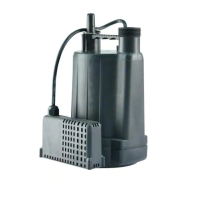
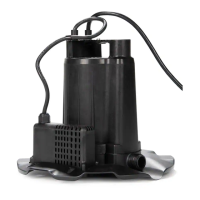
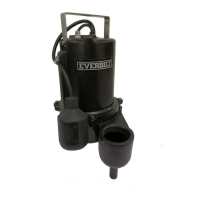
This document describes the Everbilt Submersible Sewage Pump, Model #ESE60W-HD, a device designed for pumping sewage and effluent. The manual provides comprehensive instructions for its safe installation, operation, and maintenance, emphasizing the importance of adhering to safety precautions and local plumbing codes.
Function Description
The Everbilt Submersible Sewage Pump is designed to automatically remove sewage and effluent from basins. It features an on/off float switch that controls its operation based on the water level in the basin. When the water level rises to a certain point, the float switch activates the pump, which then discharges the liquid. Once the water level drops to a predetermined lower point, the float switch deactivates the pump. This automatic operation ensures efficient and continuous removal of wastewater without constant manual intervention. The pump is specifically designed for use in pump basins with a minimum depth of 30 inches and is capable of handling suspension liquids containing solid particles up to 2 inches (5.1 cm) in size.
Usage Features
The pump's design incorporates several features to ensure reliable and safe operation. It is equipped with a built-in thermal protection switch that safeguards the motor from burning out due to overheating or overloading. If the motor overheats, the protector automatically trips, and once the motor cools down, it resets and restarts. This feature is crucial for extending the lifespan of the pump and preventing damage.
For installation, the pump requires a dedicated, separately fused, grounded line with a minimum capacity of 20 A, or a non-fuse breaker at the recommended amperes. It is essential that the voltage of the power supply matches the pump's voltage. The pump must be placed on a hard, level surface within a suitable gas-tight basin, which should be a minimum of 18 inches in diameter and 30 inches deep, and vented according to local plumbing codes.
The discharge piping can be constructed from ABS, PVC, polyethylene, or galvanized steel pipe, with proper adapters needed for connecting plastic pipes to the pump. A union must always be installed in the discharge line, just above the sump pit, to facilitate easy removal of the pump for cleaning or repair. A check valve is mandatory in the discharge line to prevent backflow into the basin, and it should be a free-flow valve capable of easily passing solids. When a check valve is used, a 3/16-inch diameter relief hole must be drilled in the discharge pipe below the floor line, between the pump discharge and the check valve, to prevent "air-lock" and ensure proper water pumping. A gate valve should follow the check valve to allow for periodic cleaning or removal of the pump. The discharge line should be as short as possible with minimal turns to minimize friction head loss and should not be restricted to sizes below 2 inches.
The float switch tether height can be adjusted to optimize pump activation based on the inlet pipe height. It is recommended to maintain at least 3 inches of cord length between the switch and the clip to ensure proper operation and prevent the pump from running dry, which can cause damage. The pump's power cord plugs into a piggyback switch plug outlet, and the switch plug then connects to a 115V GFCI power outlet. This setup ensures that the pump is always submerged in water during operation, preventing dry running.
Maintenance Features
Regular maintenance is crucial for the longevity and efficient operation of the Everbilt Submersible Sewage Pump. The manual provides clear instructions for clearing clogs, which is a common maintenance task. To clear debris, the pump must first be unplugged from its electrical power source. The volute and O-ring can then be removed by unscrewing four screws on the pump body. Once these components are off, any debris around the impeller can be removed, and the pump can be reassembled.
A critical aspect of the pump's design is its oil-filled motor, which serves two purposes: efficient cooling and permanent lubrication of the bearings. It is explicitly stated that the pump body should NOT be disassembled, as this will cause oil to leak out and void the warranty. This design choice simplifies maintenance by eliminating the need for periodic lubrication of the motor bearings.
Troubleshooting guidance is also provided to address common issues such as the pump not running, running but not delivering water, running continuously, delivering only a small amount of water, or tripping circuit breakers. These troubleshooting steps often involve checking electrical connections, ensuring the float switch operates freely, inspecting for clogged impellers or volute openings, and verifying proper check valve installation. In cases of frequent overload trips, it is recommended to check for a stuck impeller, wrong/low voltage, or an electrical failure in the motor, with a suggestion to have a competent repairman service the motor if an electrical failure is suspected.
The manual also emphasizes safety during servicing, advising users to always shut off the main power breaker and unplug the pump. In flooded conditions, it is crucial to avoid standing in water and to wear insulated protective sole shoes. For electrical service disconnection in such conditions, contacting the local electric company or a qualified licensed electrician is recommended.


 To Next Page
 General