
 Need help?
Do you have a question about the Everlast POWERTIG 210 EXT and is the answer not in the manual?
Provides contact information for Everlast in the United States, including email and phone numbers.
Provides contact information for Everlast in Canada, including email and phone numbers.
Provides contact information for Everlast in Australia, including phone numbers for Sydney and Port Macquarie.
Emphasizes user responsibility for safe operation and proper maintenance of the welding unit.
Warns about potential interference from High Frequency (HF) waves with electronic equipment and pacemakers.
Details essential PPE including safety glasses, welding helmet, hearing protection, flame-proof clothing, and boots.
Covers warnings regarding pacemakers, inhalation risks, and hazardous chemicals during welding.
Addresses electrical shock risks, fire hazards, and proper equipment maintenance for safe operation.
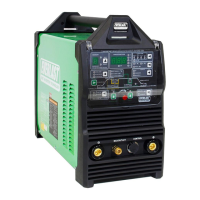
Introduces the digital microprocessor and IGBT module design of the welder.
Lists and illustrates key accessories like torch assemblies, regulator, work clamp, and foot pedal.
Provides a comprehensive table of technical specifications for the PowerTIG 210 EXT welder.
Describes the welder's general overview, key features like IGBT modules, and high-frequency design.
Offers guidance on proper use, maintenance, cleaning, and safety tips for the welding unit.
Illustrates how to connect TIG torches (air-cooled and water-cooled) and foot pedal.
Shows the correct polarity and connections for Stick welding operations.
Details rear panel connections including power input, gas inlet, and grounding points.
Identifies and labels the main components on the welder's front panel.
Provides detailed descriptions for each front panel control and connector.
Explains the functions of the memory, pre-flow, and start amps controls on the main panel.
Details parameters like Upslope, Welding Amps, Pulse Time On, and Pulse Amps.
Covers Down Slope, End Amps, Post Flow, Purge Gas, and Process Selector controls.
Explains 2T/4T/Pedal selector, AC Waveform selector, and Data Indicator functions.
Identifies and labels the main components on the welder's rear panel.
Details the gas input connection, power cord, and the 2-pole power switch.
Explains the operation of the 2T/4T sequencer and the use of torch switches.
Describes the different AC wave forms and their effect on puddle wet-in and stability.
Explains how AC frequency and balance affect arc control, cleaning, and penetration.
Details the parameters and examples for standard pulse welding in AC and DC modes.
Explains advanced AC pulse mode and arc force control for stick welding.
Discusses the use and limitations of air-cooled torches and the need for a water cooler.
Describes DINSE connectors and provides notes on foot pedal operation and display readings.
Provides instructions on grinding tungsten for optimal arc performance, including DOs and DON'Ts.
Explains the procedures for Lift Start and High Frequency Start TIG arc initiation.
Describes the tapping and scratch/match methods for starting stick welds.
Offers general polarity recommendations and welding guides for steel and stick electrodes.
Recommends suitable tungsten types (Ceriated, Lanthanated) for inverter welders.
Provides a detailed breakdown and parts list for TIG torch components.
Illustrates the pinout for the 7-pin connector used with the foot pedal.
Lists common welding issues and their corresponding causes and solutions.
Explains specific trouble codes that may appear on the unit and their diagnoses.
 General
| Brand | Everlast |
|---|---|
| Model | POWERTIG 210 EXT |
| Category | Welding System |
| Language | English |



 To Next Page