
 Need help?
Do you have a question about the Extech Instruments 42280A and is the answer not in the manual?
Introduces the Extech 42280A Temperature & Humidity Datalogger and its capabilities.
Lists key features like large display, alarms, data storage, USB connectivity, and mounting options.
Lists items included with the 42280A meter.
Details optional accessories available for purchase, such as a power adapter and calibration solutions.
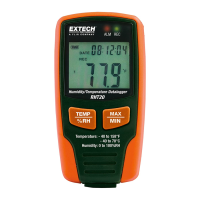
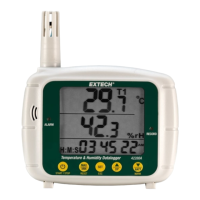
Details the components and functions of the datalogger's front panel, including sensors, LEDs, and buttons.
Explains the different elements and readings displayed on the datalogger's screen and the function of its LEDs.
Provides detailed explanations of the functions for each button on the datalogger.
Identifies the wall mounting hole and battery compartment on the back of the device.
Describes the tripod mount and footers located on the bottom of the meter.
Explains the datalogger's operation when powered but not logging data.
Details how to view readings and use functions in monitoring mode.
Explains the datalogger's memory capacity and the need for configuration before logging.
Guides users through configuring the datalogger via PC software.
Details how to configure the datalogger using its physical buttons and interface.
Explains how to initiate the datalogging process after configuration.
Describes the function and setting of the start delay timer for logging.
Explains how to add time-stamped markers to the log during a session.
Details how to conserve battery by turning off the display during logging.
Explains the procedure to stop the datalogging session.
Guides users on connecting the logger to a PC and saving data files.
Describes the content and structure of the PDF log report generated from logged data.
Explains the format and content of the text file log report.
Introduces the temperature and RH alarm functions of the datalogger.
Explains the different types of alarms that can be configured (Single, Cumulative, Disabled).
Details how to set temperature and RH alarm limits.
Describes how to use a delay timer to reduce nuisance alarms.
Explains how alarms are triggered and indicated.
Lists the statistical data provided in log reports related to alarms.
Explains the possibility of user or factory calibration for RH.
Provides step-by-step instructions for performing RH calibration using salt solutions.
Offers important tips and procedures for accurate RH calibration.
Details Extech's calibration and repair services and warranty information.
Provides contact information for customer support, calibration, and returns.
The Extech 42280A is a portable, battery-operated datalogger designed to monitor, display, and log Air Temperature, Dew Point Temperature (DP), and Relative Humidity (RH). It is suitable for monitoring environmental conditions in various residential, commercial storage, and in-transit locations. The device features a large display, a five-button keypad, two LED indicators, and an alert beeper. It comes with PC software for convenient configuration and global parameter settings. The built-in temperature and RH sensor offers high accuracy and quick response to ambient changes, with the capability for field calibration using optional RH reference solutions.
The primary function of the 42280A is to monitor and log temperature and relative humidity data over time. It operates in two main modes: Monitoring Mode and Datalogger Mode.
In Monitoring Mode, the device displays real-time measurements of air temperature and relative humidity, updating every 10 seconds. Users can also view Dew Point Temperature (DP) by pressing the DP button, which replaces the RH measurement on the middle display row while keeping air temperature on the top row. The date and time alternate on the bottom row at 5-second intervals. The device also tracks and displays Maximum (MX) and Minimum (MN) readings for both temperature and RH, which can be cycled through by short-pressing the MAX/MIN button. Long-pressing the MAX/MIN button resets these memories. Alarm conditions are visually indicated by a flashing red LED and an 'H' (high alarm) or 'L' (low alarm) icon on the display when readings exceed programmed limits. Battery status, showing the approximate number of days remaining, can be checked by short-pressing the BATT button. A low battery icon appears when the voltage is very low.
In Datalogger Mode, the 42280A records up to 24,000 temperature and 24,000 RH readings in its internal memory. Before logging, the device must be configured either via a PC (recommended) or using the front-panel keypad. If logging is attempted without configuration, it will not start. Once logging begins, the green Record LED flashes every 10 seconds, and the REC display icon flashes once per second. If a Start Delay has been programmed, the REC icon will be visible but not flashing until the delay elapses, after which it will start flashing. During logging, the display updates readings at the set sampling rate. The red Alarm LED will flash if measurements exceed programmed limits. For extended logging sessions, an optional 9V power adapter is recommended to prevent data loss due to low battery. Users can add up to eight time-stamped markers to the logging record by long-pressing the MARK button, which helps pinpoint specific events or location changes in the log report. To conserve battery during logging, the display can be switched off by short-pressing the START/STOP button, while the logger continues to run in sleep mode. Short-pressing the button again restores the display. Logging stops automatically when the internal memory is full or when the START/STOP button is long-pressed. After a logging session, data can be downloaded to a PC to generate PDF or tab-delimited text file reports.
 General
| Brand | Extech Instruments |
|---|---|
| Model | 42280A |
| Category | Data Loggers |
| Language | English |

 To Next Page