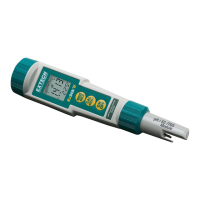
The ExStik® EC500 is a versatile handheld meter designed for measuring pH, Conductivity, Total Dissolved Solids (TDS), Salinity, and Temperature. Its dynamic cell-constant technology allows for a wide range of measurements with a single electrode, making it a reliable tool for various applications.
Function Description
The ExStik® EC500 operates by immersing its electrode into a sample. For pH measurements, the tip of the electrode is placed in the sample or makes contact with a wet surface. For Conductivity, TDS, or Salinity measurements, the electrode needs to be submerged in at least 2.5cm of the test sample. The meter features an auto-ranging capability in Conductivity, TDS, and Salinity modes, automatically adjusting to the appropriate range for the reading.
The device offers multiple measurement functions: pH, Conductivity (µS), Salinity (ppm S), TDS (ppm), and TDS (mg/l). Users can easily switch between these modes by pressing and holding the MODE/HOLD button. The display will scroll through the available units, and releasing the button at the desired unit sets the measurement function.
A key feature of the EC500 is its TDS Compensation Ratio, which determines the TDS value by multiplying a conductivity reading by a user-selectable ratio factor. This ratio can be adjusted between 0.4 and 1.0, with typical settings between 0.5 and 0.7, to suit different applications. In Salinity mode, the ratio is automatically set between 0.4 and 0.6.
The meter also includes a Data Hold mode, which freezes the current reading on the display and stores it in memory. This is activated by a momentary press of the MODE/HOLD button. Pressing it again exits the HOLD mode and returns to normal operation.
Usage Features
The ExStik® EC500 is designed for ease of use, starting with its power management. It uses four CR2032 Lithium Ion Batteries, and a 'BAT' indicator on the LCD signals when the batteries are weak. An auto power-off feature conserves battery life by shutting off the meter after 10 minutes of inactivity, though this feature can be disabled if continuous operation is required.
Before initial use or after storage, the electrode should be soaked in tap water or pH 4 buffer solution for about 10 minutes. White KCL crystals, which may appear on the cap or electrode due to storage, will dissolve during this soaking or can be rinsed away.
Calibration is crucial for accurate measurements. For pH, it's recommended to calibrate with pH 7 buffer solution first, followed by a buffer solution closest to the expected pH value of the sample. The meter supports 1, 2, or 3-point pH calibration, automatically recognizing buffer solutions (pH 4, 7, or 10). During calibration, the pH reading flashes, and upon completion, "SA" and "End" are displayed before returning to normal operation. Circled indicators (L, M, or H) on the LCD confirm completed calibrations. A "CAL" icon will appear after 15 on/off cycles without pH calibration, serving as a reminder.
For Conductivity, calibration should be performed with a standard in the expected range of the sample, preferably from low to high conductivity values for maximum accuracy. The meter recognizes standardizing solutions of 84µS/cm, 1413µS/cm, or 12.88mS/cm. This procedure also calibrates Salinity and TDS ranges, as their values are calculated from conductivity. "Range calibrated" symbols (L, M, H) appear on the display to indicate calibrated ranges.
The meter allows for storing up to 25 tagged readings. Each stored reading is assigned a location number and displayed on the lower display, with the main display showing the stored value. If more than 25 readings are stored, the oldest readings are overwritten. Stored readings can be recalled by pressing the CAL/RECALL button followed by the MODE/HOLD button, then scrolling through them with the MODE/HOLD button. The memory can be cleared by pressing and holding the ON/OFF button for 4 seconds until "clr" is displayed.
Temperature units can be switched between °C and °F. With the unit off, pressing and holding the CAL/RECALL button while momentarily pressing the ON/OFF button will change the temperature display units.
Maintenance Features
Proper maintenance ensures the longevity and reliability of the ExStik® EC500. The pH electrode life can be preserved by keeping the sponge in the protective cap soaked with tap water or pH 4 buffer solution.
The meter's design allows for easy battery replacement. The battery compartment cap twists off, and the battery carrier, holding four CR2032 batteries, can be pulled out using small tabs. It's important to observe polarity when replacing batteries. Used batteries should be disposed of at appropriate collection sites, not in household waste. Similarly, the instrument itself should be taken to a designated collection point for electrical and electronic equipment disposal at the end of its life.
Electrode replacement is also straightforward. The electrode collar unscrews, and the electrode gently rocks off. A new electrode plugs into the meter socket, ensuring proper connection, and the collar is tightened to create a good seal.
Cleaning the probe is essential, taking care not to scratch or damage the sensing or platinized electrode surfaces. Different contaminants require specific cleaning solutions and procedures:
- Water soluble substances: Soak or scrub with a soft brush in deionized water, then recondition in pH 4 or 7 buffer for 1 hour.
- Grease & Oil: Soak or scrub with a soft brush in warm water and household detergent for a maximum of 10 minutes, rinse thoroughly with DI water, then recondition in pH 4 or 7 buffer for 1 hour.
- Heavy grease & Oil: Soak in alcohol for a maximum of 5 minutes, scrub with a soft brush, rinse thoroughly with DI water, then recondition in pH 4 or 7 buffer for 1 hour.
- Lime and hydroxide coatings: Soak in 10% acetic acid until the coating dissolves (maximum 5 minutes), rinse thoroughly with DI water, then recondition in pH 4 or 7 buffer for 1 hour.
It's crucial not to soak the electrode in cleaning solutions for longer than recommended times, as this can cause a reference potential shift and degrade performance due to the non-refillable pH reference electrolyte chamber.
To ensure maximum accuracy, the electrode should be rinsed in de-ionized water between measurements to avoid cross-contamination, especially when high accuracy is required or when measuring low conductivity samples. Accumulated salt deposits from the reference electrode in the storage cap should also be rinsed away.
The meter also features a "RENEW" warning, which flashes if the probe is not performing to expected specifications (pH electrode slope below 70%). If cleaning and recalibration don't resolve this, the probe should be replaced.
In case of a frozen display, it's likely due to the Data Hold mode being inadvertently activated; pressing the MODE/HOLD button again or cycling power will resolve this. If the unit does not turn on, check for low or dead batteries, or incorrect battery polarity. If the unit becomes unresponsive to key presses, a hard reboot (removing batteries, holding ON/OFF for 5 seconds, then replacing batteries) may be necessary. Calibration data can be reset by turning off the meter, pressing and holding the CAL/RECALL and MODE/HOLD buttons, then momentarily pressing ON/OFF until "dFLt rSt" appears.



 To Next Page
 General