EasyManua.ls Logo

Falcon 350 Series - User Manual

Falcon 350 Series
4 pages
Print Icon
To Next Page IconTo Next Page
Loading...
T100699 Ref.1
E350/30
FOUR HOTPLATE RANGE
USERS INSTRUCTIONS
Falcon Foodservice Equipment
HEAD OFFICE AND WORKS
Wallace View, Hillfoots Road, Stirling. FK9 5PY. Scotland.
SERVICELINE CONTACT -
PHONE - 01438 363 000 FAX - 01438 369 900
SECTION 1 - GENERAL DESCRIPTION
SECTION 2 - CONTROLS and OPERATION
SECTION 3 - COOKING HINTS
SECTION 4 - CLEANING and MAINTENANCE
This appliance has been CE-marked on the basis of compliance with the Low Voltage and EMC Directives for
the voltages stated on the Data Plate.
IMPORTANT
This appliance must only be installed by a competent person in compliance with the regulations in
force at the time.
UK regulations are listed on the front of the Installa tion and Service Manual.
Regular servicing by a qualified person is recommended to ensure the continued safe and efficient
performance of the appliance.
WARNING - THIS APPLIANCE MUST BE EARTHED!
Upon receipt of this manual, the installer should instruct a responsible person (or persons) as to the correct
operation and maintenance of the unit.
This equipment is designed FOR PROFESSIONAL USE ONLY and be operated by QUALIFIED persons. It is
the responsibility of the supervisor or equivalent to ensure that the user wears SUITABLE PROTECTIVE
CLOTHING. Attention should also be drawn to the fact that some parts of the appliance will, by necessity,
become VERY HOT and could cause burns if touched accidentally.
WEEE Directive Registration No. WEE/DC0059TT/PRO
At end of unit life, dispose of appliance and any replacement parts
in a safe manner, via a licenced waste handler.
Units are designed to be dismantled easily and recycling of all
material is encouraged whenever practicable.
Question and Answer IconNeed help?

Do you have a question about the Falcon 350 Series and is the answer not in the manual?

Overview

This document provides user instructions for the Falcon E350/30 Four Hotplate Range, a piece of foodservice equipment designed for professional use.

Function Description

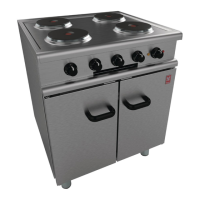
The Falcon E350/30 is a four-hotplate range that is part of the Falcon 350 series of modular equipment. This series features units with either 350mm or 700mm dimensions, allowing for the installation of matching equipment suites. While some models in the series are designed for counter mounting, the E350/30 range and its integrated oven are floor-standing units.

The appliance is equipped with four identical circular hotplates, each controlled by a six-heat switch. These hotplates feature an inbuilt cut-out mechanism that automatically reduces heat input if the plates are left uncovered at a high switch setting. The oven component is thermostatically controlled, with an amber neon lamp indicating when current is being supplied to its elements. This neon extinguishes once the selected temperature is reached. A red neon on the control panel indicates that electricity is being supplied to the appliance (i.e., the isolating switch is ON and the unit is ready for use).

The E350/30 is designed for professional use only and should be operated by qualified personnel. Supervisors are responsible for ensuring users wear suitable protective clothing, as some parts of the appliance will become very hot and can cause burns if touched accidentally.
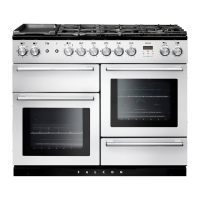
Important Technical Specifications

  • Model: E350/30 Four Hotplate Range
  • Series: Falcon 350 series
  • Dimensions: Modular, either 350mm or 700mm for suite compatibility.
  • Hotplates: 4 identical circular hotplates
  • Hotplate Control: Six-heat switches for each hotplate (settings 1 to 6, 1 being lowest, 6 being maximum).
  • Oven Control: Thermostatically controlled, knob marked in degrees centigrade (°C).
  • Oven Shelves: Two grid shelves provided, with 5 shelf positions. When using two shelves, they must be spaced at least two runners apart (e.g., positions 2 & 4, with 1 at the top).
  • Oven Tray Size: Accepts standard Gastronorm flanged trays up to size 1/1 (placed sideways). Alternatively, ordinary trays up to 490mm x 400mm can be used. Larger trays should not be used as they may impair heat circulation. Trays should be centrally disposed on shelves.
  • Electrical Indicators: Red neon for overall power supply, amber neon for oven element power.
  • Compliance: CE-marked in compliance with Low Voltage and EMC Directives for voltages stated on the Data Plate.
  • WEEE Directive Registration: WEE/DC0059TT/PRO

Usage Features

Hotplates:

  • For efficient operation, good contact between hotplates and utensils is crucial.
  • Ground-based pots should be used, and the plate surface must be clean.
  • For maximum efficiency, the pot diameter should match that of the plate. Very small or very large pots should be avoided to conserve fuel.
  • Spillage should be cleaned immediately to prevent burning on and becoming difficult to remove.

Oven:

  • Pre-Heating: Allow at least 40 minutes for the oven to heat up from cold, regardless of the temperature setting.
  • Food should be inserted quickly, and doors closed firmly.
  • Avoid leaving oven doors open for prolonged periods while the oven is on.
  • Temperature Settings (Thermostat Knob in °C):
    • 100 to 125: Slow
    • 125 to 175: Moderate
    • 175 to 200: Fairly Hot
    • 200 to 230: Hot
    • 230 to 250: Very Hot

Cooking Hints (Roasting Meat - High Temperature Method):

  • High temperature (quick) roasting times are for average requirements and may vary based on meat quality and shape.
    • Beef (on the bone): 15 mins per 0.5kg (1lb)
    • Beef (no bone): 20 mins per 0.5kg (1lb)
    • Mutton and Lamb: 20 mins per 0.5kg (1lb)
    • Veal and Pork: 25 mins per 0.5kg (1lb)
    • Chicken: 45 to 90 mins (according to size and age)
    • Goose, Duck, Turkey: 15 mins per 0.5kg (1lb) + a further 15 mins

Cooking Hints (Roasting Meat - Low Temperature Method):

  • Low temperature (slow) roasting requires longer cooking but reduces weight loss and achieves more even cooking, suitable for less tender joints.
    • Beef (on the bone): 20 mins per 0.5kg (1lb)
    • Beef (no bone): 30 mins per 0.5kg (1lb)
    • Mutton and Lamb: 30 mins per 0.5kg (1lb)
    • Veal and Pork: 35 mins per 0.5kg (1lb)
    • Chicken: 60 to 120 mins (according to size and age)
    • Goose, Duck, Turkey: 20 mins per 0.5kg (1lb) + a further 15 mins

Average Cooking Times and Settings (Oven pre-heated for 40 minutes):

  • Roast (quick): Setting 230, Runner Position 3 for single shelf, Time according to weight.
  • Roast (slow): Setting 175, Runner Position 3 for single shelf, Time according to weight.
  • Poultry (slow): Setting 175, Runner Position 3 & 5 for two shelves, Time according to weight.
  • Braising: Setting 165, Runner Position 3 & 5 for two shelves, Time 30 per 0.5kg (1lb) + 30.
  • Casseroles: Setting 135, Time 90-180 minutes.
  • Pastry (Fruit Pies): Setting 230, Runner Position 2 for single tray, Time 30-40 minutes.
  • Pastry (Plate Pies): Setting 230, Runner Position 2 for single tray, Time 40-50 minutes.
  • Pastry (Puff/Rough Puff): Setting 245, Time 10-15 minutes.
  • Pastry (Sausage Rolls): Setting 245, Runner Position 2 & 4 for two trays, Time 20-25 minutes.
  • Pastry (Scones): Setting 250, Time 10-15 minutes.
  • Puddings (Custard): Setting 160, Time 40-60 minutes.
  • Puddings (Milk): Setting 150, Runner Position as for Pastry, Time 45-90 minutes.
  • Puddings (Yorkshire Pudding): Setting 245, Time 40-50 minutes.
  • Cakes (Slab Cake Rich): Setting 150, Runner Position 5, Time 5 minutes.
  • Cakes (Slab Cake Plain): Setting 160, Runner Position 5, Time 5 minutes.
  • Cakes (Queen Cakes): Setting 195, Runner Position as for Pastry, Time 15-20 minutes.
  • Cakes (Sponge Sandwich): Setting 195, Runner Position as for Pastry, Time 20-25 minutes.
  • Cakes (Very Rich Cakes Christmas): Setting 150, Runner Position 5, Time 15-25 minutes.
  • Bread Rolls: Setting 245.

Baking on One Shelf:

  • For small quantities of cakes, scones, etc., position the grid shelf on Runner 2 or 3.

Baking on Two Shelves (Small Cakes etc.):

  • For larger quantities, use runners 2 and 4.
  • Normally, the top tray should be removed first, and the lower tray moved up to the vacated top position.
  • Milk puddings and Yorkshire puddings can be cooked on two shelves simultaneously, potentially interchanging halfway through cooking.

Baking Large Cakes:

  • For large fruit cakes in tins, two shelves can be used. It is advisable to interchange the upper and lower tins halfway through the estimated cooking time to ensure even cooking and reduce overcooking/undercooking.

Maintenance Features

Caution:

  • Before cleaning, switch off the appliance at the isolating (main) switch.
  • Allow the appliance to cool before cleaning.
  • Clean with a detergent/water solution, rinse, and thoroughly dry.
  • Stubborn stains can be removed with nylon or scotch pads, but exercise care on stainless steel surfaces.
  • Never use harsh abrasives on stainless steel or vitreous enamelled finishes.
  • Do not clean with a jet of water or steam.

Oven Cleaning:

  • The oven base plate is removable.
  • The shelf support runners are also removable: lift upwards to release lower fixings, move the bottom of the runner slightly inwards towards the oven centre, then drop the runner to release top locations. Ensure correct orientation when refitting.

Important Note on Cleaners:

  • Do not use proprietary cleaners, especially those with high caustic content, on vitreous enamelled surfaces (facia panel, drip tray, flue upstand, and upper door surfaces). This is particularly important when the appliance is hot. Such cleaners can cause serious damage or discoloration to the enamel finish. Only a soap or detergent solution should be used.

Installation and Servicing:

  • This appliance must only be installed by a competent person in compliance with current regulations.
  • Regular servicing by a qualified person is recommended to ensure continued safe and efficient performance.
  • The appliance MUST BE EARTHED.
  • Upon receipt of the manual, the installer should instruct a responsible person on correct operation and maintenance.

End of Life Disposal:

  • At the end of its unit life, dispose of the appliance and any replacement parts safely via a licensed waste handler.
  • Units are designed for easy dismantling, and recycling of all materials is encouraged.

Contact Information:

  • Head Office and Works: Wallace View, Hillfoots Road, Stirling, FK9 5PY, Scotland.
  • Serviceline Contact:
    • Phone: 01438 363 000
    • Fax: 01438 369 900

Falcon 350 Series Specifications

General IconGeneral
BrandFalcon
Model350 Series
CategoryRanges
LanguageEnglish

Related product manuals