- 2 -
1. System Description.
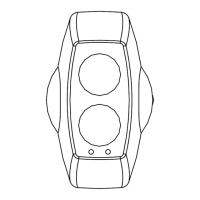
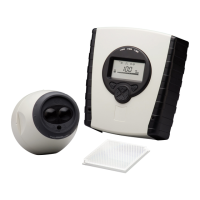
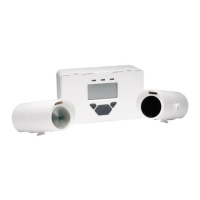
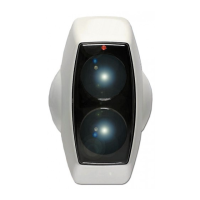
The Detector comprises a Transmitter and Receiver contained within one enclosure.
The Transmitter emits an invisible infrared light beam that is reflected via a prism(s) mounted directly opposite
and with a clear line of sight. The reflected infrared light is detected by the Receiver and analysed.
The Detector has a maximum lateral detection defined by the local National Standard. As a guide a common
lateral distance of 7.5m will be used in this guide. Use the latest beam detector standards EN54 part 12, VdS
2095 or BS5839 part 1 for further guidance.
The optimal beam distance from the ceiling will be between 500mm and 600mm, again the Local National
Standard will give guidance.
2. System Operation.
Smoke in the beam path will reduce the received infrared light proportionally to the density of the smoke. The
Detector analyses this attenuation, or obscuration of light, and acts accordingly.
Alarm thresholds of 12%, 25%, 35%, and 50% can be selected to suit the environment, where 50% is the least
sensitive. If the received infrared signal reduces to below the selected threshold and is present for
approximately 10 seconds, the Alarm relay is activated, and the Alarm Led illuminates.
There are two modes to the operation of the Alarm relay : Auto Reset and Alarm Latching. Auto reset mode will
reset the Alarm relay, and Alarm LED, 5 seconds after the received infrared signal has recovered to a level
above the alarm threshold. Latching mode holds the Alarm relay, and Alarm LED, active indefinitely after an
alarm condition has occurred. There are two methods to clear the latched mode.
1) Place the beam into Prism Targeting or Alignment Mode, and then go back to Run Mode.
2) Remove power to the beam. Power must be removed from the Detector for 10 seconds.
If the infrared beam is obscured rapidly to a level of 93%, or greater, for approximately 10 seconds the Fault
relay is activated. The Fault LED will also illuminate. This condition can be entered in a number of ways, for
example, an object being placed in the beam path, transmitter failure, loss of the prism(s), sudden misalignment
of the Detector, or the received signal becomes too high. The Fault relay will reset within 5 seconds of the
condition being rectified.
The Detector monitors long term degradation of signal strength caused by component ageing or build up of dirt
on optical surfaces. This operates by comparing the received infrared signal against a reference signal every 15
minutes; differences of less than 4.7%/Hour are corrected automatically. When the detector is showing AGC
fault (Fault LED flashing once in every two seconds), the detector will still operate correctly indicating Alarm
conditions as normal. Realignment of the beam may be necessary if AGC fault occurs.
3. Detector Positioning.
It is important that the Detector is positioned correctly to minimise the detection time.
Experiments have shown that smoke from a fire does not rise directly upwards, but fans out or mushrooms due
to air currents and heat layering effects. The time to signal a fire condition depends on the location of the
Detector within the premises, the volume and density of smoke produced, construction of the roof, ventilation
arrangements and airflow within the detection area.
Smoke layering, where smoke does not reach the ceiling level due to layers of static hot air, is overcome by
mounting the Detector/Prism(s) at the recommended height below the ceiling (see section 1). This brings the
infrared beam below the heat layer and into the smoke layer. However, if there are objects below the ceiling
that could obscure the beam path, the detector/prism(s) positioning may need to be adjusted.
It is recommended that a beam path clearance radius of 0.5 metres be employed.
Refer to the Detector minimum spacing graph on page 3 for detection under flat ceilings.


 To Next Page
 Loading...