4
1 Functional description of balanced
ventilation
1.1 Fans (M1, M2)
The fans ensure that air enters and leaves the building.
They can be individually adjusted for optimal operation.
The unit can be regulated at three different speeds via the
control panel: Min, Normal and Max. See chapter 5.1 for more
information.
1.2 Filters (FI1, FI2)
Filters with a high filter grade (ePM1 55% F7) are used as
standard for both supply air and extract air so that the air
which enters the building is clean. The filters also ensure that
the unit stays clean and can maintain thermal efficiency and
air flow.
1.3 Rotor (
HR-R)
The air passes through the rotary wheel-type heat
exchanger (recovery). The rotor functions as a heat
magazine. The heat from the extract air heats up one part of
the rotor. When the heated part comes over to the supply
air side, the heat is transferred to the supply air.
1.4 Heating element (EB1) (for UNI 2 E)
If the energy recovered from the extract air is insufficient to
maintain the set supply air temperature, an electric heating
element will help raise the temperature. The heating element
is protected against overheating by the thermostat (F20)
which cuts out at high temperature. For extra safety, the
thermostat (F10) cuts out at critical temperatures. If the
thermostat (F10) is tripped, it has to be reset manually by
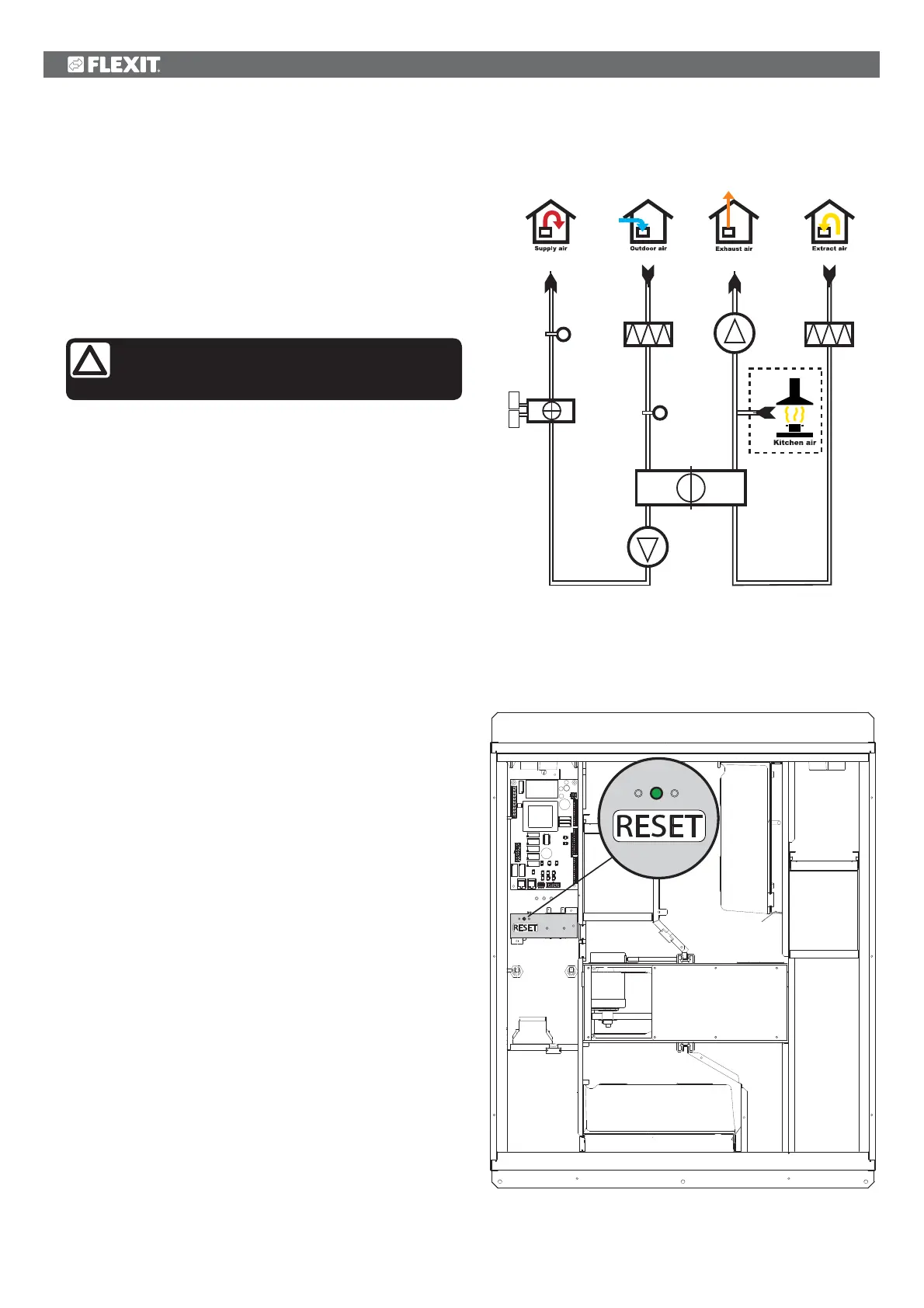
pressing the reset button (see Fig. 2). If the alarm is tripped
repeatedly, contact the service company or distributor. See
chapters 4.7 and 7.10 for more information.
1.5 Temperature sensors (B1, B4)
The unit has two temperature sensors as standard. The
supply air sensor (B1) registers the temperature after the
heating battery. The outdoor air sensor (B4) registers the
temperature of the outdoor air.
Fig. 1
Fig. 2
Adjustment must always be carried out by
qualified staff before the installation is used for
the first time.
B1
EB1
F10
F20
M4
HR-R
FI2
FI1
B4
M1
K
M2


 To Next Page