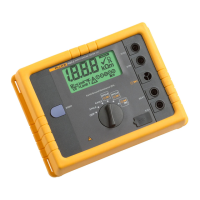
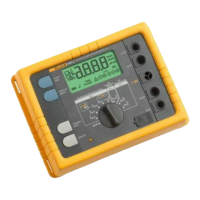
1625
Users Manual
78
Measuring Method
The current voltage measuring method is based on the block diagram circuit
shown in the figure below.
U meas.
V
G
I
E
ES
S
E
S
R
S
R
E
U
E
I
H
H
R
H
edw057.eps
An AC generator G feeds current I via earth electrode E (earth electrode resis-
tance R
E
) and auxiliary earth electrode H (auxiliary earth electrode resistance
R
H
).
Voltage U
E
drops on earthing resistance R
E
(U
E
proportional to R
E
.) This volt-
age is picked up and measured by probe S. With the so called three wire cir-
cuit, the instrument sockets E and ES are connected to each other. In a four
wire circuit an separate cable is used to connect socket ES with the earth elec-
trode.
With that, the voltage drop of the cable between socket E and earth electrode is
not measured. As the voltage measuring circuit has such a high impedance, the
influence by the probe resistance R
S
is neglectable within certain limits.
Thus the earthing resistance evolves
1
Meas
E
U
R =
and is independent from the resistance of the auxiliary earth electrode R
H
. The
generator runs at a frequency between 70 and 140 Hz.
It has to hold a minimum distance of 5 Hz to one of the nominal frequencies
between 16 2/3, 50 or 60 Hz and their harmonic waves. A frequency selective
filter adjusted to the generator frequency is inserted.



 To Next Page