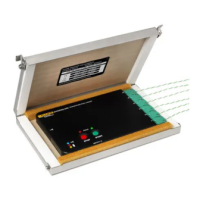
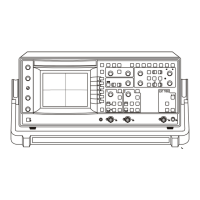
The RUSKA 2465A-754 Gas Piston Gauge is a pneumatic pressure standard designed for accurate generation and measurement of gas pressures up to 1000 psi. It operates on the fundamental pressure equation PRESSURE = FORCE / AREA, using carefully determined masses applied to a piston of known area to produce a calculable pressure. This gauge is a precision measuring device within the RUSKA Gas Lubricated Piston Pressure Gauge System.
A primary feature of the gauge is its ability to accurately reproduce performance at lower pressures. The low viscosity of the gas provides excellent lubrication for the close-fitting piston/cylinder assembly. Relative motion between the piston and cylinder, achieved by an electric motor, distributes gas molecules throughout the annulus, minimizing friction and contributing to the gauge's high reputation.
The gauge can measure either absolute pressures or those referenced to the atmosphere. It is equipped with a bell jar, which, when placed over the weights, allows for the reduction of external reference air pressure to 100 microns Hg (mercury) at 0 °C. The nominal operating pressure range is from 1.4 kPa (0.2 psi) to 4.8 mPa (1000 psi). This range is covered by three interchangeable piston/cylinder assemblies, ensuring sufficient overlap for continuity of measurement and detailed investigations of subintervals. The gas lubricated piston pressure gauge is widely used as a standard for calibrating transducers, Bourdon-tube type gauges, manometers, and other dead weight gauges.
Technical Specifications:
Low Range Piston:
- Pressure Range (Model 2465): 1.4 to 172 kPa (0.2 to 25 psi) absolute, gauge or negative gauge.
- Pressure Range (Model 2468): 1.4 to 345 kPa (0.2 to 50 psi) absolute, gauge or negative gauge.
- Pressure Uncertainty Rating: 0.0010% RDG (10 ppm) or 0.07 Pa (1.0E-05 psi), whichever is greater (approximate 95% level of confidence).
- Uncertainty Threshold: 7 kPa (1 psi).
- Resolution: 1 ppm or 1 mg, whichever is greater.
- Precision (Typical Type A Unc.): 2 ppm.
- Long Term Stability: 1 ppm per year.
- Piston/Cylinder Material: 440C Stainless Steel/Tungsten Carbide.
- Thermal Coefficient: 1.5E-05 per deg. C.
- Maximum Sink Rate (Model 2465 at Max Pressure): 3.8 mm/minute (0.15 in/minute).
- Maximum Sink Rate (Model 2468 at Mid Pressure): 1.27 mm/minute (0.05 in/minute).
Lower Mid Range Piston:
- Pressure Range (Model 2465): 12 to 700 kPa (1.7 to 100 psi) absolute or gauge.
- Pressure Range (Model 2468): 12 to 1380 kPa (1.7 to 200 psi) absolute or gauge.
- Pressure Uncertainty Rating: 0.0010% RDG (10 ppm) or 0.28 Pa (4.0E-05 psi), whichever is greater (approximate 95% level of confidence).
- Uncertainty Threshold: 27.6 kPa (4 psi).
- Resolution: 1 ppm or 1 mg, whichever is greater.
- Precision (Typical Type A Unc.): 2 ppm.
- Long Term Stability: 1 ppm per year.
- Piston/Cylinder Material: Tungsten Carbide/Tungsten Carbide.
- Thermal Coefficient: 9.1E-06 per deg. C.
- Sink Rate at Maximum Pressure (Model 2465): 3.8 mm/minute (0.15 in/minute).
- Sink Rate at Mid Pressure (Model 2468): 1.27 mm/minute (0.05 in/minute).
Upper Mid Range Piston:
- Pressure Range (Model 2465): 14 to 3500 kPa (2 to 500 psi) absolute or gauge.
- Pressure Range (Model 2468): 14 to 7000 kPa (2 to 1000 psi) absolute or gauge.
- Pressure Uncertainty Rating: 0.0026% RDG (26 ppm) or 2.8 Pa (4.0E-04 psi), whichever is greater (approximate 95% level of confidence).
- Uncertainty Threshold: 110 kPa (16 psi).
- Resolution: 1 ppm or 1 mg, whichever is greater.
- Precision (Typical Type A Unc.): 2 ppm.
- Long Term Stability: 1 ppm per year.
- Piston/Cylinder Material: Tungsten Carbide/Tungsten Carbide.
- Thermal Coefficient: 9.1E-06 per deg. C.
- Sink Rate at Max Pressure (Model 2465): 3.8 mm/minute (0.15 in/minute).
- Sink Rate at Mid Pressure (Model 2468): 1.27 mm/minute (0.05 in/minute).
High Range Piston:
- Pressure Range: 14 to 7000 kPa (2 to 1000) absolute or gauge.
- Pressure Uncertainty Rating: 0.0026% RDG (26 ppm) or 2.8 Pa (4.0E-04 psi), whichever is greater (approximate 95% level of confidence).
- Uncertainty Threshold: 248 kPa (36 psi).
- Resolution: 1 ppm or 1 mg, whichever is greater.
- Precision (Typical Type A Unc.): 2 ppm.
- Long Term Stability: 1 ppm per year.
- Piston/Cylinder Material: Tungsten Carbide/Tungsten Carbide.
- Thermal Coefficient: 9.1E-06 per deg. C.
- Sink Rate at Max Pressure (Model 2465): 3.8 mm/minute (0.15 in/minute).
Mass Set:
- Approximate Total Mass (Model 2465): 6.31 kg.
- Approximate Total Mass (Model 2468): 12.31 kg.
- Approximate Carrier Mass: 0.1 kg.
- Smallest Increment: 10 gram.
- Mass Material: 300 Series, Non-magnetic, Austenitic, Stainless Steel (low mass carrier and plate may be of other non-magnetic material).
- Adjustment Method: Completely machined with no fill cavities.
- Mass Uncertainty: 0.0005% (5 ppm) or 5E-07 kg, whichever is greater.
- Optional Fine Increment Trim Set: ASTM Class 1, 20g to 1 mg.
Temperature Range:
- Operating: 18 °C to 28 °C.
- Storage: -40 °C to 70 °C (limited by dissimilar metals of Low range Piston/Cylinder).
Humidity Range:
- Operating: 20% to 75% non-condensing.
- Storage: 0% to 90% non-condensing.
Pressure Medium:
- Clean dry gas, Nitrogen or equivalent, regulated to a Pressure Compatible with each particular piston/cylinder assembly. Dew Point of less than or equal to -51 °C (-60 °F).
Maximum Working Pressure:
- 2465 with High Range Piston/Cylinder: 7000 kPa (1000 PSIG).
- 2465 with Upper Mid Range Piston: 3500 kPa (500 PSIG).
- 2465 with Low Range Piston/Cylinder: 700 kPa (100 PSIG).
- 2465 with Lower Range Piston/Cylinder: 172 kPa (25 PSIG).
- 2468 with Upper Mid Range Piston: 7000 kPa (1000 PSIG).
- 2468 with Lower Mid Range Piston/Cylinder: 1380 kPa (200 PSIG).
- 2468 with Low Range Piston/Cylinder: 345 kPa (50 PSIG).
Power Requirements:
- 2465A-754 (DWG base): 15 watts, 115 VAC or 230 VAC; 50 or 60 Hz.
Usage Features:
The gauge should be installed in a room with a stable temperature between 18 °C and 28 °C, free from excessive personnel traffic, air drafts, and airborne dust. The base must be level and secure on a sturdy work surface capable of supporting fifty pounds without deflecting. Leveling is achieved by adjusting two screws until the bubble in the level vial is centered.
The motor unit can operate on either 115 VAC or 230 VAC, 50 or 60 Hz. The voltage selector is located on the power inlet module. Fuses (3AG Slo-blo 1/4 Amp) must be correctly installed based on local power supply conditions. An optional electronic thermometer probe can be inserted into a dedicated hole on the back left side of the base, with heat sink compound recommended for faster response. If a glass thermometer is preferred, it screws into a 1/4 NPT hole on the right-hand side of the 2465-12 Assembly.
Safety Precautions:
- Do not overpressure the piston.
- Avoid rapid pressure changes; use a metering valve for flow control. Maximum rate is 0.7 MPa (100 psi) per minute.
- Ensure the retaining ring of the high-pressure piston is securely in place before operation.
- Do not operate the gauge with a dirty or sticky piston.
- Avoid rotating pistons against upper or lower stops longer than necessary, as bearings are not lubricated.
- Handle gauge parts, especially pistons and cylinders, with extreme care due to small tolerances. Use cotton gloves to prevent acid etching from fingerprints.
- Pistons and cylinders are matched assemblies; each piston operates only in its particular cylinder.
- Stop operation immediately if any metal-to-metal contact sound is heard, as this can cause damage.
- Always provide the instrument's serial number when ordering replacement parts.
- The circular weight-loading table of the Low Range Piston must never enter the cylinder bore. Handle the assembly with a firm grasp on the weight loading table until it is in the housing.
- The Low Range Piston/Cylinder (2460-5) must be assembled with the O-Ring relief on the cylinder in the downward position.
- Do not use oxygen as the pressure supply media; use only dry, clean nitrogen. Do not exceed specified maximum inlet pressures for each piston/cylinder type.
- Do not use hydrocarbon lubricants; use only Fluke-supplied lubricant (Dupont Krytox 240 AA Grease or Krytox 143 AZ Fluorinated Oil).
- Turn off power and remove the power cord before any maintenance.
- Ultrasonic cleaning may damage the crystalline structure of tungsten carbide pistons and cylinders; follow Fluke's cleaning procedures.
- Do NOT turn the voltage select wheel while it is in place within the fuse compartment; always remove it first.
- Always remove the thermometer before shipping the gauge base.
Establishing Gauge Pressures:
Pressure should be admitted slowly, preferably through a metering valve. A pressure adjusting pump (e.g., RUSKA 2465A-800 Manual Pressure Controller) is convenient. A reading can be taken when the piston is floating (suspended on a gas cushion between piston stops), not oscillating, and the system is at equilibrium.
When sufficient weights are on the piston, they can be rotated slowly by hand opposite to the cylinder's rotation. The weights will eventually rotate with the cylinder. Rotating them against the cylinder's motion allows the operator to observe any irregularities. Quick rotation with the cylinder indicates a dirty piston and cylinder. The motor should be used only when necessary; once weights gain momentum, the motor can be turned off to reduce heat generation.
Maintenance Features:
Routine maintenance includes lubricating O-Rings (54-703-006) on the Vacuum Seal Assembly (2465-14) and Cylinder Housing Assembly (2460-65) every six weeks with Dupont Krytox 240 AA Grease (45-339). Replace O-Rings if leakage occurs.
To lubricate/replace the O-Ring Rotary Seal on the Cylinder Housing, remove shoulder screws (71-103), pull the O-Ring holder, unscrew the packing nut (2460-4-15), lubricate/replace the O-Ring, and reassemble.
For drive gear shaft O-Ring seal lubrication or drive gear lubrication, remove hex head screws from the Gear Support (2460-4-19), loosen the hub clamp (13-485), and pull the drive gear shaft. Lubricate drive gears with a mixture of Dupont Krytox 240 AA Grease and molybdenum disulfide.
Vacuum Seal (2460-14), Packing Nut, and O-Rings are only needed if a vacuum reference pressure is used.
Ball Bearings (5-144) should be cleaned and lubricated with one drop of DuPont Krytox 143 AZ Fluorinated Oil whenever the gauge is disassembled.
Do NOT lubricate the lower thrust bearing (2460-4-25) or the upper thrust bearing (2460-5-6); clean them with acetone or high-grade alcohol if dirty.
Power fuses (3AG Slo-blo 1/4 Amp, part #26-222) are located in the power-in receptacle on the side of the Motor Case Assembly (2465-15) and should be replaced if necessary.
Piston/Cylinder Cleaning Instructions:
Cleaning is required when the piston/cylinder assembly is dirty or sticky. This involves partial disassembly and careful handling to prevent exposure to dirt, corrosive fingerprints, or accidental drops.
Cleaning Supplies: Solvent (high-grade alcohol or acetone), low-lint paper wipers (Kimberly Clark, Kimwipes number 34155), cleaning tools (2460-56 for Low Range, 2460-70-5 for Mid Range), wooden applicator sticks (Puritan number 807-12), Cashmere Bouquet brand hand soap, bottle brushes (RUSKA part number 7-682 for Low Range, 7-681 for Mid Range, 7-680 for 35 Bar and High Range), size 0 rubber stopper (RUSKA part number 81-536), and warm tap water.
Procedure:
- Prepare a clean work area near a running tap water source.
- Prepare folded wipers for wiping the outside of the piston and cylinder, and twisted wipers for cleaning the cylinder bore.
- Disassemble the piston/cylinder assembly.
- Pre-clean parts with solvent-soaked wipers.
- Scrub the cylinder bore with a soft bottle brush, soap, and warm water. Rinse thoroughly and dry immediately with pre-folded wipers.
- Scrub the piston exterior with a soft paper wiper, soap, and warm water. Rinse thoroughly and dry immediately.
- Allow piston and cylinder to set for about 15 minutes before reassembly.
- Clean thrust bearings, cylinder containers, and retaining rings with solvent-soaked wipers.
- Inspect O-rings for damage and replace if necessary. Apply a slight amount of lubricant to O-rings and wipe off excess.
- Carefully insert the piston into the cylinder (O-ring groove downward for Low Range, narrow neck upward for others), allowing it to sink freely. Do not force.
- If lint is an issue, use a clean dry gas source to blow it off.
- Install thrust bearings and retaining clips as specified for each piston type.
- Install the assembly into the instrument base and perform functional testing.

 Need help?
 General

 To Next Page