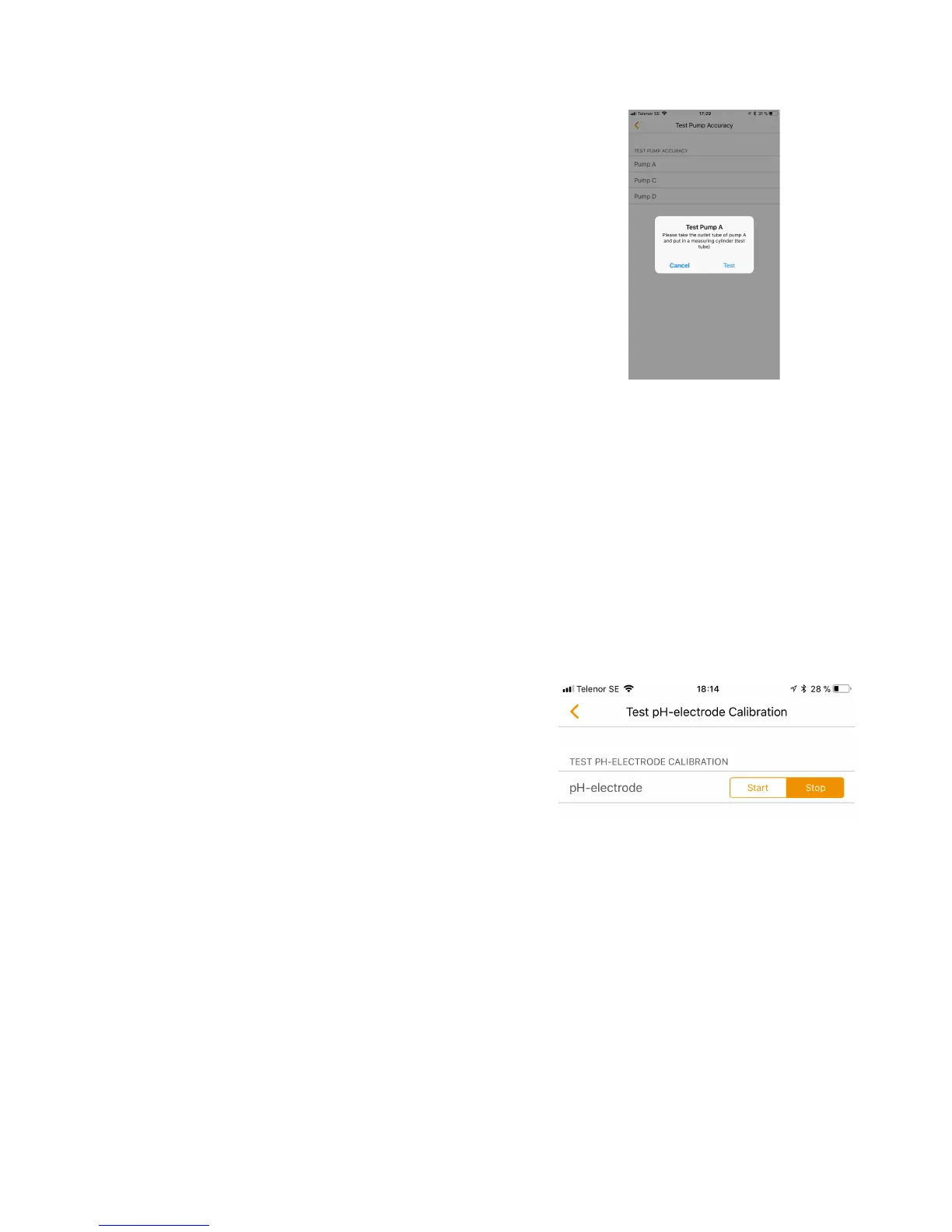
Test pump accuracy
This function allows you to control the calibration status of
the pump, for instance to help decide if there is a need to
recalibrate the pump."
"
When you press this button, test pump accuracy, you test(
the accuracy of the latest calibration of pump A, C or D.(
Before pressing the button to start the test, take out the(
pipe from the probe holder from the pump you want to(
check, and place that pipe in a proper measure cylinder.(
Then press ”test pump (A,C,D)” of the pump you aim to(
test, and the pump will start and stop after a certain(
time. Read the delivered volume in the test vial. Ideally, the
delivered fluid volume should be the following: "
# #"
• Pump A:49.5-50.5 ml"
• Pump C:9.9-10.1 ml "
• Pump D:9-11 ml "
If the delivered volume deviates from the above intervals, go to calibrate and
recalibrate that pump! (
"
Test pH-electrode accuracy
If you correctly calibrate the electrode every 6
months, you should rarely need this function.
(
When you press this button, test pH-electrode
accuracy and then push start, you will see a
continuous pH reading on the LCD screen. (
You can now easily check if the pH electrode is accurate or needs recalibration.
Carefully rinse the electrode in RO or distilled water, wipe it off, and place it in a
solution with a known pH. Then compare the expected value with the reading on the
LCD. "
This function will help you decide if there is a need to recalibrate the pH electrode. If
you correctly calibrate the electrode every 6 months, you should rarely need
this function.
LCD-Screen
On the LCD-screen there is some basic info. Between measurements the machine is
in standby mode and will always show the last measured dKH-value, when the next


 To Next Page