4746
Carefully study the basics of safety and the rules of cycling before you drive. If you purchased
a bicycle for a child, explain the rules of the road and safety to him\her and make sure that the
child understands everything and can operate the bicycle.
Always wear a helmet, glasses and gloves.
— Regardless of your experience or riding style, always wear a helmet. Its use reduces the risk
of injury in the event of a trafc accident. It is important to choose a helmet that is comfortable
and suitable in size.
— Glasses protect your eyes from dust and insects.
— Gloves will make cycling more comfortable and protect your hands when dropped.
Use suitable clothing.
Your clothes should be comfortable. It is necessary to choose t-body clothes.wide trouser-leg
can catch on the cranksets or get stuck between chain and stars. A wide jacket can catch on the
handlebar or saddle. Shoes should have tenacious sole, non-slip on the pedals.
Follow the rules of the road.
Most states and regions have their own specic rules for cyclists. Therefore, you must know and
comply with the Rules of the road and other state and local laws that regulate trafc safety.
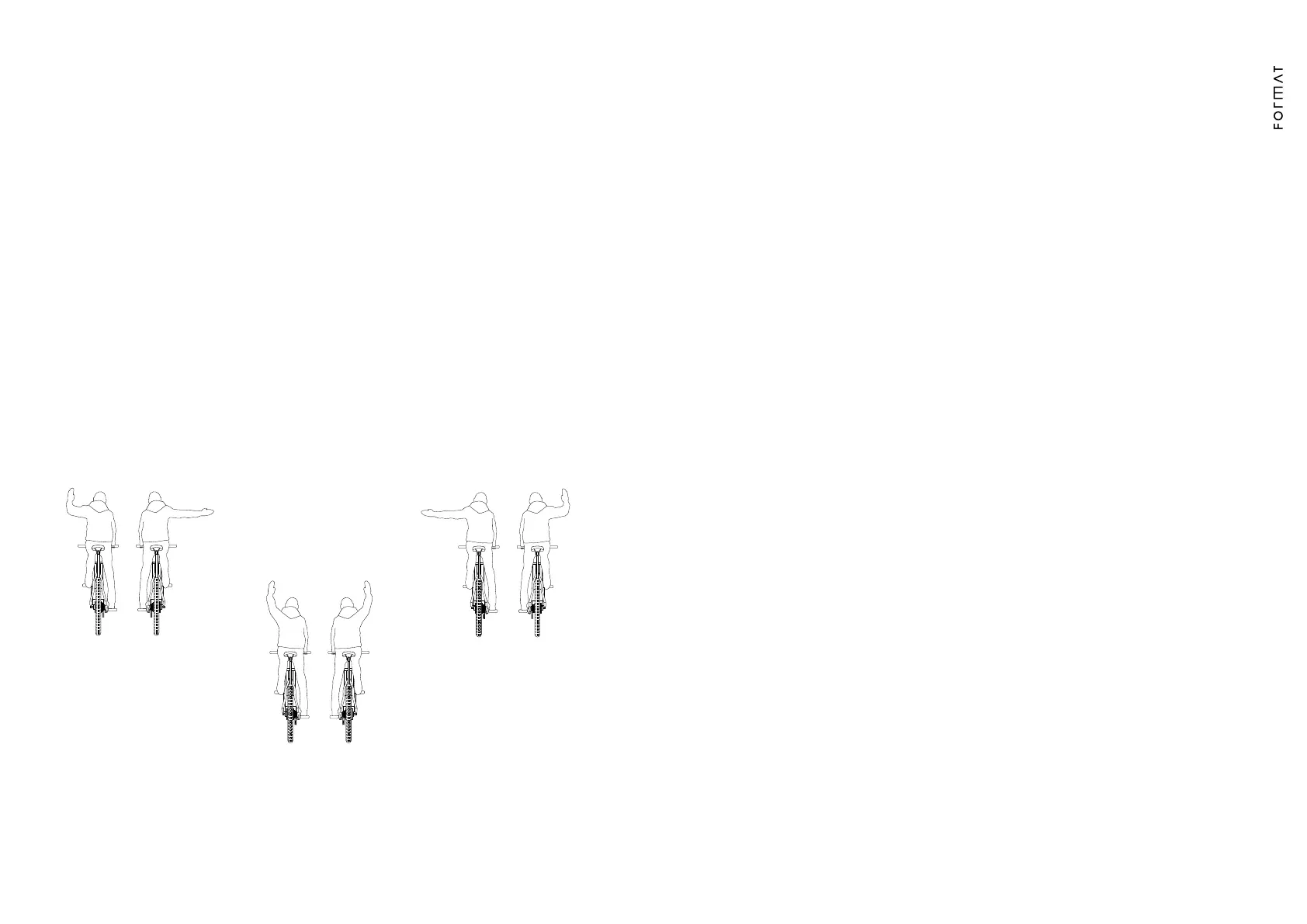
Use appropriate manual signals.
SAFETY
Never drive against trafc.
Depending on which trafc in the country — right-hand or left-hand — you should go along the
right or left lane.
Drive along the highway in a column.
If you are traveling in a group, move along the highway in a column.
Be careful when driving off-road.
Wear protective clothing, including a helmet, goggles, and gloves. Make sure that passage
is allowed in this place. Not all parks and private estates are open to cyclists. Riding on the
ground is dangerous due to stumps, stones, potholes and so on. Avoid rocks, twigs, hollows.
On the descent, slow down by moving the body weight back and down; it is preferable to use
the rear brake.
Use the bike for its intended purpose.
— Improper use of the bicycle may result in damage to the frame or components and, as a
result, to injuries. At the same time, the use of the bicycle for other purposes leads to the refusal
of warranty repairs.
— If your bike is classied as road, city, cruiser, do not use it to travel on rough terrain, where
there is no asphalt or dense dirt.
— Trekking and lady mountain bicycles are designed for comfortable riding in parks and forest
paths. These bikes involve walking at a walking pace, do not use them to ride on extreme tracks.
— If your bike is designed for sports skiing (XC, all terrain, trail, cyclocross, 4x, BMX), you can
condently use it for riding on the appropriate tracks: on rough terrain, special cross-country
tracks, in extreme parks, pamp-tracks and so on.
— Relate your capabilities to the complexity of the route and avoid hazardous areas. No matter
how high your skill level is, remember that cycling is a potentially traumatic activity. Do not
forget about protective equipment, do not overestimate your capabilities, be vigilant.
Remember about other road users
You should always be aware of potential problems and be prepared for unforeseen situations.
A bicycle is less visible on the road than a car. Warn others about your approach and be
extremely careful.
Keep track of the road.
Be careful, pits, drainage ditches, curbs and other unexpected obstacles can meet on the road.
When approaching tram or train tracks, slow down. Cross the rails at a right angle. If you are
unsure of how to safely overcome the obstacle, get off the bike and drive alongside it.
Use the brakes carefully.
Always keep a safe distance when stopping in front of other vehicles or objects. The braking
force must correspond to the condition of the track and weather conditions. Press both brakes at
the same time, avoid too high pressure of the front brake. Remember that the brake levers on the
Handlebar are responsible for the correspond¬ing brakes: the brake lever on the right is for the
rear brake, on the left is the front brake.
Be careful when driving in wet weather.
Any brakes, regardless of their type and design features, cannot work in wet weather as
effectively as in dry weather. In wet weather, the brakes, even in good condition, properly
adjusted and lubricated, require more lever pressure. The braking distance in such weather is
longer, and it will take longer to stop. In addition, wet weather degrades visibility (for you and
drivers) and reduces traction. Slow down corners on wet roads. Slippery leaves and manhole
covers are also dangerous.
Turn right Turn left
Breaking


 To Next Page
 Loading...