23
WWW.FORNEYIND.COM
The following is a troubleshooting table provided to help you determine a possible remedy when you are having a
problem with your welder.
This table does not provide all possible solutions, only those possibilities considered likely to be common faults.
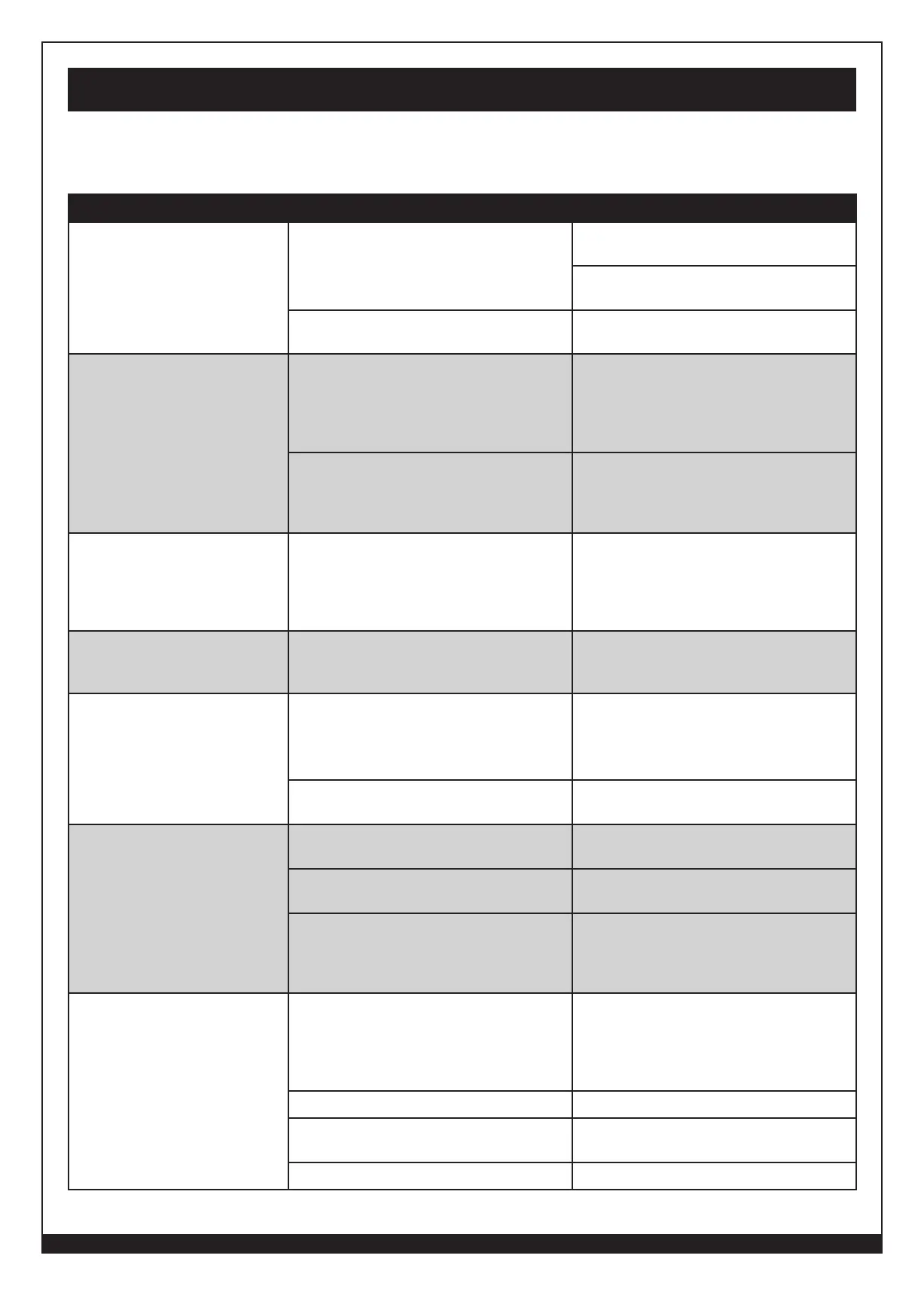
PROBLEM
POSSIBLE CAUSE POSSIBLE SOLUTION
All LEDs OFF,
No output power, Fan not
operating.
No input power. Connect machine to proper input power
source.
Verify that circuit breaker has not been tripped
in your main power panel. Reset if needed.
POWER SWITCH is OFF. Ensure POWER SWITCH (rear) is in the ON
position.
FAULT CODE F01 DISPLAYED.
Exceeded duty cycle; thermal protector
engaged.
Allow welder to cool at least 10 minutes with
machine ON (observe and maintain proper
duty cycle). FAULT/THERMAL OVERLOAD
INDICATOR LED should turn off after the
machine has cooled.
Insufficient air flow causing machine to
overheat before reaching duty cycle.
Check for obstructions blocking air flow and
ensure that there are 12 inches of clearance
between any obstacles and the vents on all
sides of the machine.
FAULT CODE F02 DISPLAYED.
No voltage or incorrect voltage supplied to
welder.
Make sure the machine is plugged in. Check
the status of your INPUT VOLTAGE INDICATOR
LED. It should be illuminated. Check the voltage
of your outlet. If it is 10% more or less than
120V or 230V, call a qualified electrician.
FAULT CODE F05 DISPLAYED.
Torch triggered before machine is ready. Torch triggered or turned on before machine
is powered on will fault. Release torch trigger
and machine will reset within five seconds.
FAULT CODE F09 DISPLAYED.
Output short or abnormal voltage feedback. Make sure the MIG wire is not touching the
grounded work piece.
Make sure the TIG electrode is not touching
the grounded work piece.
Stick electrode stuck to work piece Make sure that your stick electrode is not stuck
to the grounded work piece.
FREQUENT CIRCUIT BREAKER
TRIPS.
Machine is drawing too much amperage
due to use of larger size electrode.
Use a smaller electrode.
Machine is not the only piece of electrical
equipment on the circuit.
Make sure the welder is on a dedicated circuit
or is the only thing plugged into a circuit.
Circuit breaker is incorrect/insufficient for use
with this machine.
Verify that the circuit breaker for the circuit
is a 20A time-delay (slow-blow) breaker for
120V and a 50A for 230V. If it is not, have a
qualified electrician install the proper breakers.
Poor quality welds.
Insufficient gas at weld area. Check that the gas is not being blown away
by drafts and, if so, move to a more sheltered
weld area. If not, check gas cylinder contents,
gauge, regulator setting, and operation of gas
valve.
Rusty, painted, oily or greasy workpiece. Ensure workpiece is clean and dry.
Poor ground connection or torch/electrode
connection.
Check ground clamp/workpiece connection
and all connections to the machine.
Incorrect settings. Check welding parameters and polarity.
Troubleshooting


 To Next Page