58
9 MODIFIERS
MODIFIER PARAMETERS
The Modify page of the modier menu contains parameters to determine the nature of the relationship between
the source(s) and the parameter. By default, a modier is linear: the parameter value moves in direct proportion
to the source. By changing this relationship, you can create a variety of desirable effects. For example, you might
adjust the “taper” of the change, reverse its effect, or smooth the changes over time. Here is an overview of the
additional parameters you can use to create these effects and many more.
The
Channel setting determines whether the modier will be enabled on ALL channels or just on one channel
(A,B,C or D). There are many creative uses for this, including effects which auto-engage only when set to a
particular channel where their modier is active.
The
Source 1 Scale, Source 2 Scale, and Operation parameters are for dual source modiers.
See p. xx for more.
Min and Max determine the range of parameter change. These are extremely important parameters.
EXAMPLE: The modier for a pedal controlling Delay Feedback has Min at “10%” and Max at “50%”. The
feedback sweeps only from 10% to 50 as the pedal is moved, even though this parameter’s actual range is
from -100% to +100%.
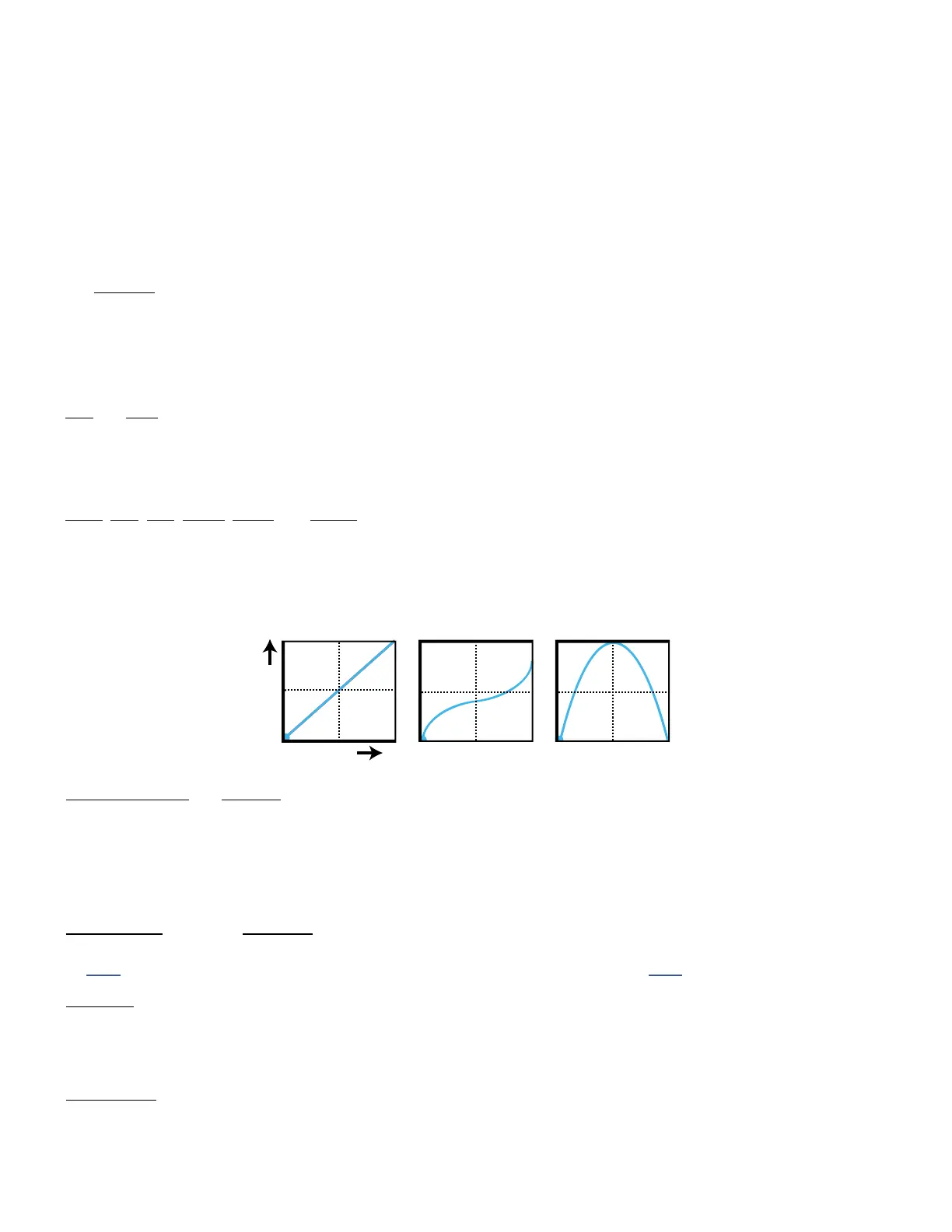
Start, Mid, End, Slope, Scale, and Offset are used to create custom curves which re-map the source to the
target. On the Modify page, a graph shows the relationship between the source (x-axis) and the parameter
(y-axis). A dot on the graph tracks the source. The default settings (rst graph below) create a 1:1 linear
relationship (the blue line) between source and parameter. As the source changes, the parameter tracks it directly.
The second two graphs below show just a few examples of the kinds of non-linear curves you can create using
Slope, Scale, and Offset. The pages which follow contain more examples.
Damping, Attack and Release: These are used to slow the rate at which the target parameter value “chases” the
source. At low settings, these add just a little smoothing. Try settings of about 5 ms to “relax” a pedal or to ease
a square LFO to eliminate clicks and pops, or use higher settings for slow, lazy changes. Increase Attack to slow
the change as the source is increased. Release controls the rate as the source decreases. The Damping type
parameter determines if damping happens in a linear (constant) or exponential manner (slowing as the source
reaches the extremes.)
Auto-Engage works with Off Value to create effects which turn ON or OFF automatically whenever the source
controller is moved. This is typically used with a Wah pedal so you don’t need a toe switch. (Follow the example
on p. 56 and set AUTO-ENGAGE to “SLOW POS” to try it out!) See also Auto-Engage on p. 60.
PC Reset sets the value for an external source when a preset rst loads. This allows you to override the actual
position of an external controller until it is moved or updated. To set the default value: after applying the modier,
exit to the Edit page. Notice that the value of that parameter can be edited as usual. If PC Reset is ON, the value
you set and then save will be used from preset load until the source is changed (i.e. the pedal has been moved).
Update Rate controls how often the modier is refreshed. The setting of slow is actually very fast, and ne
for the majority of applications. The faster settings require additional CPU but provide even smoother sound
performance when ultra fast changes are required (while using a fast LFO for instance). Check this setting if you
think you hear “zipper noise” while a modier is in use.


 To Next Page