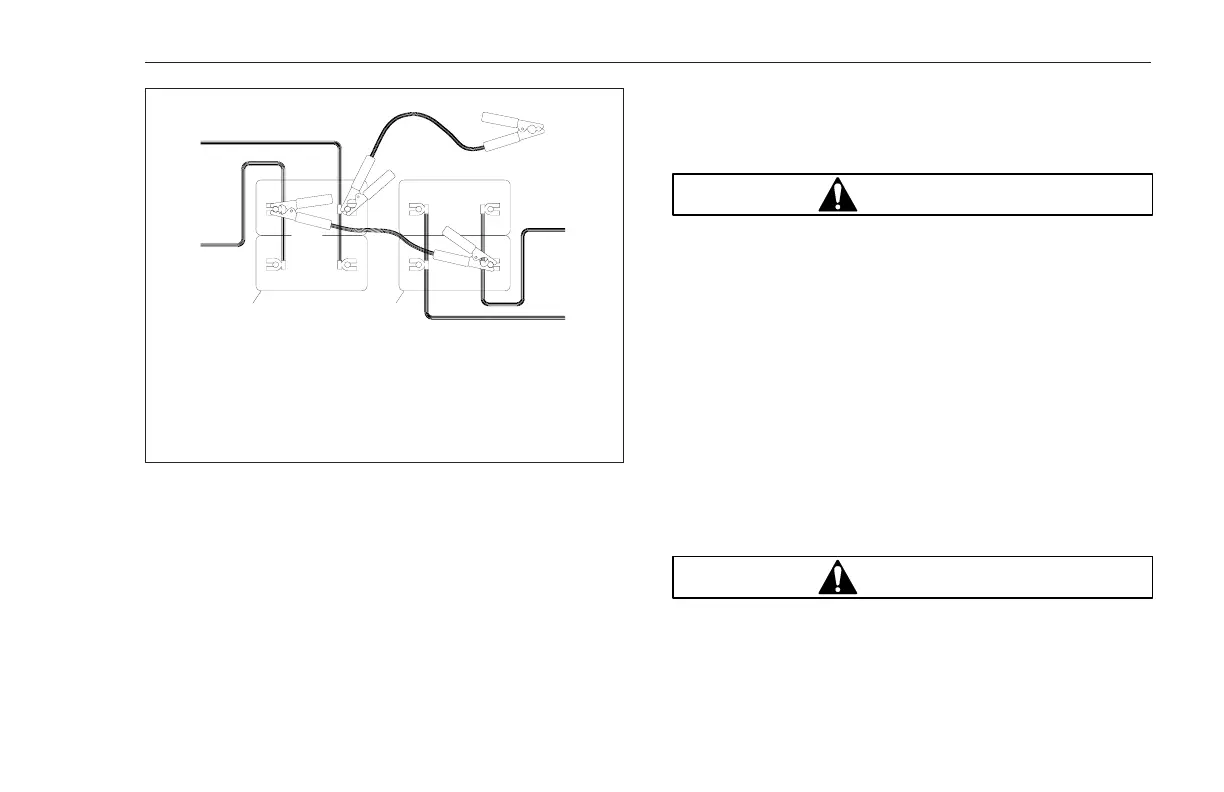
vehicle needing the start. The vehicle frame is usu-
ally a good ground. Do
not
connect the cable to or
near the discharged batteries.
4. Start the engine of the vehicle with the booster bat-
teries, and let the engine run a few minutes to
charge the batteries of the other vehicle.
5. Attempt to start the engine of the vehicle with the
batteries receiving the charge. Do not operate the
starter longer than 30 seconds, and wait at least
two minutes between starting attempts to allow the
starter to cool.
6. When the engine starts, let it idle a few minutes.
WARNING
Do the next step exactly as instructed and do not
allow the clamps of one cable to touch the clamps
of the other cable. Otherwise, a spark could occur
near a battery, possibly resulting in severe personal
injury from explosion and acid burns.
7. Disconnect the grounded cable from the frame or
other nonbattery location. Then, disconnect the
other end of the cable.
8. Disconnect the remaining cable from the newly
charged battery, or jump-start post if equipped, first.
Then, disconnect the other end.
Fire in the Cab
WARNING
Urethane foam is flammable! Do not allow any
flames, sparks, or other heat sources such as ciga-
rettes or light bulbs to contact urethane foam. Ure-
thane foam in contact with such heat sources could
cause a serious, rapid fire, which could result in
+−
+
−
+
−
+−
f540303a
10/18/94
A
B
C
D
E
F
G
21
A
E
A. To Ground
B. 3rd
C. To Frame (ground)
D. 4th
E. To Starter
F. 2nd
G. 1st
1. Booster Battery 2. Discharged Battery
Fig. 10.2, Jumper Connections
In an Emergency
10.4



 To Next Page