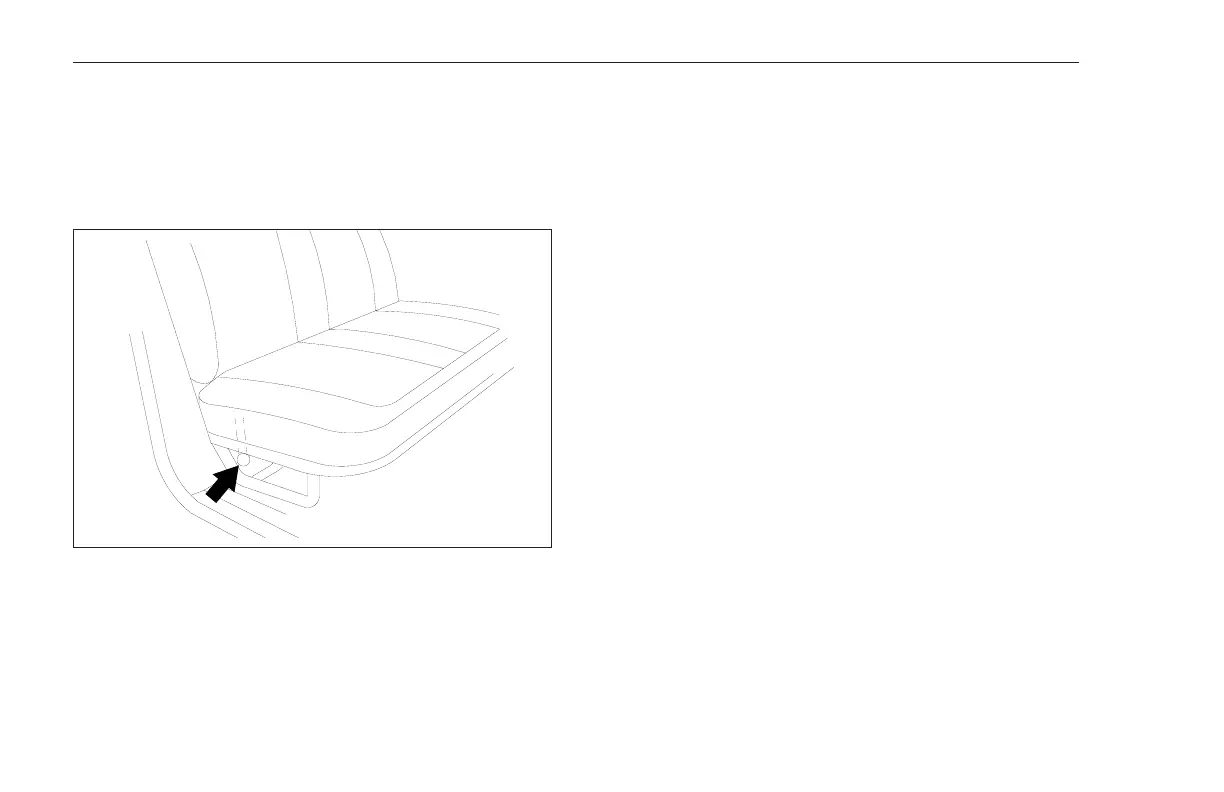
Passenger’s Seat
The passenger’s seat is not adjustable. See Fig. 2.7.
Access to the storage compartment under the seat is
obtained by moving the release lever and tilting the
seatback forward.
Seat Belts and Tether Belts
General Information
Seat belt assemblies are designed to secure persons in
the vehicle to help lessen the chance of injury or the
amount of injury resulting from accidents or sudden
stops. For this reason, the manufacturer urges that the
driver and all passengers, regardless of age or physical
condition, use seat belts when riding in the vehicle.
Seat belt assemblies in the vehicle meet Federal Motor
Vehicle Safety Standard 209, "Type 1," and "Type 2"
requirements. They are recommended for all persons
weighing over 50 pounds (23 kg).
A child restraint system should also be provided for
each child weighing 50 pounds (23 kg) or less. It should
meet the requirements of Federal Motor Vehicle Safety
Standard 213, "Child Restraint Systems." When provid-
ing such a restraint system, carefully read and follow all
instructions pertaining to installation and usage for the
child. Make certain the child remains in the restraint
system at all times when the vehicle is in motion.
In addition to seat belt assemblies, tether belts are in-
stalled on suspension-type seats. Tether belts help se-
cure the seat to the floor and are intended to restrain
the seat and seat belt in case of an accident or sudden
stop.
IMPORTANT: Seat belts have a finite life which
may be much shorter than the life of the vehicle.
Regular inspections and replacement as needed
are the only assurance of adequate seat belt se-
curity over the life of the vehicle.
f910247
09/09/97
Fig. 2.7, Passenger’s Seat Release Lever (typical)
Vehicle Access and Features
2.7



 To Next Page