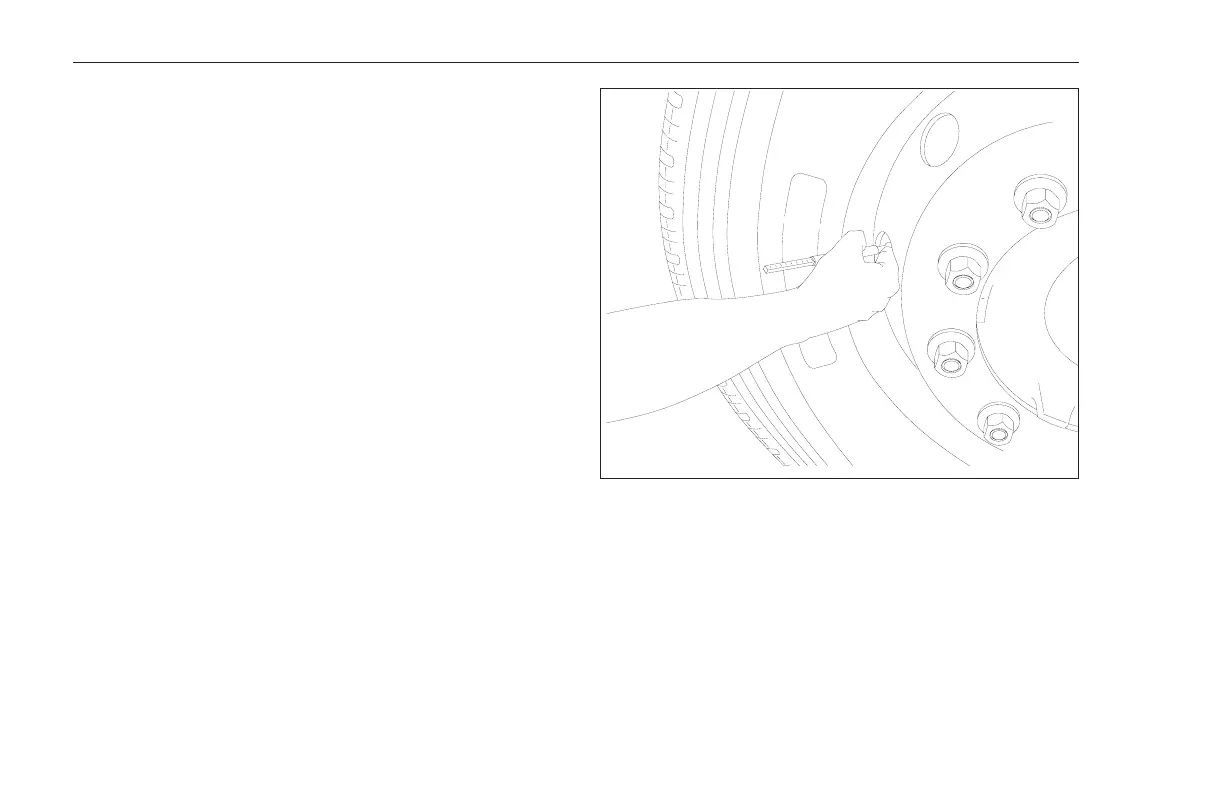
caps are on every tire and that they are
screwed on finger-tight. Inflate the tires to
the applicable pressures, if needed.
Overinflation gives the treaded surface of
the tire a convex shape (Fig. 9.6). This
causes extreme tire wear in the middle part
of the tire since this section is primarily in
contact with the road.
Underinflation gives the tread surface a con-
cave shape (Fig. 9.6). This causes exces-
sive tire wear on the outer edges of the tire
since they are primarily in contact with the
road.
37.2 If a tire has been run flat or underinflated,
check the wheel for proper lockring and side
ring seating, and possible wheel, rim, or tire
damage before adding air.
37.3 Moisture inside a tire can result in body ply
separation or a sidewall rupture. During tire
inflation, compressed air reservoirs and lines
must be kept dry. Use well-maintained inline
moisture traps and service them regularly.
37.4 Inspect the tires for bulges, cracks, cuts, or
penetrations. A tire pressure check will assist
in uncovering hidden damage. A weekly
pressure loss of 4 psi (28 kPa) or more in a
tire may indicate damage and the tire should
be inspected and repaired or replaced.
37.5 Tires should also be inspected for oil con-
tamination. Fuel oil, gasoline, and other pe-
troleum derivatives, if allowed to contact the
tires, will soften the rubber and destroy the
tire.
f400061
11/03/94
Fig. 9.5, Check Tire Pressure
Pretrip Inspection and Daily Maintenance
9.19




 To Next Page