
 Need help?
Do you have a question about the Fujitsu WPYA050LE and is the answer not in the manual?
Defines cold water and hot water operation modes.
Explains how inverter control reduces compressor ON/OFF times.
Notes reduced electricity usage with inverter control.
Details defrosting based on outdoor heat exchanger temperature.
Activates anti-freeze operation below 2°C outdoor temperature.
Inhibits restarting for approximately 3 minutes.
Specifies conditions for defrosting start and stop, including timing.
Explains danger, warning, caution marks and safety precautions.
Lists unit error codes and corresponding troubleshooting checks and solutions.
Provides sensor resistance values at various temperatures for diagnosis.
Details methods for viewing and canceling past error codes on the unit display.
Outlines procedures for checking fuses, motors, pumps, and valves.
Step-by-step instructions for safely removing the controller PCB.
Instructions for properly reassembling the controller PCB.
Explains how to access and interpret operational data on the unit display.
Details how to enable or disable freeze prevention based on outdoor temperature.
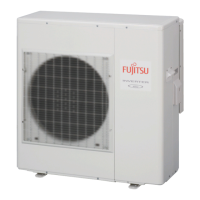
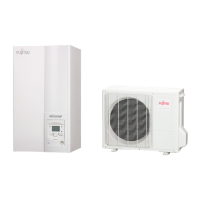
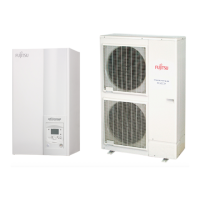
This document outlines the service and operational details for the Fujitsu Air to Water Heat Pump, Monobloc type, specifically the outdoor unit model WPYA050LE. It covers the unit's functions, technical specifications, operational procedures, troubleshooting, and maintenance guidelines.
The WPYA050LE is an air-to-water heat pump designed for both cold water and hot water modes, providing versatile heating and cooling capabilities. A key feature is its inverter control, which minimizes compressor ON/OFF cycles, ensuring stable water temperature during operation and contributing to energy efficiency. This inverter technology allows the unit to operate with lower electricity consumption compared to conventional air-to-water heat pumps.
The unit incorporates a defrost control system that monitors the outdoor heat exchanger temperature via a thermistor. Defrosting initiates when the compressor has run continuously for 40 minutes (after heating start or previous defrost completion) and the outdoor heat exchanger temperature remains below -1.5°C for two minutes. Defrosting stops when the outdoor heat exchanger temperature rises to 15°C (with the 4-way valve ON) or after 12 minutes of compressor operation.
An anti-freezing control mechanism is also integrated for the circulation water. This feature automatically activates when the outdoor temperature drops below 2°C, preventing the circulation water from freezing. For safety, a time delay control inhibits restarting the unit for approximately 3 minutes after shutdown. The expansion vessel is protected by a frost protection heater, which turns on if the outdoor temperature stays below 3°C for one minute and turns off if it rises above 5°C for one minute.
General:
Performance:
Electrical Data:
Dimensions & Weight:
Air Circulation:
Heat Exchanger:
Refrigerant System:
Water Pipe Size:
Thermostat:
The unit offers various operational modes and controls accessible via its display board. Users can monitor key operational data such as circulating water return temperature, compressor operating frequency, discharge temperature, power consumption, defrost thermistor temperature, ambient air temperature, suction temperature, and circulating water outgoing temperature. This monitoring is activated by switching ON MODE SW. 4 on the PCB (DISPLAY) and cycling through data using the PUMP SW.
Charging the circulation water and purging air from the water circuit is facilitated by pressing the PUMP SW. on the display PCB. The water pump starts for 10 minutes, and digital segments on the display light up sequentially. If further air purging is needed, the PUMP SW. can be pressed again after the pump stops. The pump operation can also be manually stopped by pressing the PUMP SW. again.
Freeze prevention settings can be configured via MODE SW. 1. The factory setting is "ON: 2. Freeze prevention operation," which warms and circulates the water when the outdoor temperature falls below 2°C. Users can also select "OFF: 1. No freeze prevention operation" if an anti-freeze solution is used.
The manual provides a comprehensive troubleshooting guide with error codes and corresponding methods of check and troubleshooting steps. This includes checks for power supply, fuses, fan motor, pump, reactor, sensors (outdoor temp., defrost temp., suction temp., discharge temp., PCB temp., circulating water temp.), compressor, 4-way valve, and heating circuit. Resistance values for various thermistors (outdoor, defrost, suction, outgoing/return circulating water, discharge) are provided in tables to aid in diagnosis.
A detailed procedure for detaching the PCB (CONTROLLER) is outlined, emphasizing safety precautions such as waiting at least 5 minutes after power-off and confirming voltage is below DC 10V before disconnecting lead wires. The steps involve unscrewing and detaching the wiring lid, top panel, front panel assembly, and then carefully disconnecting lead wires and unlocking hooks to remove the PCB. Reassembly instructions are provided in reverse, with emphasis on correct lead wire connections and routing.
The manual also highlights critical safety warnings for servicing, including avoiding contact with electrically charged parts, waiting for capacitor discharge, and not touching high-voltage components. It stresses the importance of proper earthing, using designated parts, and ventilating the room if refrigerant leakage occurs. In case of refrigerant leakage, it is crucial to find and mend the leak, then collect and recharge the refrigerant with the prescribed mass. Damaged cables must be replaced, and power supply cords should not be extended or connected in halfway. Regular checks of insulated resistance (more than 1M Ω) are also recommended.


 To Next Page
 General