EasyManua.ls Logo

GE 10 - Exhaust Connection

GE 10
16 pages
Print Icon
To Next Page IconTo Next Page
To Previous Page IconTo Previous Page
Loading...
Installation
Instructions
SEALING
OF
JOINTS
@
Alljoints
should
be
tight
to
avoid
leaks.
The
male
end
of
each
section
of
duct
must
point
away
from
the
dryer.
*
The
duct
shall
not
be
assembled
with
screws
or
other
fastening
means
that
extend
into
the
duct
and
catch
lint.
*
Ductjoints
can
be
made
air
and
moisture-tight
by
wrapping
the
overlapped
joints
with
duct
tape.
e
Horizontal
runs
should
slope
down
toward
the
outdoors
1/4
inch
per
foot.
INSULATION
Duct
work
that
runs
through
an
unheated
area
or
is
near
air
conditioning
should
be
insulated
to
reduce
condensation
and
lint
build-up.
EXHAUST
CONNECTION
BEFORE
PERFORMING
THIS
EXHAUST
INSTALLATION,
BE
SURE
TO
DISCONNECT
THE
DRYER
FROM
ITS
ELECTRICAL
SUPPLY.
A\WARNING
-
To
REDUCE
THE
RISK
OF
FIRE
OR
PERSONAL
INJURY:
This
clothes
dryer
must
be
exhausted
to
the
outdoors.
«Use
only
4”
rigid
metal
ducting
for
the
home
exhaust
duct.
«Use
only
4”
rigid
metal
or
UL-listed
flexible
metal
(serni-
rigid
or
foil-type)
duct
to
connect
the
dryer
to
the
home
exhaust
duct.
It
must
be
installed
in
accordance
with
the
instructions
found
in
“Connecting
the
Dryer
to
House
Vent”
on
pages
5-6
of
this
manual.
*
Do
not
terminate
exhaust
in
a
chirnney,
a
wall,
a
ceiling,
gas
vent,
crawl
space,
attic,
under
an
enclosed
floor,
or
in
any
other
concealed
space
of
a
building.
The
accumulated
lint
could
create
a
potential
fire
hazard.
*
Never
terminate
the
exhaust
into
a
common
duct
with
a
kitchen
exhaust
system.
A
combination
of
grease
and
lint
creates
a
potential
fire
hazard.
*Do
not
use
duct
longer
than
specified
in
the
exhaust
length
table.
Longer
ducts
can
accumulate
lint,
creating
a
potential
fire
hazard.
*
Never
install
a
screen
in
or
over
the
exhaust
duct.
This
will
cause
lint
to
accumulate,
creating
a
potential
fire
hazard.
*Do
not
assemble
ductwork
with
any
fasteners
that
extend
into
the
duct.
These
fasteners
can
accumulate
lint,
creating
a
potential
fire
hazard.
*Do
not
obstruct
incoming
or
exhausted
air.
«Provide
an
access
for
inspection
and
cleaning
of
the
exhaust
system,
especially
at
turns
and
joints.
Exhaust
system
shall
be
inspected
and
cleaned
at
least
once
a
year.
THIS
DRYER
COMES
READY
FOR
REAR
EXHAUSTING.
IF
SPACE
IS
LIMITED,
USE
THE
INSTRUCTIONS
IN
SECTION
13
TO
EXHAUST
DIRECTLY
FROM
THE
SIDES
OR
BOTTOM
OF
THE
CABINET.
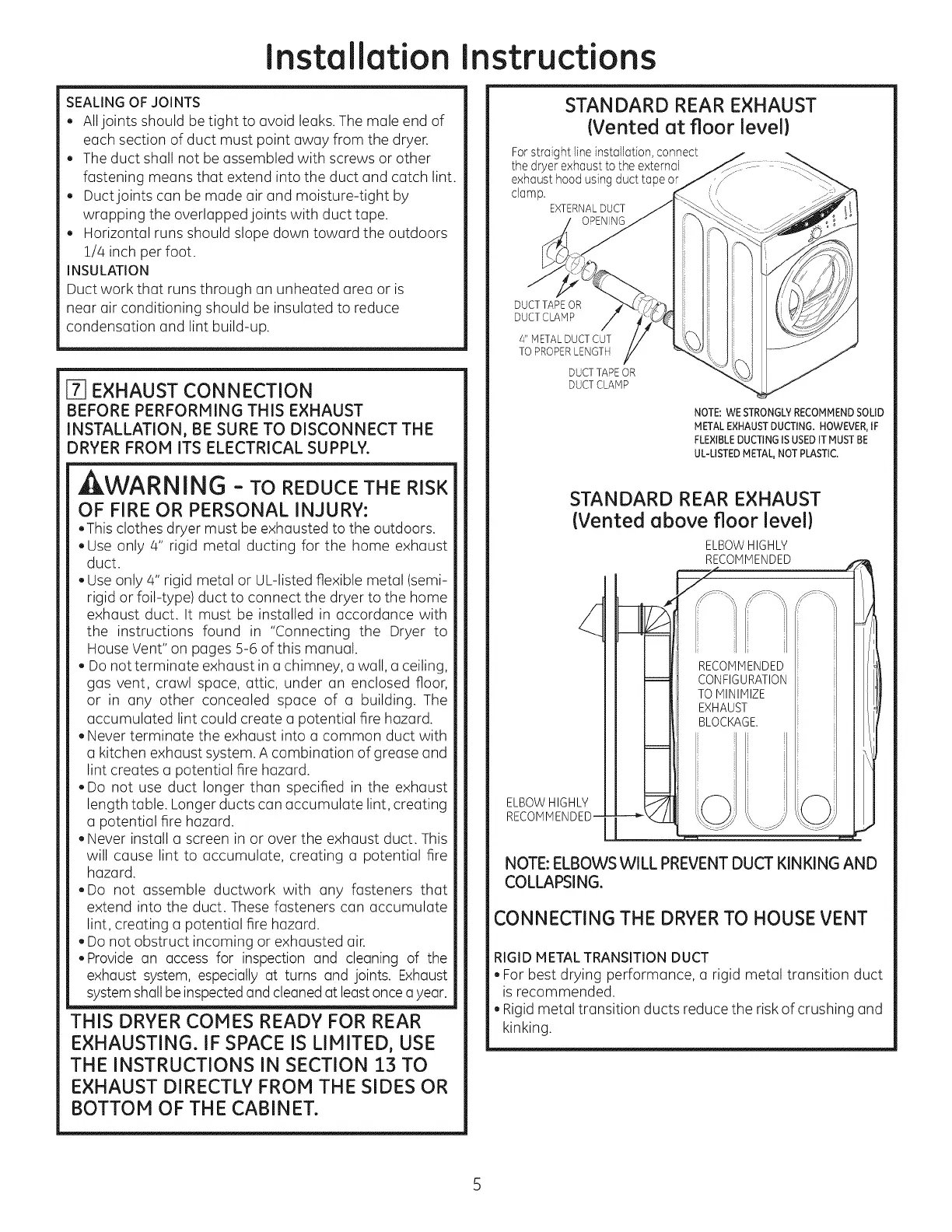
STANDARD
REAR
EXHAUST
(Vented
at
floor
level)
For
straight
line
installation,
connect
the
dryer
exhaust
to
the
external
aaa
exhaust
hood
using
duct
tape
or
clamp.
EXTERNAL
DUCT
OPENING
TO
PROPER
LENGTH
DUCT
TAPE
OR
DUCT
CLAMP
DUCT
TAPE
OR
7p
DUCT
CLAMP
/
.
4"
METAL
DUCT
CUT
/
NOTE:
WE
STRONGLY
RECOMMEND
SOLID
METAL
EXHAUST
DUCTING.
HOWEVER,
IF
FLEXIBLE
DUCTING
IS
USED
IT
MUST
BE
UL-LISTED
METAL,
NOT
PLASTIC.
STANDARD
REAR
EXHAUST
(Vented
above
floor
level)
ELBOW
HIGHLY
RECOMMENDED
RECOMMENDED
CONFIGURATION
TO
MINIMIZE
EXHAUST
BLOCKAGE.
ELBOW
HIGHLY
RECOMMENDED
NOTE:
ELBOWS
WILL
PREVENT
DUCT
KINKING
AND
COLLAPSING.
CONNECTING
THE
DRYER
TO
HOUSE
VENT
RIGID
METAL
TRANSITION
DUCT
*For
best
drying
performance,
a
rigid
metal
transition
duct
is
recommended.
¢
Rigid
metal
transition
ducts
reduce
the
risk
of
crushing
and
kinking.

Related product manuals