6.3.4.1 Using the mechanical seal
For perfect operation, mechanical seals require a lubrication film in the sealing
gap, which prevents contact between the two sliding surfaces. Usually this
lubrication film is formed by the pumped product or by an externally supplied
flushing/sealing fluid.
Due to the friction heat between the sliding faces, the lubrication film evaporates
towards the atmosphere. This means there is a leak that is invisible in water,
water-like or volatile liquids (e.g. alcohol). The amount of leakage for faultless
operation is usually only a few ml/h; however, it may multiply depending on other
influences.
Particularly in the running-in phase, mechanical seals, regardless of size, type or
design, are subject to low leakage. In individual cases, it may be necessary to
tolerate a low, visible leakage or to counteract it with suitable measures.
Dry run
The mechanical seal needs a lubrication film between the sliding surfaces for
correct sealing.
If the lubrication film is missing or interrupted between the sliding surfaces, dry
running occurs. The friction heat generated by the direct contact of the sliding
surfaces leads to the destruction of the mechanical seal. Depending on the
material pairing, this can take place within a few seconds.
6.3.4.2 Space requirements
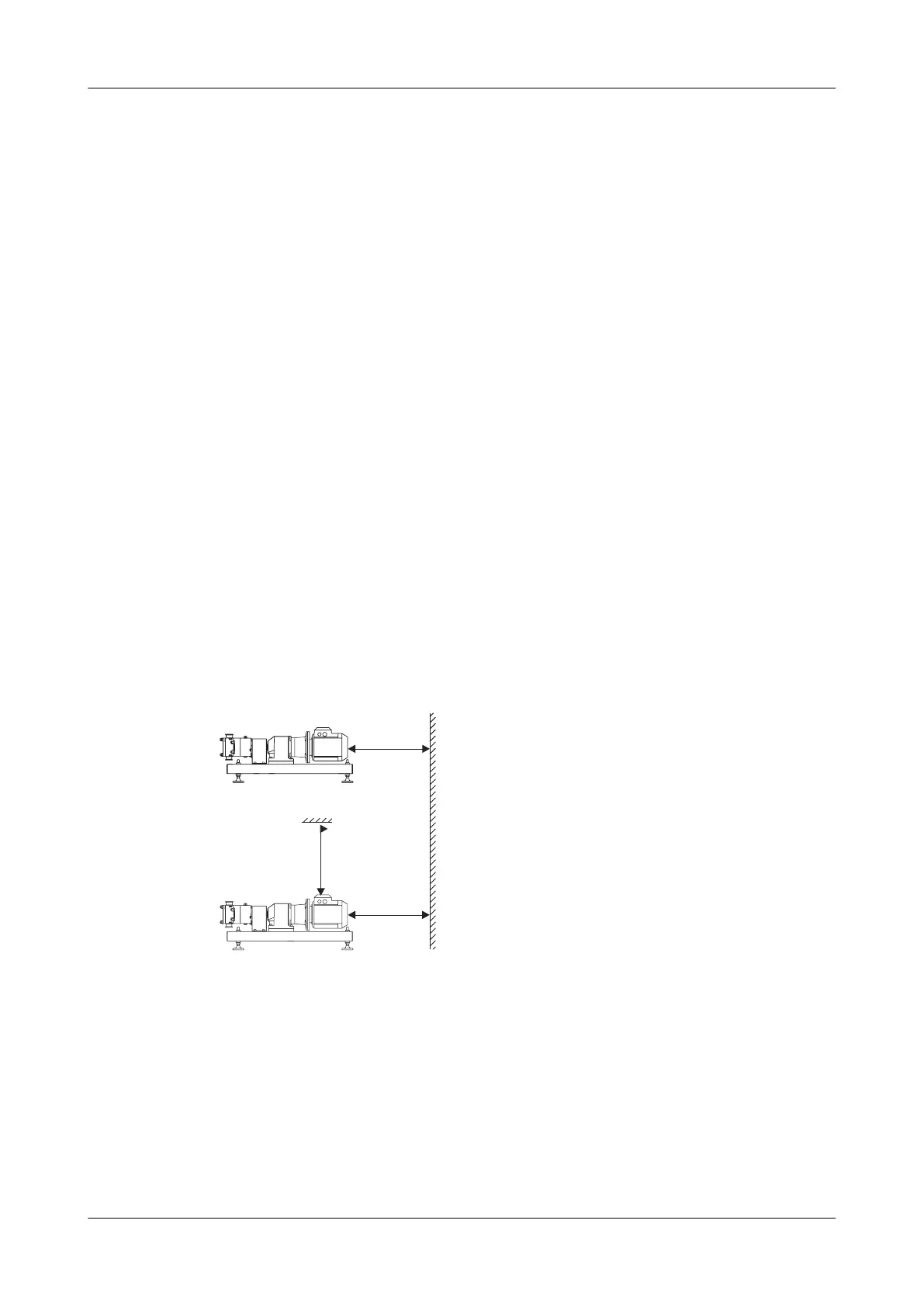
Maintain the following minimum distances.
Pay attention to motor performance.
0.55 - 4 kW
5.5 - 30 kW
300 mm
1000 mm
300 mm
Fig.11: Minimum distances (schematic representation)
6.3.4.3 Noise and vibration damping
In NOVALOBE rotary piston pumps with base frame, the machine feet are
equipped with dampening rubber.
Vibrations and noises are caused by the pulsating flow in the system and a
vibration transmission through the base of the pump to the ground. Acoustic
decoupling of the pump leads to a noise reduction.
Assembly and installation
Setup, installation, and connection
BA.280.YYY.001.GB_4
21.02.2022 33








 To Next Page