917001/CP0905 29
T-Bar Controls
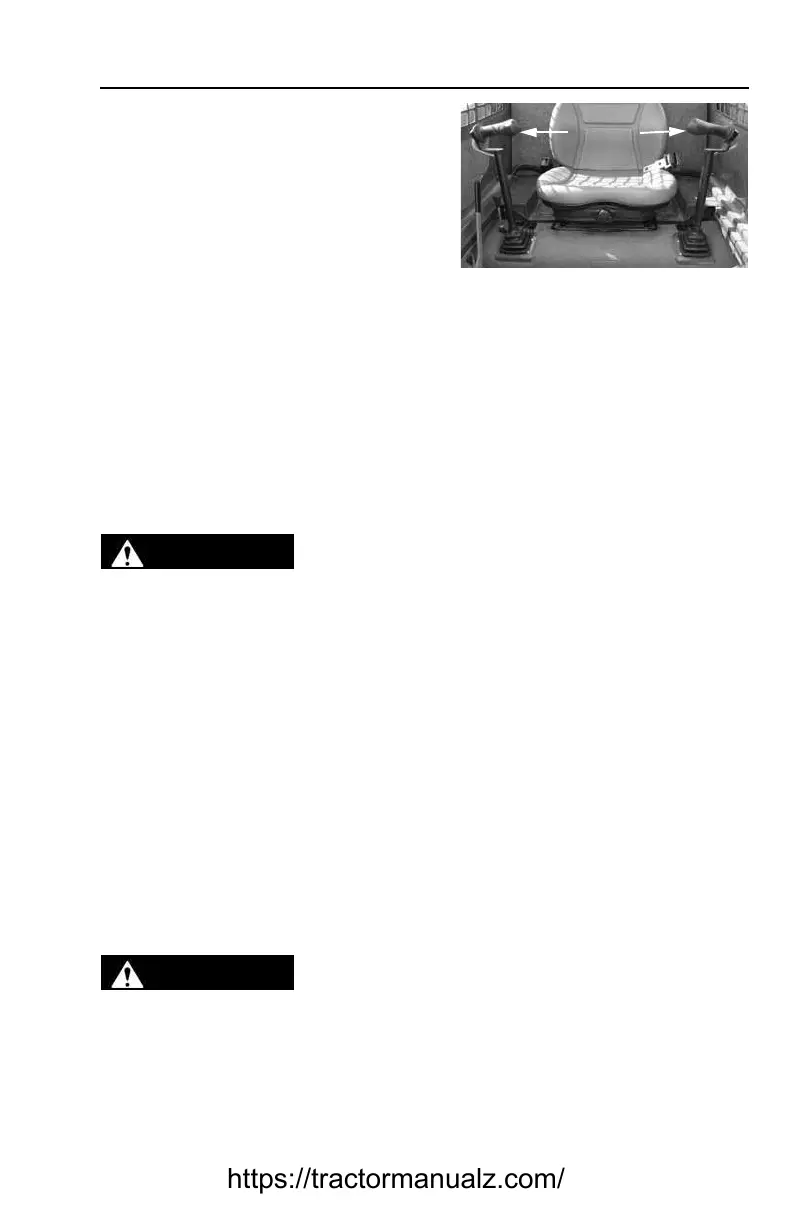
Your loader may be equipped with the
Gehl T-Bar control option. The left T-Bar
controls the drive and the right T-Bar con-
trols the lift/tilt.
Drive Controls
Forward, reverse, speed and turning
maneuvers are accomplished by move-
ment of the left T-Bar. To go forward, push
the control forward; for reverse, pull the
control rearward. To turn right, turn the
control clockwise; to turn left, turn the
control counterclockwise. For gradual turns, move the T-Bar slightly forward or
rearward. For sharp turns, turn the control clockwise or counterclockwise.
Moving the T-Bar farther from neutral increases the speed steadily to the max-
imum travel speed. Tractive effort decreases as speed increases. To get maximum
tractive effort, move the T-Bar only slightly away from the neutral position. The
engine will stall if the control is moved too far forward when loading the bucket.
Be sure the T-Bar controls are in neutral
before starting the engine. Operate the con-
trols gradually and smoothly. Excessive speed and quick control
movements without regard for conditions and circumstances are
hazardous and could cause an accident.
Lift/Tilt Control
Moving the lift arm and tilting the attachment are accomplished by movement of
the right T-Bar. To raise the lift arm, pull the control straight rearward; to lower
the lift arm, push the control straight forward. To tilt the attachment forward
and down, twist the control clockwise; to tilt the attachment up and back,
twist the control counterclockwise.
Note: The speed of the lift/tilt motion is directly proportional to the amount of
T-Bar movement and engine speed.
To place the lift arm into the detent (“float”) position, push the right T-Bar all the
way forward. This position allows the lowered lift arm to float while traveling
over changing ground conditions.
Never push the lift/tilt T-Bar control into the
“float” position with the attachment loaded or
raised, because this will cause the lift arm to lower very rapidly.
Figure 12 T-Bar Controls
1. Lift/Tilt Control
2. Drive Control
1
2
WARNING
WARNING
https://tractormanualz.com/



 To Next Page