ADMA 3.0
USER MANUAL
Document Revision 2.01 | 2021 Page 89/137
11.4 Pre-alignment
During pre-alignment, the roll- and pitch angles are calculated from accelerometer data, while the
vehicle is at standstill. The duration of the pre-alignment determines the expected precision of the
angle estimation. Typical time periods are in the range of 5 - 30 seconds.
Make sure the vehicle is not exposed to any other vibrations then the vehicle engine during the pre-
alignment period. Especially shocks from closing doors or movements in the vehicle have to be
avoided. The LED of the selected CAN interface (if activated) flashes once per second during this
period. All data is available at the full data rate once the pre-alignment period has elapsed.
11.5 AutoInit
11.5.1 Yaw angle auto initialization (AutoInit)
If the ADMA is operated with (D)GNSS, you might omit entering a start course, as this will be
automatically set by the ADMA’s AutoInit function.
After pre-alignment, a first estimation for roll and pitch is found and set as starting values. The ADMA
AutoInit function will overwrite the yaw angle with the GNSS course after exceeding a velocity
threshold, which will help Kalman filter settling, and eliminates the need to have the user enter a start
course. The velocity threshold can be adapted at the ADMA Webinterface menu PARAMETERS.
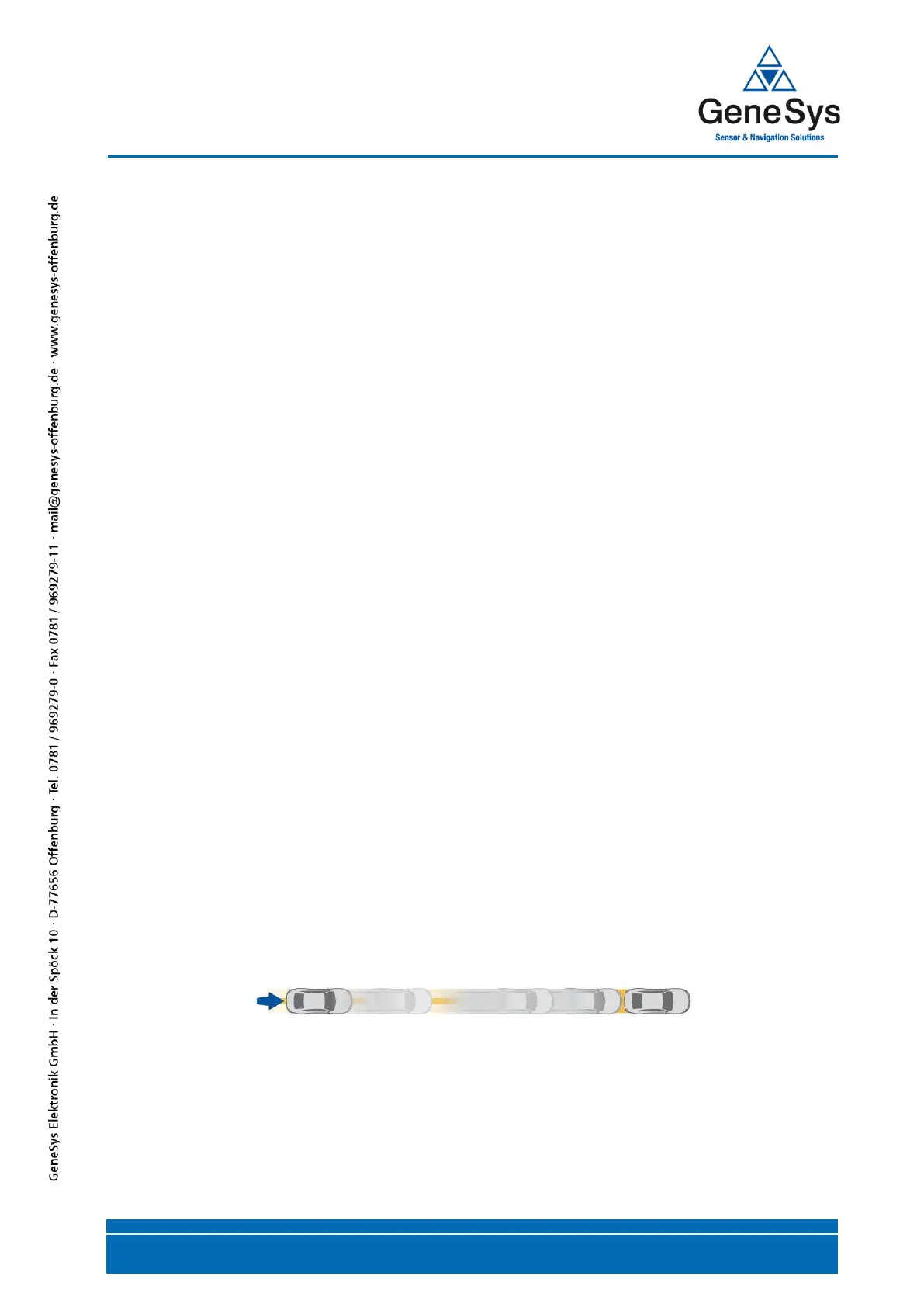
Make sure travelling straight ahead when exceeding this threshold (no float angle).
Note: The AutoInit function will only be executed once at each measurement.
For a successful yaw initialisation, it is important to reach a certain vehicle velocity, as the GNSS
course is calculated from the GNSS velocity. According to the thumb rule: higher vehicle speed
reduces the GNSS course error introduced by GNSS velocity noise. Please keep this also in mind when
you are expecting poor GNSS reception.
When analysing data, the successful execution of the AutoInit routine can be detected in the data
when the vehicle reaches the configured velocity threshold first time (unless the initial yaw angle was
already true). Yaw angle and GNSS course should then be similar, but only if the classic coordinate
system is chosen (please see configuration options of the ADMA). Please note, that the coordinate
system as stated in DIN 70000 is rotated about the roll angle by 180°, hence pitch and yaw angles
will have an inverted sign compared to the classic coordinate system. The GNSS course will be output
according to the classic coordinate system.
• DIN 70000 90° (west) 270° (east) counter clockwise
• Classic 90° (east) 270° (west) clockwise
Figure 65 AutoInit, go straight exceeding the velocity limit


 To Next Page