Need help?
Do you have a question about the GreenWorks 82T16 and is the answer not in the manual?
Read and understand all instructions before using this product. Follow all safety warnings.
Inspect cords, check damaged parts, charging in rain, battery removal, specific battery packs, charging, metal objects shorting, battery leaks.
No damaged batteries, no fire/high temp, battery disposal, no opening batteries, handling batteries.
Liquid ejection, contact precautions, damaged/modified batteries, fire/high temp, disposal, opening batteries.
Advice for safe and effective operation, including harness use and cutting techniques.
Advice on tilting, moving the machine, avoiding dangerous areas, and cutting uncut grass.
Possible causes and solutions for the machine failing to start.
Solution for when the battery pack is depleted and the machine won't start.
Troubleshooting for when lock-out button and trigger are not used correctly.
Causes and solutions for the machine stopping during operation.
Reasons and fixes for the cutting line not advancing properly.
Troubleshooting for when the cutting line breaks frequently.
Solutions for poor cutting performance and dull cut-off blades.
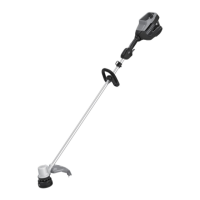
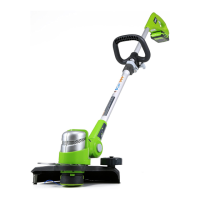
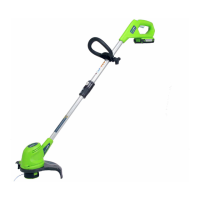
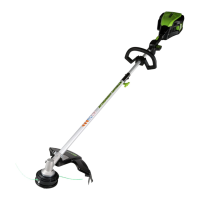
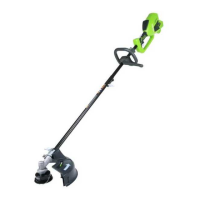
This document describes the Greenworks Commercial 82T16 String Trimmer (model STB402), an outdoor power tool designed for cutting grass, light weeds, and similar vegetation at or around ground level. The cutting plane of the machine should be approximately parallel to the ground surface. It is not intended for cutting or chopping hedges, shrubs, bushes, flowers, or compost.
The string trimmer operates as a cordless, battery-powered device. Its primary function is to cut vegetation using a nylon cutting line. The machine is equipped with an on/off button to connect and disconnect the electrical circuit. A green light indicates when the electrical circuit is on and the machine is ready to operate. If the machine is not used for more than 30 seconds, it will automatically stop. A reverse button is available to address situations where grass winds around the trimmer head or blade, allowing the user to clear it and restart the machine. Speed adjustment is possible via a speed button. The cutting line is automatically released and trimmed to the correct length by a line cut-off blade on the guard, ensuring consistent and efficient cutting.
To start the machine, the user first pushes the on/off button, then the lock-out button rearward, and finally pulls the trigger. To stop the machine, the trigger is released.
Safety is paramount during operation. Users are warned to read and understand all instructions before use to prevent electric shock, fire, and serious personal injury. It is crucial to wear safety glasses with side shields (complying with ANSI Z87.1) and a face mask in dusty work environments. Loose clothing or jewelry should be avoided as they can get caught in moving parts. Rubber gloves and substantial footwear are recommended for outdoor work, along with protective hair covering for long hair. The machine should not be exposed to damp or wet conditions, used in rain, or operated under the influence of alcohol, drugs, or medication. Bystanders, children, and pets must be kept at least 50 feet away.
The trimmer should be held firmly with two hands and operated with proper footing and balance. Overreaching should be avoided. When cutting, it is recommended to tilt the machine toward the area to be cut, using only the tip of the cutting line. Moving the machine from right to left helps prevent thrown debris from reaching the operator. Tall grass should be cut from the top down. The trimmer head should not be forced into uncut grass. Users should be aware that wire and picket fences, as well as stone and brick walls, curbs, and wood, can cause rapid cutting line wear and breakage. The machine should always be operated with the guard in place.
The battery pack must be installed correctly. The lift ribs on the battery pack should align with the grooves in the battery compartment, and the pack should be pushed in until it locks with an audible click. To remove the battery pack, the battery release button is pushed and held while the pack is pulled out. Before installing or removing the battery pack, the machine must be stopped, and the motor allowed to cease rotation. Only Greenworks GLW300/GLW600 batteries (or other BAB series) and Greenworks GC400 charger (or other CAB series) should be used. Damaged battery packs or chargers must be replaced.
For transportation, the machine should be stopped, the battery pack removed and charged, and gloves worn. The blade guard should be assembled.
Regular maintenance is essential for the safe and efficient operation of the string trimmer. Before any maintenance, the machine must be stopped, the battery pack removed, and the motor allowed to cool. The machine should be stored in a cool and dry place.
Cleaning the machine after use involves wiping it with a moist cloth dipped in neutral detergent. Aggressive detergents or solvents should not be used on plastic parts or handles. The trimmer head should be kept free of grass, leaves, or excessive grease. Air vents must be kept clean to prevent overheating of the motor or battery. Water should not be sprayed onto the motor or electrical components.
The cutting line needs periodic attention. The machine uses a nylon cutting line with a 0.080" (2.0 mm) diameter. Heavier lines or other materials like metal wire or rope should not be used. To install new cutting line, the remaining line on the spool is removed. The slots on the spool cap are aligned with the slots on the trimmer head, and the cutting line is threaded through the holes until an equal length extends from each side. The spool cap is then turned clockwise to wind the line into the trimmer head, leaving approximately 5 inches of line extending from each side. No more than 15 feet of cutting line should be installed at a time. When replacing the spool, the tabs on the sides of the trimmer head are pushed simultaneously to remove the spool cover. The old spool is removed, and a new one is inserted, ensuring the cutting line is in the slot and extends approximately 15 cm before installing the spool cover.
If the trimmer head needs to be removed, a metal rod is inserted into the specified angle transmission hole to fix the trimmer head. The spool cover and spool are then removed, and the nut on the trimmer head is loosened clockwise with a wrench before the head is removed. To reassemble, the trimmer head is placed onto the housing, the nut installed, the metal rod used to fix the head, and the nut tightened counterclockwise with a wrench. It is important to ensure the cut-off blade is installed when using the trimmer head.
The machine should be inspected regularly for damaged parts, including the guard, moving parts, and mountings. Any damaged parts should be repaired or replaced by an authorized service center using identical manufacturer's replacement parts and accessories. The handles should be checked regularly to ensure they are tightly installed, and all nuts, bolts, and screws should be tight.
Battery packs should be handled with care. If a battery pack cracks or breaks, or leaks, it should not be recharged or used. The terminals of a damaged battery should be covered with heavy-duty adhesive tape. Users should not attempt to remove or destroy battery pack components, open the battery pack, or dispose of batteries in household trash or by incineration. Leaking electrolytes are corrosive and toxic, and contact with eyes or skin, or ingestion, should be avoided. Batteries should be taken to a certified recycling or disposal center. When not in use, battery packs should be stored away from other metal objects to prevent shorting, which can cause fire. Charging should only occur within the specified temperature range to prevent damage and fire risk.
For storage, the battery pack should be removed, and the machine kept out of reach of children and away from corrosive agents like garden chemicals and de-icing salts. The machine should be secured during transport to prevent damage or injury.
 General
| Type | String Trimmer |
|---|---|
| Power Source | Battery |
| Voltage | 82V |
| Cutting Width | 16 inches |
| Weight | 12.3 lbs |
| Line Diameter | 0.080 in |
| Battery Type | Lithium-Ion |
| Adjustable Handle | Yes |
| Warranty | 4 years |

 To Next Page