-20-
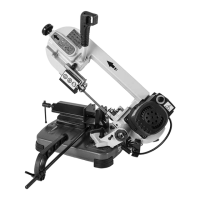
G9742 Metal Cutting Bandsaw (Mfg. Since 11/06
Blade Selection
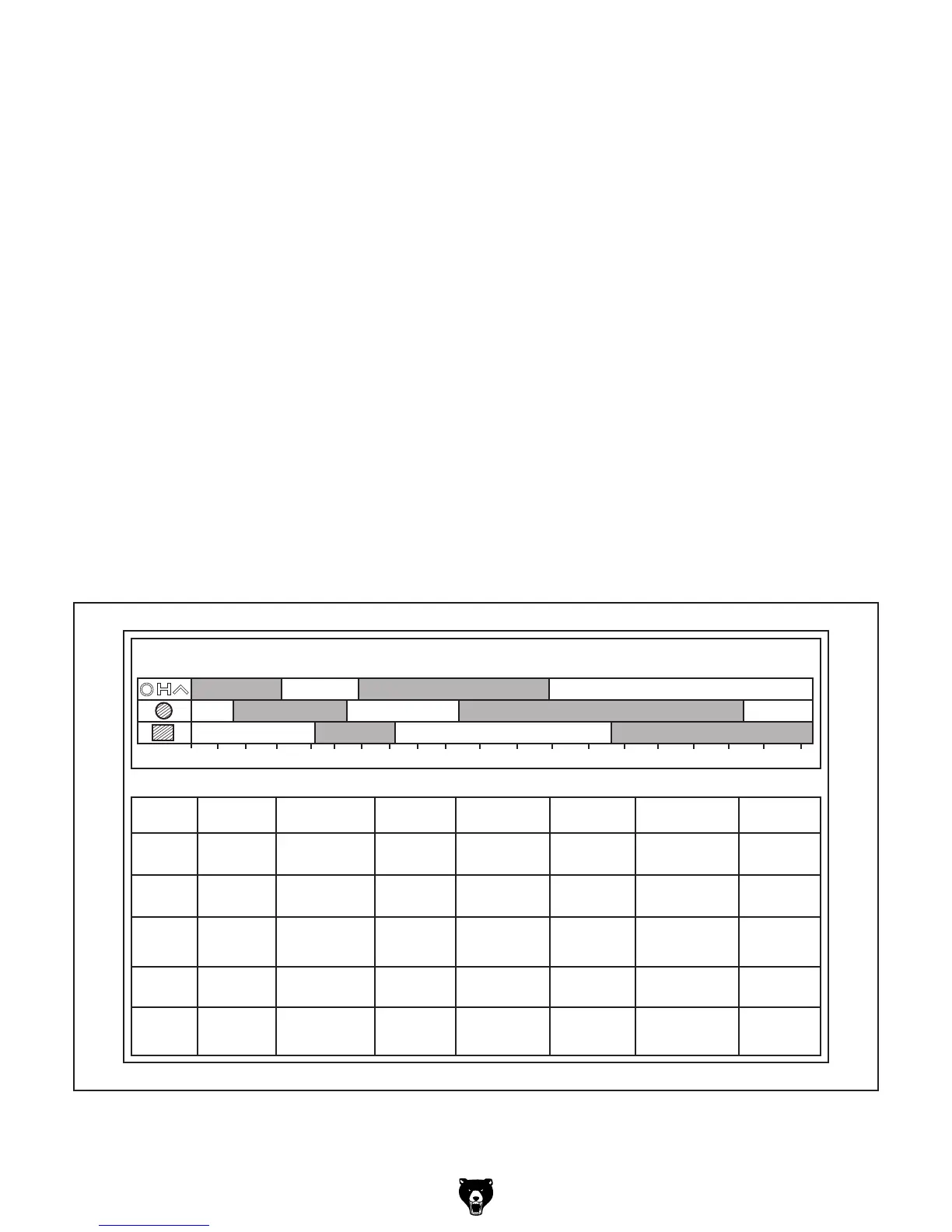
The chart below is a basic starting point for choos-
ing blade type based on teeth per inch (TPI) for
variable tooth pitch blades and for standard raker
type bimetal blades/HSS blades. However, for
exact specifications of bandsaw blades, contact
the blade manufacturer.
Here are some general rules of thumb with
respect to bandsaw blade use.
• At least three teeth must contact the metal
at any phase of the cut. Otherwise, the teeth
can load up with metal, fracture, and break
off. If the TPI is too high, the teeth can load
up with material and overheat, damaging the
blade.
• For a faster but rougher cut, use a blade with
a lower TPI and a higher feed rate.
• For a slower but smoother cut, use a blade
with more TPI and a lower feed rate.
Copper
Alloy
229~482
(70) (147)
203~213
(62) (65)
85-203
(26) (62)
220
(67)
220~534
(67) (163)
203
(62)
85
(26)
321
(98)
180~220
(54) (67)
95~213
(29) (65)
242
(75)
65~85
(20) (26)
180~220
(54) (67)
75~118
(25) (36)
246
(75)
108~225
(33) (75)
196~354
(60) (108)
203
(62)
111~321
(34) (98)
150~203
(46) (62)
Aluminum
Alloy
Thin
Tube
Angle
Steel
Carbon
Steel
Speed FPM
(M/Min)
Speed FPM
(M/Min)
Speed FPM
(M/Min)
Speed FPM
(M/Min)
Material
TOOTH SELECTION
CUTTING SPEED RATE RECOMMENDATION
Material Material Material
Tool Steel
Mold Steel
High-Speed
Tool Steel
Alloy
Steel
Water
Hardened
Tool Steel
Stainless
Steel
CR Stainless
Steel
Free Machining
Stainless Steel
Gray
Cast Iron
Ductile
Austenitic
Cast Iron
Malleable
Cast Iron
Plastics
Cold-Work
Tool Steel
Hot-Work
Tool Steel
Oil-Hardened
Tool Steel
50
2 3 4 5 6 7 8 9 10 11 12 13 14 15 16 17 18 192½ 3½
75 100 150 200 250 300 350 400
2/3
2/3
2/3 1.4/2.5
1.4/2.5
1.5/.8
1.5/.8
3/4
3/4
3/4
4/6
4/6
5/8
450
mm
inch
Figure 21. Blade selection chart.
To select the correct blade TPI:
1. Measure the material thickness. This mea-
surement is the length of cut taken from
where the tooth enters the workpiece, sweeps
through, and exits the workpiece.
2. Refer to the "Material Thickness" row of the
blade selection chart in Figure 21, and read
across to find the workpiece thickness you
need to cut.
3. Refer to the "Shape" of metal and "Material
Type" columns, and find the shape and
material to be cut.
4. In the applicable row, read across to the right
and find the box where the row and column
intersect. Listed in the box is the minimum
TPI recommended for the variable tooth pitch
blades, and the TPI for bimetal raker blades
in parentheses.


 To Next Page