
 Need help?
Do you have a question about the Grundfos alpha2 l and is the answer not in the manual?
Provides instructions and diagrams for correctly mounting the GRUNDFOS ALPHA2 L pump.
Explains how to adjust the control box position and the procedure for changing it.
Details the step-by-step process for reorienting the pump's control box.
Outlines the necessary steps and safety precautions for connecting the pump to the power supply.
Recommends and describes pump settings based on different heating system types.
Explains the proportional-pressure and constant-pressure control modes of the pump.
Describes how to vent trapped air from the pump for optimal operation.
Describes how to vent trapped air from the entire heating system.
Explains the relationship between pump settings and their corresponding performance curves (Q/H and P1).
Provides detailed technical data including voltage, protection, EMC, and temperature ratings.
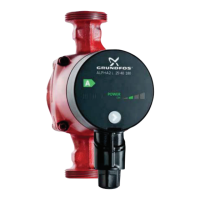
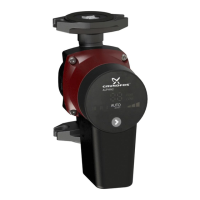
The GRUNDFOS ALPHA2 L circulator pump is designed for the circulation of water in heating systems, specifically underfloor heating, one-pipe, and two-pipe systems. It incorporates a permanent-magnet motor and differential-pressure control, allowing for continuous adjustment of the pump's performance to match actual system requirements.
The ALPHA2 L pump is engineered to optimize the setting of the pump duty point in systems with constant or variable flows, as well as in systems with variable flow-pipe temperatures. It ensures efficient distribution of heat by adjusting its performance based on the system's heat demand. The pump operates in two primary control modes: proportional-pressure control (PP) and constant-pressure control (CP). In proportional-pressure control, the differential pressure across the pump is regulated according to the flow, meaning the head (pressure) is reduced with falling heat demand and increased with rising heat demand. In constant-pressure control, a constant differential pressure is maintained across the pump regardless of the flow. The pump also offers three constant-speed settings (Speed I, II, and III), where it runs at a fixed speed on a corresponding performance curve.
The ALPHA2 L is designed for easy installation and start-up. In most cases, the pump can be started with its factory setting (highest proportional-pressure curve, PP2) without requiring additional adjustments. The user-friendly front-mounted control panel allows for straightforward selection of pump settings. The pump has seven optional settings, indicated by distinct light fields on the control panel, which can be cycled through using a push-button. These settings include two proportional-pressure curves (PP1, PP2), two constant-pressure curves (CP1, CP2), and three constant-speed settings (Speed I, II, III). The "POWER ON" light field indicates when the power supply is active. If this light field is the only one on, it signals a fault preventing proper pump operation, such as seizing-up.
The pump is suitable for clean, thin, non-aggressive, and non-explosive liquids, free from solid particles, fibres, or mineral oil. For heating systems, the water quality should meet accepted standards like the German standard VDI 2035. The pump is self-venting, meaning it typically does not need to be vented before start-up. Any air in the pump that causes noise will usually cease after a few minutes of operation. For quicker venting, the pump can be temporarily set to speed III. However, it is crucial that the system is filled with liquid and vented before the pump is started, and the required minimum inlet pressure must be available. The pump must not run dry.
The control box position can be changed in 90° steps to accommodate different installation orientations. This involves slackening and removing four hexagon-socket head screws, turning the pump head to the desired position, and then reinserting and cross-tightening the screws. It is important to drain the system or close isolating valves on either side of the pump before changing the control box position, as the pumped liquid may be hot and under high pressure. After changing the position, the system must be refilled or isolating valves reopened.
To reduce heat loss from the pump housing and pipework, insulation can be applied to the pump housing and pipes. Polystyrene insulating shells are available as an accessory for this purpose. However, the control box and control panel should not be insulated or covered. Fault finding is facilitated by the control panel's indicators. If the pump does not run, the "POWER ON" light field being off suggests issues like a blown fuse, tripped circuit breaker, or a defective pump. If "POWER ON" is the only light field on, it indicates a power supply problem (too low voltage) or a blocked pump. Noise in the system or pump can be due to air in the system, high flow, or low inlet pressure. Insufficient heat can be caused by low pump performance. In case of a fault, the pump can be reset by switching the power supply off and on. The pump requires no external motor protection.
 General
| Pump Type | Circulator Pump |
|---|---|
| Series | ALPHA2 L |
| Max Head | 6 m |
| Voltage | 230 V |
| Frequency | 50/60 Hz |
| Temperature Range | 2°C to 110°C |
| Material | Cast iron |
| Max Operating Pressure | 10 bar |
| Installation Length | 180 mm |
| Enclosure Class | IP42 |
| Insulation Class | F |
| Weight | 2.1 kg |
| Protection Class | Class I |







 To Next Page
