7
Warning Device
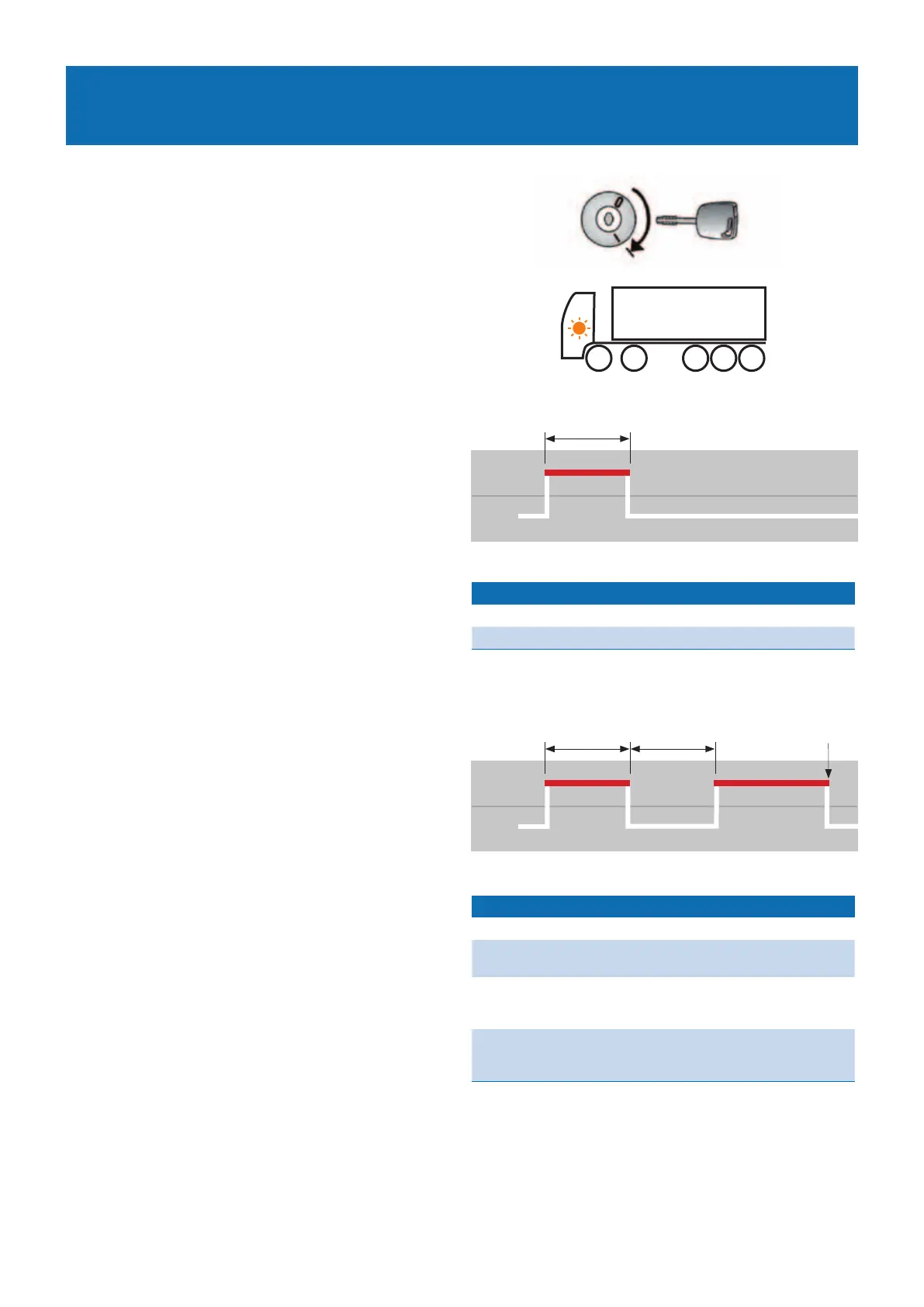
The warning device function depends on the ISO7638 power supply
used:
A warning device located on the driver's console of the towing
vehicle is operated from the ISO7638 power cable only when the
EB+ Gen 2 is powered by the ignition switch. (Fig 9)
Note: If a dedicated power source is unavailable to the EB+ Gen
2 from the ISO7638 connector then system integrity will not be
indicated by the cab mounted warning device.
As an option to the cab warning device a trailer mounted warning
lamp may be provided as an auxiliary function. This lamp mimics the
signal to the cab warning device but will only function if the ISO7638
power is connected.
Note: The signal produced may be different to that produced by the
cab device due to possible modification of the cab device by the
towing vehicle.
System Check Procedure
1. On power up of the system, the warning device must indicate one
of the following sequences in order to show a fault-free system:
OPTION 'A' - (Fig 10)
OPTION 'B' - (Fig 11)
2. During the self-check procedure, the system cycles the EPRV's.
With foot brake applied one exhaust of air from each EPRV will be
audible.
Once these two checks are made with correct results, no further
checks are required.
If the results are not satisfactory, Haldex DIAG+ or EB+ Info Centre
should be used to establish the diagnosis.
This information is described visually in Fig 14 on page 11.
Power Up Modes
The EB+ Gen 2 system has two power up modes. With switching the
Ignition on (B+ applied) the following occurs:
With no yellow line pneumatic pressure (i.e. Brakes OFF)
The system adopts load sensing mode when the brakes are applied.
This load sensing mode is limited to 2 minutes for any single brake
application, after which it returns to a push-through condition
(approx 1:1).
The push-through condition is cancelled on vehicle movement above
10 km/h returning the system to load sensing operation.
With yellow line pneumatic pressure (i.e. Brakes ON) (Park on air)
Apply foot brake, switch Ignition On.
The system adopts a push-through (approx 1:1) condition. When
the brakes are released and re-applied the system remains in push-
through unless the brakes are released for longer than 2 minutes,
after which it returns to load sensing operation.
This condition is cancelled on vehicle movement above 10 km/h
returning the system to load sensing operation.
ON
OFF
2 sec.
ON
OFF
2 sec. 2 sec. @ 10 km/h
Option A
ON for 2 seconds Warning device OK and system self-checking.
OFF System self-checked (not sensors)
Option B
ON for 2 seconds Warning device OK and system self-checking.
OFF for 2
seconds
System self-checked and preparing to check
sensors.
ON until moving System waiting for vehicle to move above 10
km/h in order to check that the sensors are
working.
OFF Once the vehicle is moving above 10 km/h
and the warning device clears, the electronic
system is fully checked.
Fig 10
Fig 11
Fig 9
Warning Device, System Check Procedure and Power-Up Modes


 To Next Page