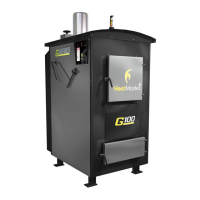
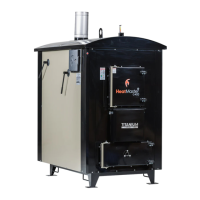
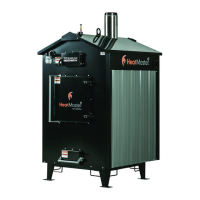
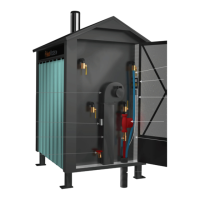
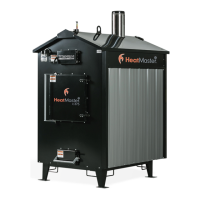
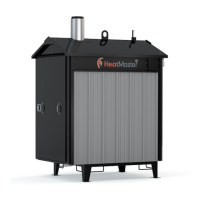
G Series Outdoor Furnaces
www.heatmasterss.com
WATER TREATMENT AND TESTING
Water Treatment Policy
To qualify for warranty, water must be tested a minimum of once per year and water treatment
added when necessary.
To take a water sample:
1. Locate your water sample bottle, mailing carton and mailing label provided to you by your dealer.
2. Open the boiler drain located at the bottom of the rear of the furnace for 10-15 seconds or until the
water runs clear. CAUTION: Water is hot! Use extreme care or a bucket to run water into and let
cool before collecting sample.
3. Fill one of the test bottles at least 1/2 to 2/3 full.
4. Fill out the mailing label provided with the test bottle completely, including your email address, the
model number and serial number of your furnace. Make sure to note if the furnace water contains
any antifreeze or additional chemicals.
5. Attach top part of label to sample bottle and bottom part to outside of mailing tube. Place bottle in
tube.
6. Mail to our testing lab. Results can take up to 4 weeks to receive and up to 8 weeks if no email
address is on hand at Heatmaster ss.
You will receive a water test report outlining what must be done (if anything). If any action is
necessary, take another sample and mail it to our test lab again to verify the recommended
changes have been made.
Add the water treatment through the fill pipe located at the top of the furnace when initially filling the fur-
nace with water or after testing, if needed. Ensure that all drains are closed. It is recommended that
water treatment be added at a 1:200 ratio when initially firing the furnace and 1:300 after that. Additional
treatment may have to be added for water with more severe properties or for systems with more chemi-
cally demanding requirements.
Recommended operating levels are as follows:
Conductivity: 100 - 4000 ppm
pH: 8.5 – 10. 5
Nitrates: no less than 730 ppm
Test Parameters and What They Mean
Conductivity
Conductivity is a measurement of minerals in your furnace water. While it is common to have minerals in
water, in excess minerals can cause many problems in hydronic systems including scaling and corro-
sion.
pH
pH is measurement of alkalinity (hard or soft water). For outdoor furnace water and the water treatment
used in outdoor furnaces it is better to have your water a little harder than softer (recommended pH
range is 9-10.5) as the active ingredients in the water treatment neutralize harder water easier than soft-
er water
Nitrates
Nitrates tested for are a measurement of how much water treatment is in the water. Nitrates measured
are active units of water treatment available to neutralize harmful elements in your furnace water. Ni-
trates also act to neutralize harmful bacteria that may build up in the furnace water over time.
Glycol
Inhibited glycol provides anti-corrosion elements and freeze protection for outdoor furnaces and is com-
patible with Outdoor Furnace Water Treatment. Because outdoor furnaces are open to the atmosphere
systems and will have fresh water added occasionally, oxygen is always entering the system and will
break down the glycol over time to create glycolic acid which will harm your furnace system. When this
happens you will be required to drain and flush your furnace system.
It is always suggested to use 100% virgin glycol instead of recycled glycol as it will break down much
sooner and create glycolic acid.
- 2 -



 To Next Page