6
• Do not use vaseline, oils, other hydrocarbon lubricants or
spray silicone anywhere. A silicon lubricant may be used
on black o-rings but is not necessary. Avoid any type of
lubricants, including silicone, on red or clear lip seals.
• Do not use pipe dope or other sealants on threads. Only teon
tape may be used on threads. Teon tape is not necessary
on the nut connection or caps because of o-ring seals.
• The pipe size for the drain line should be a minimum of
3/4”. Backwash ow rates in excess of 7 gpm or length
in excess of 20’ require 1” drain line.
1. Place the conditioner where you want to install it, making
sure it is on a clean, level and rm base.
2. Do all necessary plumbing (inlet to inlet, outlet to outlet and
drain line to drain). The control valve, ttings and/or bypass
are designed to accommodate minor plumbing misalignments
but are not designed to support the weight of a system or
the plumbing.
3. When assembling the installation tting package (inlet and
outlet), connect the tting to the plumbing system rst and
then attach the nut, split ring and o-ring. Heat from soldering
or solvent cements may damage the nut, split ring or o-ring.
Solder joints should be cool and solvent cements should be
set before installing the nut, split ring and o-ring. Avoid get-
ting primer and solvent cement on any part of the o-rings,
split rings, bypass valve or control valve.
4. A jumper ground wire should be installed between the
inlet and outlet pipe whenever the metallic continuity of
a water distribution piping system is interrupted. Install
grounding strap on metal pipes.
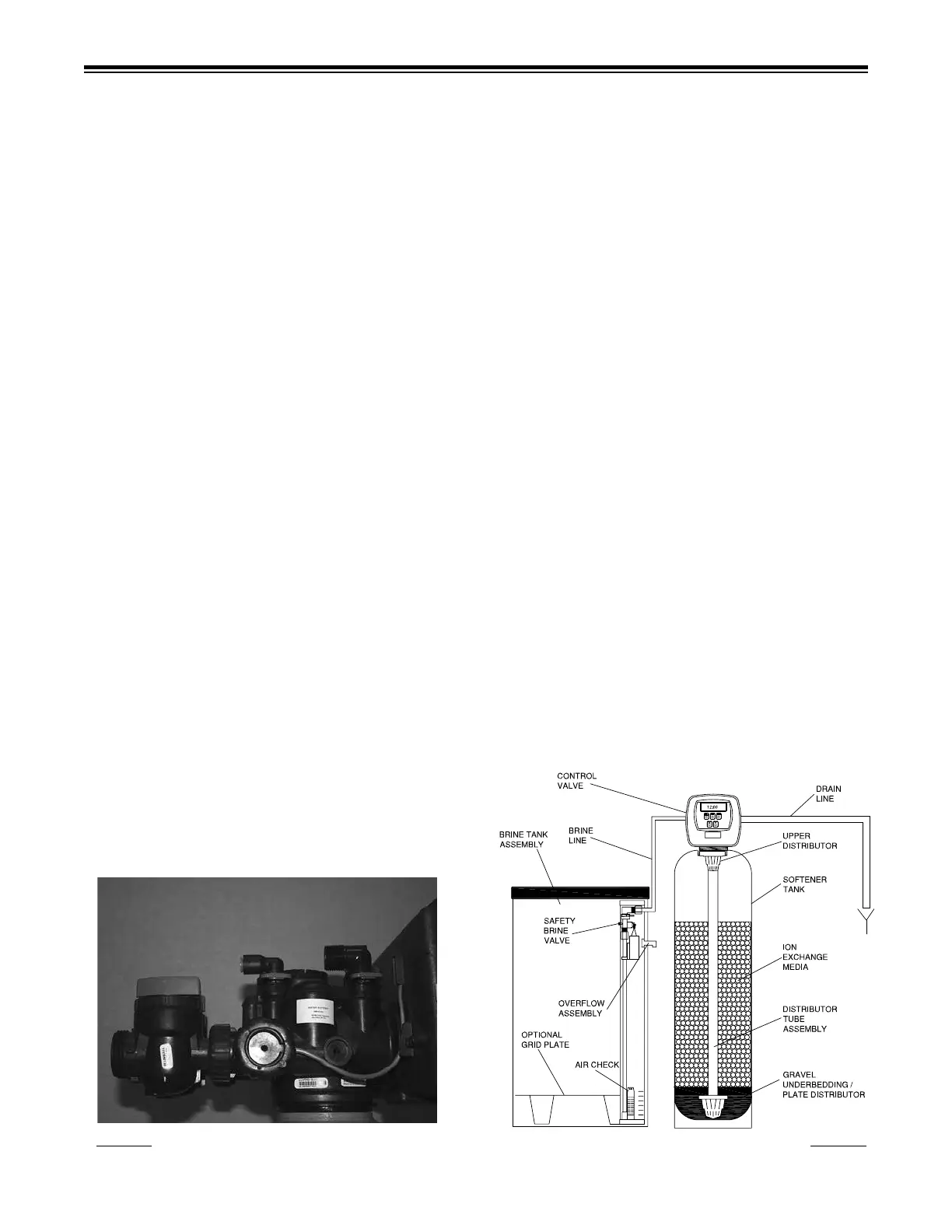
5. The drain connection may be made using either 5/8” polytube
(See gure 6a, page 6) or a 3/4” female adapter. If soldering,
joints near the drain must be done prior to connecting the
drain line ow control tting. Leave at least 6” between the
drain line control tting and solder joints when soldering pipes
that are connected on the drain line control tting. Failure
to do this could cause interior damage to the drain line ow
control tting.
6. The brine rell ow control assembly is installed in an easy
to access rell elbow located on top of the control valve.
The rell ow control assembly is attached to the control
valve with a locking clip. The locking clip allows the elbow to
rotate 270 degrees so the outlet can be orientated towards
the saltkeeper.
7. Connect the brine line found in the brine tank to the brine
connection on the control valve. The control valve has a
standard rell elbow which a 3/8” exible tube can be con-
nected, see gure 6a, page 6. (An optional elbow can be
ordered which accommodates a 1/2” exible tube for a high
regenerant draw rate situation). Both elbows use the same
rell ow control and retainer. Do not connect the other end
of the brine line to the safety brine valve in the brine tank at
this time. Make sure the oor is clean beneath the salt tank
and that it is level and smooth.
8. A 1/2” (inside diameter) gravity drain line may be connected to
the overow tting on the side of the brine tank. This overow
is in case of a malfunction in the brine shut off. If the unit is
installed where water may ow in the event of an overow
and cause water damage, connect a length of exible tubing
and run to a drain below the level of the overow. (Do not
connect the tubing to the drain line on the control valve.
Do not run tubing above overow height at any point.)
INSTALLATION INSTRUCTIONS
(All electrical & plumbing should be done in accordance to all local codes)
Figure 6b
Drain
Connection
Brine Line
Connection
Bypass
Figure 6a





 To Next Page