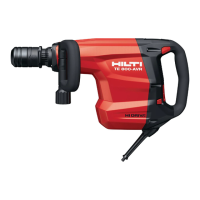
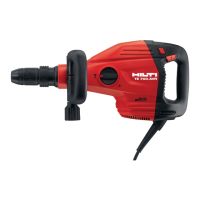
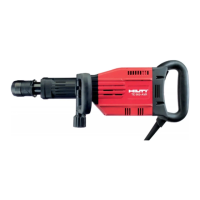
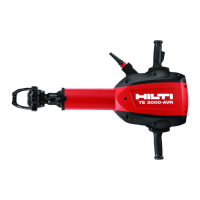
The Hilti TE 3000-AVR is a robust, hand-held electric breaker designed for professional use, specializing in chiseling work on concrete, masonry, and asphalt. Its powerful 28 mm hex chuck allows for efficient material removal, making it suitable for demanding demolition tasks. Beyond chiseling, the tool can also be utilized for excavation and compacting applications, offering versatility on various job sites.
A key feature of the TE 3000-AVR is its Active Vibration Reduction (AVR) system. This innovative technology significantly reduces the vibrations transmitted to the operator, enhancing comfort and allowing for longer working periods with less fatigue. This is crucial for preventing vibration-related disorders of the blood vessels and nervous system in the fingers, hands, and wrists, emphasizing Hilti's commitment to user safety and well-being.
The breaker is equipped with a service indicator LED, which provides important operational feedback. When the service indicator lights red, it signals that the end of the service interval has been reached, and servicing is due, or that a fault has occurred in the tool. If the service indicator blinks red, it indicates protection against overheating or that the electric supply voltage is too high. These visual cues help operators monitor the tool's health and ensure timely maintenance, preventing potential damage and downtime.
For ease of use and safety, the TE 3000-AVR features a detachable supply cord with a keyed, releasable plug connector. This design allows for quick and secure connection and disconnection of the power cord, simplifying transport and storage while also facilitating maintenance. The connection process involves pushing the connector into the socket until it engages, then turning it clockwise. Disconnection is achieved by turning the connector counterclockwise and pulling it out. It is critical to ensure the connector is clean and dry before connecting to prevent leakage current issues.
The tool's design incorporates user-friendly elements such as clearly marked grips for secure handling and air vents to ensure proper cooling during operation. The accessory tool retainer/locking bar and chuck mechanism are designed for straightforward accessory tool changes. When fitting an accessory tool, a small amount of grease should be applied to the connection end, and the locking bar opened. The tool is then pushed into the chuck until it seats, and the retaining bar is brought into the appropriate locking position (A for tools with a collar, B for tools with a locking groove). A quick pull test confirms correct engagement. When removing a hot accessory tool, protective gloves are essential due to sharp edges and high temperatures. The guide tube also gets hot during use, requiring caution.
Maintenance of the TE 3000-AVR is designed to be straightforward, focusing on keeping the tool clean and checking for damage. Users should carefully remove stubborn dirt and clean the air vents with a dry brush. The casing can be cleaned with a slightly damp cloth, avoiding silicone-containing cleaning agents that could damage plastic parts. Regular checks of all visible parts and controls for signs of damage are recommended, and any malfunctions should be addressed by Hilti Service. It is crucial to always unplug the supply cord before performing any care or maintenance tasks to prevent electric shock. Repairs to electrical components should only be carried out by trained electrical specialists.
For transport and storage, it is advised not to transport the electric tool with accessory tools fitted. The supply cord should always be unplugged before storage. The tool should be stored in a dry place, out of reach of children and unauthorized persons. After long periods of transport or storage, the tool should be checked for damage before use.
In case of troubleshooting, the manual provides guidance for common issues. For instance, if the breaker doesn't start, it could be due to electronics initialization, an interruption in the electric supply, the generator being in sleep mode, or an incorrectly fitted detachable supply cord. Solutions range from switching the tool off and on again, checking the power outlet, applying a load to the generator, or correctly fitting the supply cord. If the service indicator lights or blinks red, it points to servicing needs, a fault, overheating, or high supply voltage, with corresponding actions like contacting Hilti Service, using a different power outlet, or allowing the tool to cool down. If there's no hammering action, the tool might be too cold, requiring it to run against a working surface to warm up the mechanism. The use of an appropriate extension cord is also highlighted for optimal performance.
Hilti emphasizes the use of genuine Hilti spare parts and consumables to ensure safe and reliable operation. Information on approved system products can be found at local Hilti Centers or online. The company also provides a manufacturer's warranty, encouraging users to contact their local Hilti representative for any warranty-related questions. Disposal of the tool should be done responsibly, with most materials being recyclable. Old tools can be returned to Hilti for recycling, aligning with environmental protection guidelines.


 To Next Page


 General