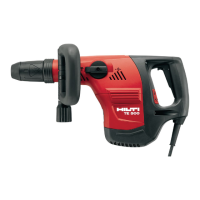
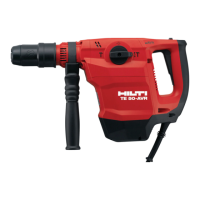
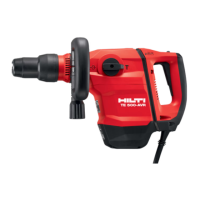
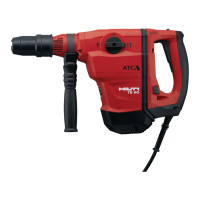
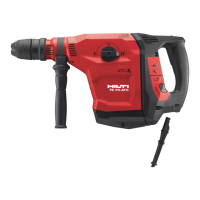
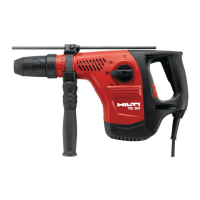
This document provides comprehensive operating instructions for the Hilti TE 50 and TE 50-AVR combihammers, designed for professional users. It emphasizes safe, trouble-free handling and use, urging users to read the documentation thoroughly before initial operation and to keep it with the product for future reference or when transferring it to other persons.
The Hilti TE 50 and TE 50-AVR are electrically-powered combihammers equipped with a pneumatic hammering mechanism. They are primarily designed for drilling in concrete, masonry, wood, and metal. Additionally, these tools can be used for light to medium-duty chiseling on masonry and for surface finishing work on concrete. Operation is permissible only when connected to a power source that provides voltage and frequency compliant with the information on the type identification plate. It's important to note that these products are not suitable for working on hazardous materials or in damp environments.
A key feature of the TE 50-AVR model is the Active Vibration Reduction (AVR) system, which significantly reduces vibration during operation, enhancing user comfort and safety. The tool also includes a service indicator, an LED that illuminates when servicing is due or flashes if the combihammer is faulty, prompting repair by Hilti Service.
The combihammer is equipped with a chuck, a depth gauge, a function selector switch, and a control switch. It comes with a side handle for improved grip and control. For models with a detachable supply cord, a lockbutton and a keyed, releasable plug connector ensure secure connection. The quick-release chuck, available as an accessory, allows for fast and keyless changes of accessory tools. This chuck is compatible with cylindrical or hexagonal shank tools like drill bits for wood and metal, or mixing paddles, which are used in the rotary-only mode without hammering action.
Before starting any work, users must prepare the workplace by ensuring it is clean and well-lit. It is crucial to unplug the supply cord before making any adjustments or changing accessories to prevent inadvertent starting and potential injury. The side handle can be fitted by releasing its clamping band, sliding it over the chuck, positioning it as desired, and then tightening the clamping band. The depth gauge, an optional accessory, is fitted similarly, allowing users to set the desired drilling depth by adjusting a screw.
When fitting accessory tools, a small amount of recommended grease should be applied to the connection end before pushing the tool into the chuck until it engages. To remove the tool, the chuck is pulled back as far as it will go. Users are advised to wear protective gloves when changing hot accessory tools and to avoid placing them on flammable materials.
The function selector switch allows users to choose between different operating modes: "Hammer drilling," "Chiseling," and "Chisel positioning." For hammer drilling, the switch is set to the hammer drilling position, the drill bit is pressed against the work surface, and the control switch is pressed to start the tool. For chisel positioning, the switch is set to the chisel positioning mode, allowing the chisel to be rotated to one of 24 different positions (in 15° increments) for optimal working. Once positioned, the switch is turned to the "Chiseling" position. During chiseling, the on/off switch can be locked in the "on" position for sustained operation.
Maintenance is critical for the safe and reliable operation of the combihammer. Users must always unplug the supply cord before performing any care or maintenance tasks to avoid electric shock. Regular cleaning involves removing dirt, cleaning air vents with a dry brush, and wiping the casing with a slightly damp cloth, avoiding silicone-containing cleaning agents. All visible parts and controls should be checked regularly for damage and proper function. Any damaged or malfunctioning parts should be repaired by Hilti Service. After cleaning, all guards and protective devices must be refitted and checked for correct function. Only genuine Hilti spare parts and consumables should be used.
Troubleshooting guidance is provided for common issues such as the power tool not starting, no hammering action, reduced power, the drill bit not rotating, or difficulty releasing the drill bit. For instance, if the tool doesn't start, it could be due to an interruption in the electric supply, activating the electronic restart interlock, which can be resolved by switching the tool off and on again. If there is no hammering action, the tool might be too cold, requiring the user to run it against the work surface until the hammering mechanism engages. These instructions help users address minor issues, but for more complex problems, contacting Hilti Service is recommended.


 To Next Page


 General
 Weight and Dimensions