Need help?
Do you have a question about the Hilti TE 7-C and is the answer not in the manual?
Defines DANGER, WARNING, CAUTION, NOTE for hazard communication.
Explains safety warning signs and general information symbols used in the manual.
Details the power tool's applications in construction, renovation, and workshops.
Details chuck types, function selector, control switch, and handles.
Covers slip clutch, lubrication, supplied items, and extension cord usage.
Lists various drill bits, chisels, and dust modules compatible with the tool.
Provides a brief note on voltage ratings and power input for the tool.
Lists rated voltage, current, frequency, weight, dimensions, and speeds.
Details protection class and drilling performance in concrete.
Covers work area, electrical safety, and personal protection warnings.
Staying alert, PPE, preventing starts, and tool maintenance advice.
Addresses workplace conditions, dust hazards, and proper material handling.
Details checks for cables, cord condition, and GFCI usage.
Guides on workpiece securing, tool handling, and cord management.
Specifies required PPE like eye protection, hard hats, and ear protection.
Step-by-step guide on attaching and positioning the side handle.
Instructions for setting the depth gauge for drilling operations.
Procedures for inserting and removing drill bits and chisels.
Steps for removing and installing the TE-C CLICK chuck.
Instructions for performing drilling and hammer drilling operations.
Guides on chiseling, chisel adjustment, and forward/reverse function.
Covers cleaning, lubrication, and general maintenance of the tool and its parts.
Lists common problems and their solutions for the power tool.
Information on how to recycle the power tool and its components.
Details the warranty coverage, exclusions, and service procedures.
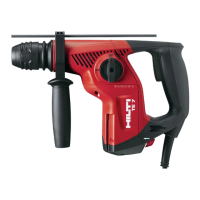
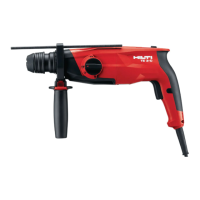
The Hilti TE 7-C rotary hammer is a powerful and versatile electrically-powered tool designed for professional use in various construction and renovation tasks. Its primary function is drilling, with a pneumatic hammering mechanism that makes it highly effective in challenging materials.
The TE 7-C is engineered for drilling in concrete, masonry, gypsum board (drywall), wood, plastic, and metal. Beyond standard drilling, it is also capable of light chiseling work on masonry and surface finishing on concrete. This dual functionality, combining rotary drilling with hammer action, makes it a highly adaptable tool for a wide range of applications.
At its core, the tool features a TE-C CLICK chuck system, designed for quick and secure insertion and removal of various insert tools. The chuck ensures that the insert tools are compatible and correctly secured, which is crucial for both performance and safety.
The power tool incorporates a function selector switch, allowing the user to choose between different operating modes: "Drilling without hammering," "Hammer drilling," "Chisel adjustment," and "Chiseling." This selector switch is designed to be operated when the motor is not running, preventing accidental changes and ensuring smooth transitions between tasks.
For precise control, the TE 7-C is equipped with a speed control switch that enables smooth starting, allowing the user to gradually increase the drilling speed. This feature is particularly useful when starting a hole, as it helps prevent the drill bit from wandering and ensures accurate positioning.
A forward/reverse switch provides directional control, allowing the drill bit to rotate in either direction. This is essential for various tasks, such as backing out a stuck drill bit or driving screws (though not its primary function). This switch should also be operated only when the motor is not running to prevent damage to the tool.
The TE 7-C also includes a mechanical slip clutch as a protective feature. In the event of the drill bit sticking, the slip clutch is designed to release, preventing the power tool from pivoting violently about its own axis. This significantly enhances user safety by reducing the risk of personal injury.
The TE 7-C is designed with user comfort and control in mind. It features vibration-absorbing grips, including a main grip and a pivotable side handle. The side handle is crucial for maintaining a secure two-handed grip, especially during hammer drilling and chiseling, where significant reactive forces can occur. The side handle also integrates a depth gauge, allowing users to precisely control the drilling depth for consistent results.
Adjusting the depth gauge is a straightforward process: the side handle clamping band is released, the handle is pivoted to the desired position, the depth gauge is adjusted, and then the clamping band is tightened to secure both the handle and the depth gauge.
Fitting and removing insert tools is facilitated by the TE-C CLICK chuck. To fit an insert tool, the user first disconnects the power, then checks that the tool's connection end is clean and lightly greased. After ensuring the dust shield's sealing lip is clean and in good condition, the insert tool is pushed into the chuck and rotated until it engages in the guide grooves, then pushed further until it clicks into place. Removal involves disconnecting power, pulling back the chuck release sleeve, and pulling the insert tool out.
The tool's chiseling function offers versatility, allowing the chisel to be adjusted to 18 different positions (in 20° increments). This ensures that flat and shaped chisels can always be set to the optimum working position for various chiseling tasks. The chisel position adjustment is performed by setting the function selector switch to "Chisel adjustment," rotating the chisel to the desired position, and then locking it by setting the switch to "Chiseling."
When working at low temperatures, the hammering mechanism may not engage immediately. The tool needs to reach a minimum operating temperature for the hammering action to begin. This can be achieved by briefly bringing the drill bit into contact with the base material and allowing the power tool to run under no load until the hammering mechanism activates.
For outdoor use, it is essential to use extension cords specifically approved and marked for such applications. When using a generator or transformer, it must meet specific power output, voltage, and frequency requirements, and be equipped with automatic voltage regulation and starting boost to prevent damage to the tool.
Proper care and maintenance are vital for the longevity and safe operation of the TE 7-C.
Regular cleaning of insert tools is recommended to remove dirt and dust deposits and protect them from corrosion. This involves wiping them with an oil-soaked rag periodically.
The power tool itself requires regular cleaning. The outer casing, made from impact-resistant plastic, and the synthetic rubber grip sections should be kept clean and free from oil and grease. Ventilation slots must be kept clear and cleaned carefully with a dry brush to prevent overheating and maintain electrical safety. It is important not to use sprays, steam pressure cleaning equipment, or running water for cleaning, as this can negatively affect the tool's electrical safety.
The dust shield on the chuck is a critical component for preventing dust ingress. It should be cleaned regularly with a dry, clean cloth. The sealing lip of the dust shield should also be cleaned and lightly greased with Hilti grease. If the sealing lip is damaged, the dust shield must be replaced to maintain effective dust protection. Replacement involves prying out the old shield with a screwdriver, cleaning the chuck area, and firmly pressing in a new dust shield until it engages.
All external parts of the power tool should be checked at regular intervals for damage, and all controls should be verified to operate faultlessly. If any parts are damaged or controls malfunction, the power tool should be repaired by Hilti Service. Repairs to the electrical section of the power tool must only be carried out by trained electrical specialists.
After any care or maintenance work, it is crucial to check that all protective and safety devices are correctly fitted and function faultlessly before using the tool again. This ensures that the tool remains safe for operation.
The power tool is lubricated with oil, which is an internal maintenance aspect handled during servicing. The manufacturer's warranty covers free-of-charge repair or replacement of defective parts over the tool's lifespan, provided it is operated, handled, cleaned, and serviced correctly, and only genuine Hilti consumables, components, and spare parts are used. Normal wear and tear are not covered by this warranty.
 General
| Impact energy (max) | 2.6 J |
|---|---|
| Sound pressure level | 89 dB |
| Vibration level (hammer drilling) | 17 m/s² |
| Drilling diameter in concrete (max) | 16 mm |
| Reverse | Yes |
| Power source | AC |
 Weight and Dimensions
| Depth | 343 mm |
|---|---|
| Width | 86 mm |
| Height | 215 mm |
| Weight | 3400 g |


 To Next Page