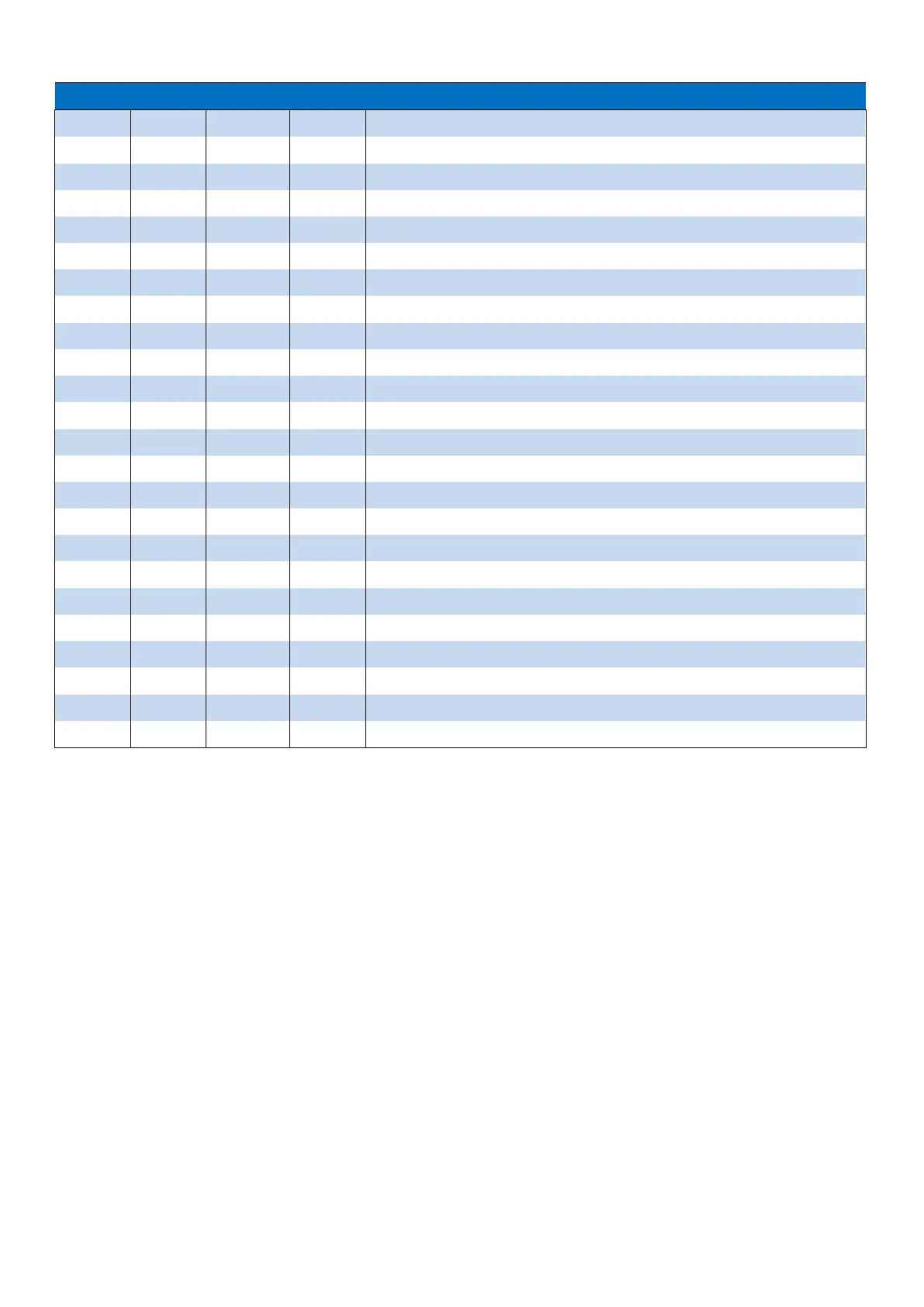
U.S. Marine VHF Channels and Frequencies
Non-Commercial (Inter-ship only)
Port Operations (Inter-ship only)
Commercial. Non-Commercial in Great Lakes only.
Commercial. Non-Commercial in Great Lakes only
U.S. Government only – Environmental protection operations.
Public Correspondence (Marine Operator)
Public Correspondence (Marine Operator)
Public Correspondence (Marine Operator)
Public Correspondence Marine Operator)
Public Correspondence only near Canadian border
Commercial, Inter-ship only
◆ Recreational boaters normally use channels listed as
Non-Commercial: 68, 69, 71, 72, 78A.
◆ Channel 70 is used exclusively for Digital Selective
Calling (DSC) and is not available for regular voice
communications.
◆ Channels 75 and 76 are reserved as guard bands for
Channel 16 and are not available for regular voice
communications.
Notes:
1. The letter “A” following a channel number indicates
simplex use of the ship station transmit side of an
international semi-duplex channel. Operations are
different from that of international operations on that
channel.
2. Channel 13 should be used to contact a ship when
there is danger of collision. All ships of length 20
meters or greater are required to guard VHF channel
13, in addition to VHF channel 16, when operating
within U.S. territorial waters.
3. Channel is Receive Only.
4. Channel 16 is used for calling other stations or for
distress alerting.
5. Output power is fixed at 1 watt only.
6. Output power is initially set to 1 watt. User can
temporarily override this restriction to transmit at high
power.


 To Next Page