8
WARNING: use toughened glass only with a minimum
thickness of 6mm (¼”) with rounded/polished edges. Take
care when handling glass. Always use suitable gloves, eye
protection and protective clothing.
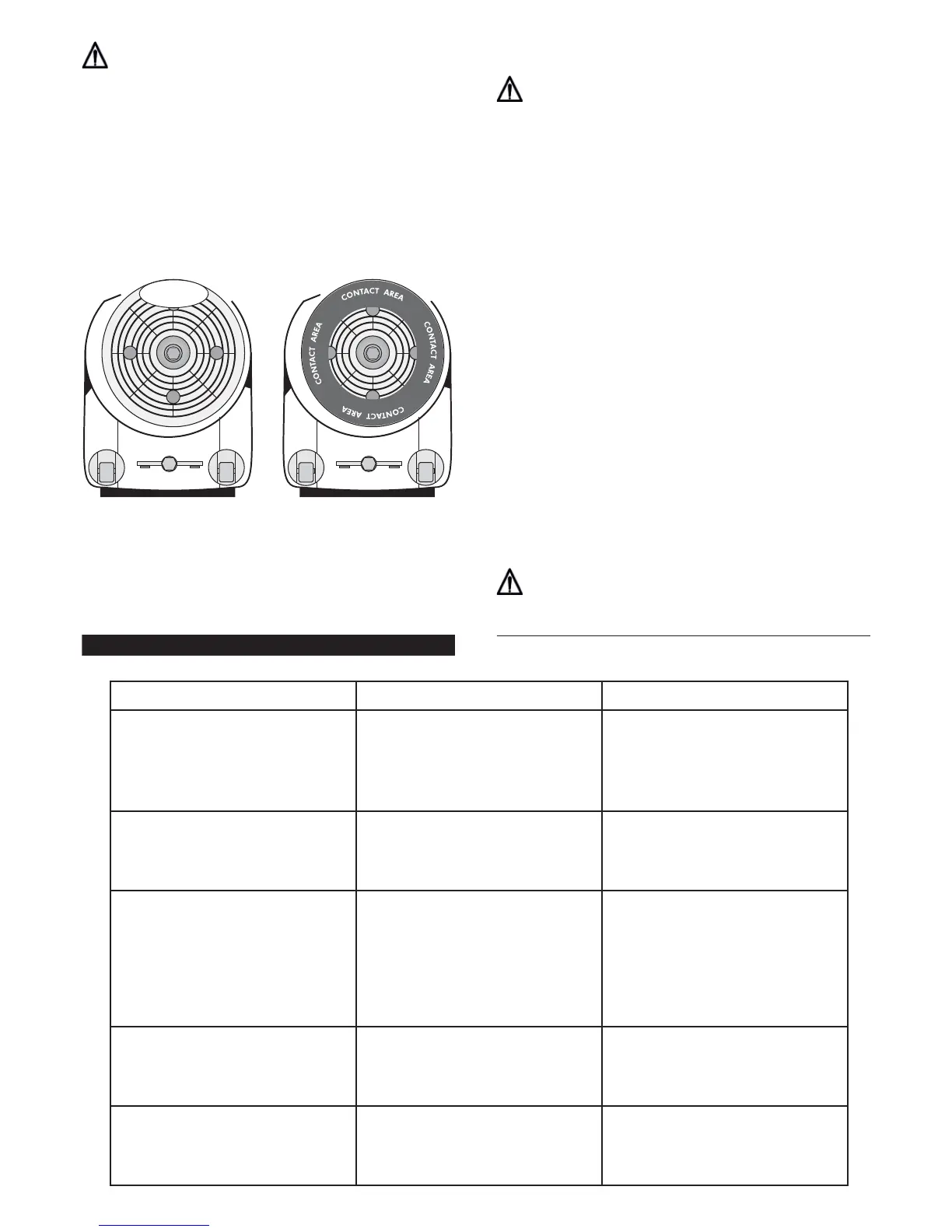
2 To adjust the castors loosen the two castor lock nuts using the
special tool Part No. 011720 and 5mm ball allen key. Adjust
the castors and check the contact area on the sanding pad.
When the contact area is correct tighten the two castor lock
nuts securely. Use a suitable thread lock compound. Finally
check the contact area is still correct after tightening the castor
lock nuts.
4. Trim the sanding pad as detailed above.
CONTACT AREA
Sanding Pad Contact Area Sanding Pad Trim Area
Electrical Testing
CAUTION: testing for electrical safety should only be
undertaken by a competent person and all results recorded.
Do not exceed 1250 volt insulation test duration of 3
seconds.
1. Examine the power cable for damage. If the outer insulation
shows the slightest of abrasions or the inner conductors are
exposed then the cable must be replaced. The cable must not
be repaired with tape or insulation sleeve.
2. Open and check the mains plug for condition, loose
connections, damaged wires, etc.
3. Remove the four Screws Ref.1 and lift off the Cover Motor
Ref.4 to check the switch, connections, leads etc. Pay special
attention to any gaskets, ‘O’ rings and seals intended to
exclude dust from the switch and switch housing area. These
must be maintained in good condition.
Carefully brush and vacuum clean the switch and brush block
assembly and inside the cover motor.
4. Refit the cover motor taking care not to trap any leads.
5. Using a piece of insulation tape or a small soft wedge lock the
bias off switch in the ‘ON’ position.
6. Use the standard procedure test for electrical safety
(Class I Earthed Appliances [U.K.]). Do not exceed 1250 volt
insulation test duration of 3 seconds.
7. Record the test results.
8. Complete a functional (run) test and record results.
CAUTION: when undertaking a functional (run) test make
sure the machine is secure. Remember the sanding disc will
rotate.
FAULT FINDING
FAULT CAUSE ACTION
The machines does not run. The power cable is not connected to the
power supply.
The motor brushes are worn
The voltage is too low.
Connect the power cable to the power
supply.
Replace the motor brushes.
Check the main power complies with the
machine’s serial plate data.
The machine runs slow. The voltage is low. Check the supply voltage.
If an extension lead is being used it is
undersized and/or it is coiled.
The machine will not pickup dust. The dust bag is full.
There is an obstruction in the dust pickup.
A motor brush is not making
Replace the paper dust bag or dust or
empty the cloth dust bag.
Disconnect the machine from the power
supply, turn the machine over and check
for obstruction.
Check and refit or replace the motor
brushes and/or the brush springs.
The machine does not sand evenly The sanding pad is damaged.
The castors are out of adjustment.
Check and service/replace the sanding
pad.
Check and adjust the castors.
The sander scores or burns the wood. The machine is not being operated
properly.
Read the instructions, do not apply
pressure when sanding.


 To Next Page