Need help?
Do you have a question about the Hitachi NT 32AE2 and is the answer not in the manual?
DANGER indicates an imminently hazardous situation which, if not avoided, will result in death or serious injury.
Explains the two mechanisms for driving fasteners: Single Actuation and Contact Actuation.
Essential safety instructions for operating the nailer, including wearing safety glasses and avoiding specific hazards.
Employer's duties include ensuring manual availability, eye protection, safe working order, and proper maintenance.
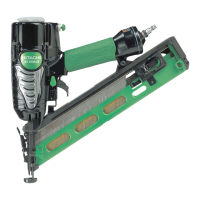
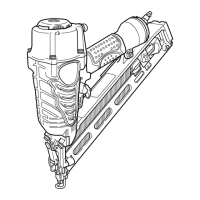
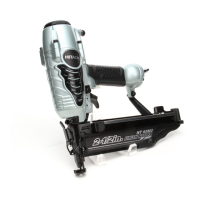
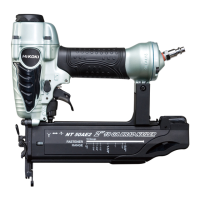
Identifies the various components of the Hitachi nailer, including the trigger, magazine, and firing head.
Details operating pressure, dimensions, weight, nail capacity, and air consumption for NT50AE2 and NT32AE2 models.
Specifies the approved 18 Gauge brad nails and their dimensions for this nailer.
Lists standard and optional accessories, including safety glasses, nose cap, case, and lubricants.
Describes typical uses such as cabinet assembly, furniture trim, and home trim/molding.
Instructions to read safety section and check specific items before starting work.
Guidelines for a safe work area, prohibiting flammable materials and unauthorized personnel.
Covers power source requirements, air compressor standards, and the use of filter-regulator-lubricator units.
Emphasizes the importance of lubrication, recommending Hitachi pneumatic tool lubricant and proper application methods.
Provides instructions for preparing and using the nailer in cold weather conditions.
Details a step-by-step checklist to test the nailer's functionality and safety before operation.
Explains how to adjust air pressure between 70-120 psi for optimal performance and nail penetration.
Provides step-by-step instructions for safely loading nails into the nailer's magazine.
Instructions on how to operate the nailer safely, emphasizing safety glasses and proper handling.
Explains two operation methods: Intermittent (Trigger fire) and Continuous (Push lever fire).
Guides users on adjusting the depth of nail penetration by turning the adjuster and performing tests.
Explains how to change the direction of the exhaust vent by rotating the top cover.
Details how to attach and detach the nose cap, which protects the workpiece from scratches.
Covers procedures for clearing jams and proper storage of the nailer to ensure longevity and safety.
Notes that Hitachi Power Tools are subject to continuous improvement and modification without prior notice.
Outlines who should perform repairs, use of approved parts, and a maintenance chart for daily/regular actions.
Provides a table of common problems, their check methods, and recommended corrections for nailer issues.
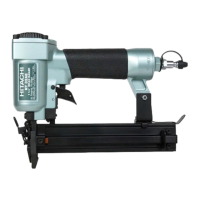
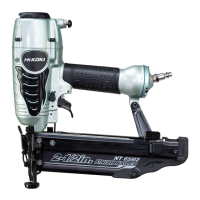
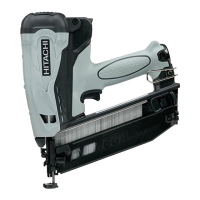
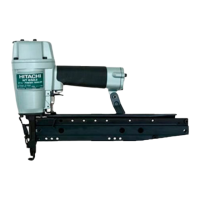
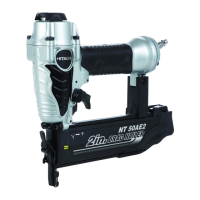
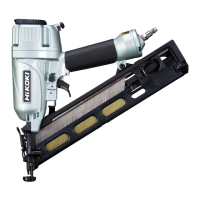
This manual describes the Hitachi Brad Nailer models NT50AE2 and NT32AE2, which are pneumatic tools designed for driving brad nails. These nailers are primarily used for applications such as cabinet and picture frame assembly, furniture trim, and on-site and mobile home trim and molding.
The Hitachi Brad Nailer operates using compressed air to drive fasteners. It features a nailing action that can be configured in two ways:
Single Actuation Mechanism (Single Sequential Actuation Mechanism): In this mode, the push lever must first be pressed against the wood, and then the trigger pulled to drive a fastener. Alternatively, the trigger can be pulled first, and then the push lever pressed against the wood. After one fastening, the trigger must be released and pressed again for subsequent fastenings. The switching device for this mechanism is set to the upward position.
Contact Actuation Mechanism: Similar to the single actuation mechanism, the push lever is pressed against the wood, and then the trigger is pulled to drive a fastener, or vice versa. However, if the trigger is held back, a fastener will be driven each time the push lever is pressed against the wood, allowing for continuous operation. The switching device for this mechanism is set to the downward position.
The nailer is equipped with a push lever that must be depressed for operation. It also includes an adjuster for controlling the nailing depth and a mechanism for changing the exhaust direction by turning the top cover. A nose cap is provided to protect the workpiece from scratches or damage.
Models: NT50AE2 and NT32AE2
Operating Pressure: 70 – 120 psi (4.9 – 8.3 bar, 5 – 8.5 kgf/cm²)
Dimensions:
Weight:
Nail Capacity: 100 Nails
Air Consumption: .025 ft³/cycle at 100 psi (.73 ltr/cycle at 6.9 bar, .73 ltr/cycle at 7 kgf/cm²)
Nail Selection (18 Gauge brad nails):
Power Source: Requires clean, dry, regulated compressed air. Air compressors must comply with ANSI Standard B 19.3. Oxygen, combustible gases, or any other bottled gases are explicitly prohibited as a power source due to explosion risk. The nailer should never be connected to pressure exceeding 200 psi (13.7 bar, 14 kgf/cm²).
Safety:
Operation Modes:
Adjusting Nailing Depth:
Exhaust Direction:
Nose Cap:
General Maintenance:
Pre-Operation Checks:
Troubleshooting:
Repairs:


 To Next Page
 General