20 KGZ Series | Version 2.02 | EN
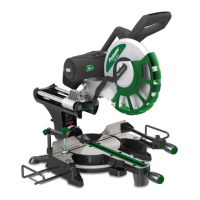
Operation the Chop- and Mitre Saw
Step 1: Pull the release button (2) and raise the saw arm
(1) to full height.
Step 2: Loosen the miter locks (18) and raise the miter
lock (19).
Step 3: Turn the miter table (14) until the pointer is at the
desired angle.
Step 4: Release the miter lock (19) and retighten the
miter locks (18).
Step 5: Lay the workpiece flat on the table with one edge
firmly against the stop (12).
If the board is bent, place the convex side against the
fence (12). If the concave side is placed against the
fence, the plate may break and block the saw blade.
When cutting long pieces of wood, support the opposite
end of the wood with side supports, a roll stand, or a
work surface that stands on the saw table.
Step 6: Before starting the saw, dry the cutting process
to make sure there are no problems, such as
cutting. B. that a clamp affects the cutting
process.
Step 7: Hold the control handle (3) and press the trigger
switch (17) and the locking lever (28).
Step 8: Let the saw blade reach its maximum speed.
Step 9: Slowly lower the saw blade into and through the
workpiece.
Step 10: Release the switch release (17) and wait until
the saw blade stops rotating before lifting the
saw blade out of the workpiece.
Step 11: Wait for the saw blade to stop before removing
the workpiece.
8.1.9Bevel Cut (Model KGZ 210 E)
A bevel cut is made by cutting across the grain of the
workpiece with the blade angled to the fence and mitre
table. The mitre table is set at the zero degree position
and the blade set at an angle between 0°and 45°.
Step 1: Pull the release button (2) and raise the saw arm
to its full height.
Step 2: Loosen the miter locks (18) and raise the miter
lock (19).
Step 3: Turn the miter table (14) until the pointer on the
miter scale (15) is at zero.
Step 4: Release the miter lock (19) and retighten the
miter locks (18).
Step 5: Loosen the miter lock (10) and move the saw
arm (1) to the left to the desired tilt angle (bet-
ween 0 ° and 45 °). Tighten the tilt lock (10).
Step 6: Lay the workpiece flat with one edge securely on
the table (12).
When the board is warped, place the convex side
against the stop. If the concave side is placed against
the stop, the plate may break and block the saw blade.
When cutting long pieces of wood, support the opposite
end of the wood with side supports, a roll stand, or a
worktop that stands on the saw table.
Step 7: Before starting the saw, dry the cutting process
to make sure that there are no problems, such
as cutting. B. that a clamp affects the cutting
process.
Step 8: Hold the control handle (5) and press the trigger
switch (17).
Step 9: While holding the control handle (3), press the
key lock (28) and the shutter button (17). Allow
the blade to reach maximum speed and slowly
lower it into and through the workpiece.
Step 10: Release the trigger switch (17) and stop the
saw blade from rotating before lifting the blade
out of the workpiece.
Step 11: Wait for the saw blade to stop before removing
the workpiece.
8.1.10 Compound Mitre Cut (Model KGZ 210 E)
If possible, always use a clamping device, eg. For ex-
ample, a screw clamp to the right of the miter table to se-
cure your workpiece. Keep your hands away from the
saw blade area when cutting your workpiece.
Never use your left hand to remove a cut off part on the
right side of the saw blade.
In a compound miter cut, a miter angle and a pitch angle
are used simultaneously. It is used to make picture fra-
mes, cut moldings, boxes with sloping sides and for the
production of roof frames. Always make a trial cut on a
piece of wood before cutting into the good material.
ATTENTION!
If possible, always use a clamping device such as a
‘G" clamp to secure your workpiece.
When cutting your workpiece, keep your hands well
away from the blade area.
Do not remove a cut-off piece on the right-hand side
of the blade using your left hand.


 To Next Page