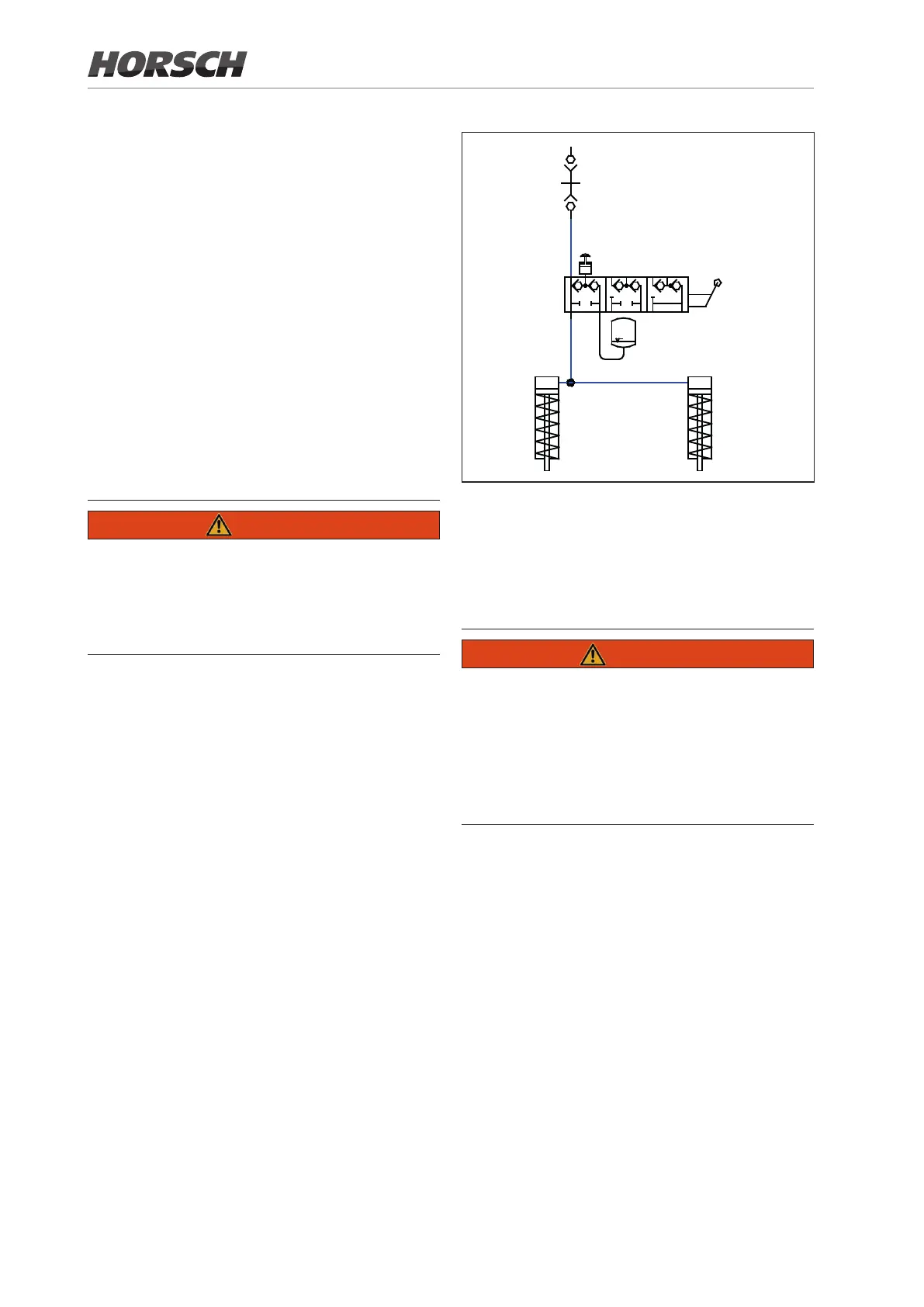
The hydraulic line controls the brake power to
the brake cylinders.
The brake inlet pressure must not exceed
150 bar.
When hitching up connect the hydraulic brake
line with the brake line on the tractor.
Fasten the release rope for the breakaway pro-
tection on a suitable point on the tractor. The
rope must under no circumstances become
entangled with other parts of the machine when
e.g. cornering. It could otherwise cause full brak-
ing action during travel.
The cable may be caught by other machine parts
and thus trigger at-out braking when cornering.
Danger of trac accidents!
Fasten the cable in such a way, that it cannot
be caught in any place.
Release the parking brake device. The ropes
must be relieved and the wheels must be free
to rotate.
Hydraulic brake
1 Hydraulic coupling for brake
2 Pressure accumulator
3 Breakaway brake valve
4 Emergency operation (spring cotter)
5 Manual brake releasing valve
6 Wheel cylinder
Danger of trac accidents caused by brake
failure!
During commissioning or after long periods of
rest: Fill the pressure accumulator for emer-
gency braking before starting to drive.
Fully kick down the brake pedal on the tractor
for this purpose.
The pressure accumulator for emergency brak-
ing must be lled before starting to drive during
initial commissioning or after longer periods of
standstill.
Fully kick down the brake pedal on the tractor for
this purpose. With each braking operation the
pressure is applied to the pressure accumulator
and lls it up as required.
Once this has been done you may drive on the road.
60 61





 To Next Page