EasyManua.ls Logo

HP 48G - And Custom Menus; Custom Key Assignments

HP 48G
84 pages
Print Icon
To Next Page IconTo Next Page
To Previous Page IconTo Previous Page
Loading...
AND
Custom
MENus
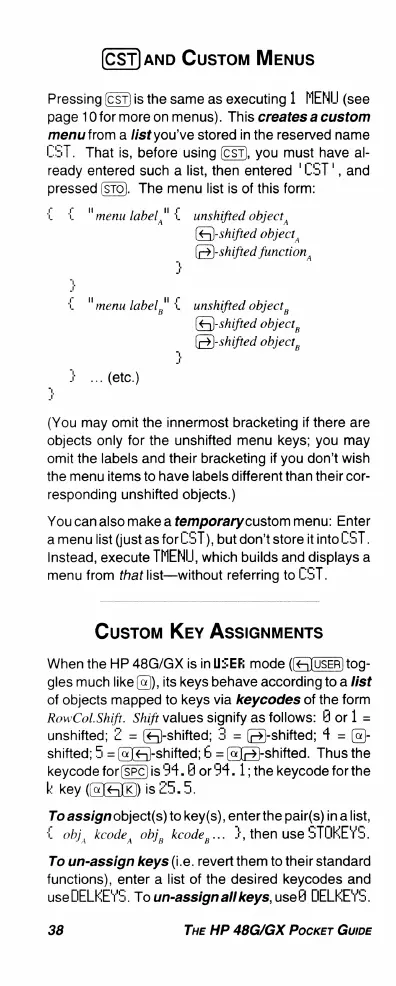
Pressing
is
the
same
as
executing
1
TMEMLU
(see
page
10
for
more
on
menus).
This
creates
a
custom
menu
from
a
listyou’ve
stored
in
the
reserved
name
C5T.
That
is,
before
using
(CST),
you
must
have
al-
ready
entered
such
a
list,
then
entered
'C5T',
and
pressed
(ST0).
The
menu
list
is
of
this
form:
Tt
"menu
label
i
unshifted
object,
(&)-shifted
object,
\
(2)-shifted
function,
£
"menu
labelB"
L
unshifted
object,
(&3)-shifted
object,
(2)-shifted
object,
1o
(etc)
(You
may
omit
the
innermost
bracketing
if
there
are
objects
only
for
the
unshifted
menu
keys;
you
may
omit
the
labels
and
their
bracketing
if
you
don’t
wish
the
menu
items
to
have
labels
different
than
their
cor-
responding
unshifted
objects.)
You
canalso
make
a
temporary
custom
menu:
Enter
amenullist
(justas
forC5T),
but
don’t
store
itintoCST.
Instead,
execute
TFMENLI,
which
builds
and
displays
a
menu
from
that
list—without
referring
to
C5T.
Custom
KEY
ASSIGNMENTS
When
the
HP
48G/GX
is
in
U%EF
mode
((&]USER)
tog-
gles
much
like
(@),
its
keys
behave
according
to
a
list
of
objects
mapped
to
keys
via
keycodes
of
the
form
RowCol.Shift.
Shift
values
signify
as
follows:
Hor
1
=
unshifted;
£
=
(&)-shifted;
3 =
(O)-shifted;
% =
(o)
shifted;
5
=
(o]
)-shifted;
&
=
(a]>)-shifted.
Thus
the
keycode
for(Spc)is
94.
H
or
34.
1;
the
keycode
for
the
k
key
(eJlK)
is
£2.
5.
To
assignobiject(s)
tokey(s),
enterthe
pair(s)inalist,
{
obj,
kcode,
obj,
kcode,...
¥,
then
use
STOKEYS.
To
un-assign
keys
(i.e.
revert
them
to
their
standard
functions),
enter
a
list
of
the
desired
keycodes
and
use[ELKEYS.
To
un-assign
all
keys,
used
DELKEYS.
38
THe
HP
48G/GX
Pocker
GuiDE

Related product manuals