UltraScan VIS Supplemental Manual for EasyMatch QC ver 2.0
21
Considering varying hardware configurations such as UV filter in/out and the different areas of view,
there are many ways to standardize the UltraScan VIS. The instrument can be standardized at any time
by selecting SENSOR > STANDARDIZE or by clicking the STANDARDIZE button on the default toolbar.
You are first prompted to indicate the instrument configuration.
When standardizing in transmittance modes you are prompted to place the white calibrated standard
at the reflectance port. Alternatively, a plug of barium sulfate (BaSO
4
) or magnesium oxide (MgO) may
be used to more closely approximate the actual sphere wall reflectance. When taking transmittance
measurements, the calibrated white tile or the plug used during standardization must be kept at the
reflectance port. When the instrument is to be used for transmittance measurements of liquids, a clear
liquid (distilled water for water-based samples, toluene or benzene for resins, or mineral oil for oils) in
a cell of the desired size should be used to set the top of the scale.
Place the cell in the transmittance compartment as close to the sphere as possible for measuring total
transmittance.
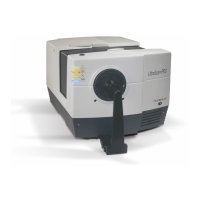
Figure 23. Top of Scale for TTRAN
Place it as close to the lens as possible when measuring regular transmittance.
Note: Closing the transmittance compartment door while making transmittance
measurements is the best practice for this instrument. However, when measuring the
transmittance of liquids that are volatile and/or toxic, it may be more important to
measure the samples quickly than to eliminate ambient room light. To see if leaving
the door open will adversely affect your color measurements, standardize the
instrument in the desired transmittance mode with the transmittance compartment
door closed, then measure either air or a typical sample with the door open and then
with the door closed. Compare the measurements. If the difference is acceptable under
your measurement method, you may measure your samples with the door open. This
test should be repeated if the instrument is moved to a new location.
Sensor > Configure Multi Mode
This command is used to set up the process by which the instrument can standardize and read in two
separate but similar modes when the standardization and read commands, respectively, are given.


 To Next Page
 Loading...