8000 SRM 1197 Maintenance Procedures Every 8 Hours or Daily
the battery area. Keep the top of the battery clean,
dry, and free of corrosion.
Make sure the battery is charged and has the correct
voltage and ampere hour rating for the lift truck. See
the nameplate.
Inspect the battery case, connector, and cables for
damage, cracks, or breaks. Contact your local bat-
tery dealer to discuss repair options for the battery
case. Check the level of the electrolyte daily on a
minimum of one cell. The correct level is halfway be-
tween the top of the plates and the bottom of the fill
hole. Add only distilled water.
Make certain the battery restraint panels are prop-
erly installed.
WARNING
Make sure the key switch is in the OFF position
and the brake is set before connecting the bat-
tery.
If the lift truck was operated with a discharged
battery, check the contactor for welded tips be-
fore a charged battery is connected.
The battery should have an equalization charge each
month, but not more than each week.
Tires and Wheels
WARNING
When the wheels have been installed, check
all wheel nuts after 2 to 5 hours of operation.
When the nuts stay tight after an 8-hour check,
the interval for checking the torque can be ex-
tended to 500 hours. Refer to the Maintenance
Schedule, Table 1 in this section.
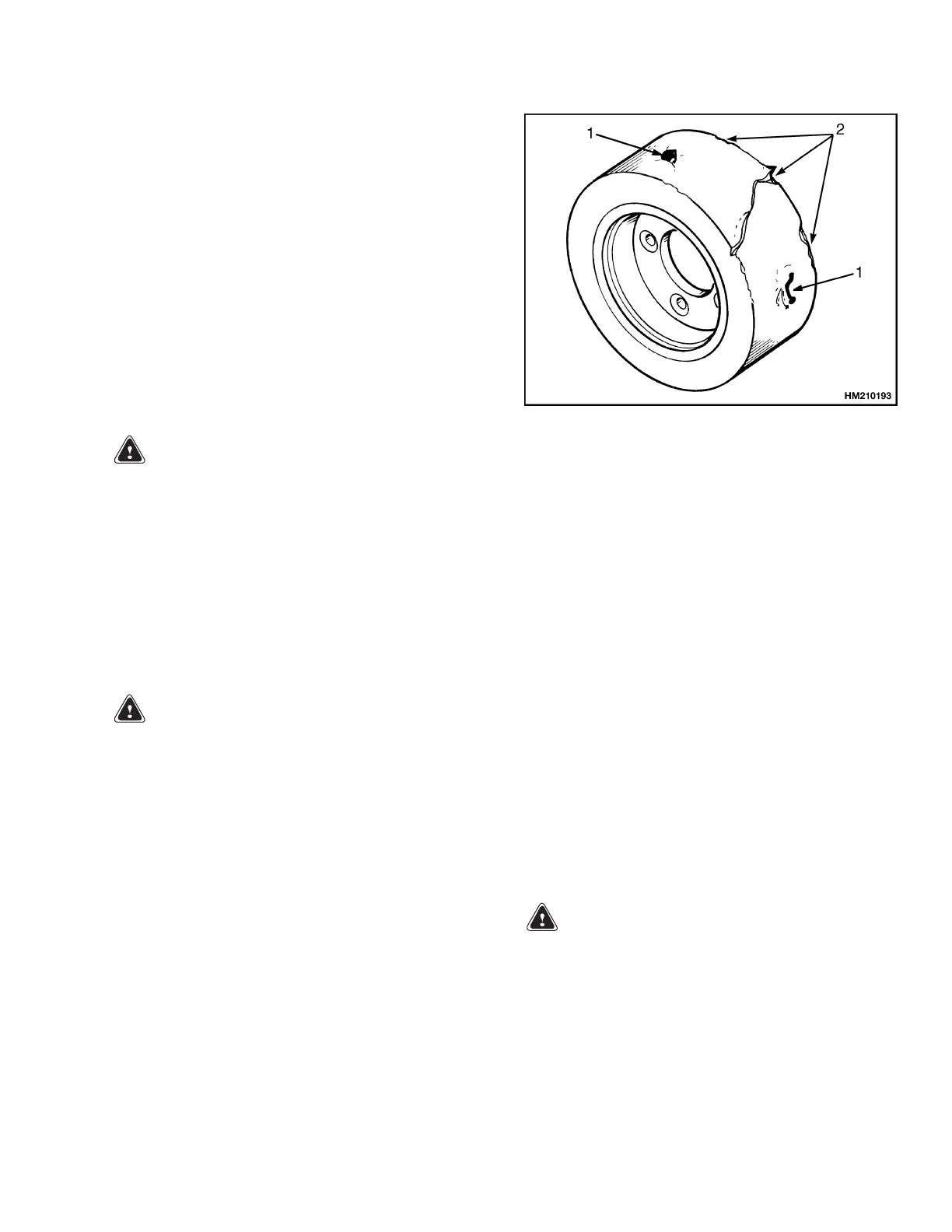
Inspect the tires for embedded rocks, glass, wire,
pieces of metal, holes, cuts, and other damage. See
Figure 8. Remove any object that will cause damage.
Check for loose or missing nuts and broken studs.
Remove any wire strapping or other material that is
wrappedaroundtheaxletopreventdamagetothe
axle seal. See Figure 10.
1. CHECK FOR DAMAGE. REMOVE NAILS, GLASS,
METAL, AND OTHER OBJECTS.
2. MAKE EDGES SMOOTH
Figure 10. Check Tires
If the wheel and tire has recently been installed,
check to ensure the lug nuts are properly tightened
to 135 N•m (100 lbf ft). When installing, snug all
the nuts, then tighten to half the torque value, then
tighten to the full torque value. Tighten the nuts in
a cross pattern to properly seat the wheel to the hub.
Frame and Load Wheels
Inspect the frame for structural damage and loose/
missing hardware. Make certain all covers are in
place and secured before operating the lift truck. In-
spect the load wheels. Loose or crooked load wheels
may indicate bearing failure. If failure is suspected,
raise the lift truck front end slightly (refer to How to
Put Lift Truck on Blocks) and check that load wheels
are secure on their axles and rotate smoothly. Repair
or replace as necessary.
Safety Labels
WARNING
Safety labels are installed on the lift truck to
give information about possible hazards. It is
important that all safety labels are installed on
the lift truck and can be read.
Check that all safety labels are installed in the cor-
rect locations on the lift truck. See the Parts Man-
ual or the section Frame 100 SRM 1185 for the cor-
rect locations of the safety labels.
17



 To Next Page